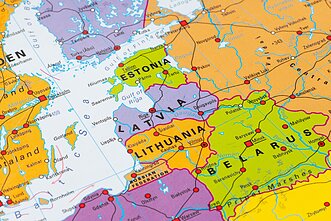
















Lithuania is one of nine nations in Central and Eastern Europe yet to ratify the so-called Istanbul Convention against gender violence. With domestic violence rates high across the region, what’s preventing countries from adopting the treaty? Emerging Europe reports.
Almost one in three women worldwide experience physical and/or sexual violence by an intimate partner or sexual violence by someone else in their lifetime.
In the majority of cases, violence is committed by a partner in their home – indeed, up to 38 per cent of all murders of women are committed by an intimate partner.
Read more: Women's rights march in Kaunas demands action on gender violence
Around one billion children aged between two and seventeen years – or half the world’s children – have experienced physical, sexual, or emotional violence or neglect in the past year.
Unfortunately, more than nine years since a Council of Europe treaty on preventing and combating violence against women and domestic violence, better known as the Istanbul Convention, was opened for signatures in May 2011, a number of states in Central and Eastern Europe are yet to ratify it.
The opposition stems from right wing political parties, conservative churches, and traditionalist organisations who claim that the convention promotes what is vaguely referred to as “gender ideology”.
The convention’s critics claim that its supposedly potent mix of feminism, queer theory, and neomarxism will destroy the traditional family, traditional gender roles, and pave the way for same-sex marriage.

Despite protests from women’s rights groups and the broader civil society sector, nine countries in Central and Eastern Europe are yet to ratify the convention: Armenia, Bulgaria, Czechia, Hungary, Latvia, Lithuania, Moldova, Slovakia and Ukraine.
Elsewhere across Europe, only the UK is yet to ratify the convention.
The latest country to come under fire for its attitude to the convention was Hungary, whose parliament, dominated by prime minister Viktor Orbán’s Fidesz party, voted on May 5 to block its ratification.
“The Hungarian authorities have failed to adequately prioritise women’s rights, in particular, to advance gender equality and women’s protection against violence,” said Krisztina Tamás-Sáróy, a Hungarian researcher at Amnesty International.
Read more: Domestic violence second most common crime in Lithuania
“The government has continued to ignore civil society pressure to properly address and tackle violence against women, including domestic violence, and to take preventive measures," she added.
As usual, the Hungarian government’s opposition to the convention was based on vague notions of “gender ideology”.
And yet while the term apparently frightens many people in Central and Eastern Europe, women’s rights groups are quick to point out that there is really no such thing.
“There’s no such thing as gender ideology for us [in] women's rights organisations,” said Rada Elenkova, programme director for Bulgarian Fund for Women, a women’s rights NGO in Bulgaria.
“This term was coined by conservative and traditional groups,” she said. “They actually came up with the idea of ‘gender ideology’ as a way to put pressure on civil society activists and civil society organisations [by claiming] that they act against the state, the church and the traditional family.”
In Bulgaria, ratification of the convention had to be put before the country’s Constitutional Court after critics suggested it would lead to a “third gender” and force the legalisation of same-sex marriage.
The Constitutional Court ended up rejecting the convention on the grounds that it defines gender as both a social and a biological category and, as far as the Bulgarian Constitution is concerned, humans are either male or female.
Elenkova pointed out the court was under severe pressure from right wing organisations who used fear and fake news to undermine the convention.
“[The campaign] was led by conservative groups who were very well organised and planned to sabotage the ratification of this convention,” she said.
“The whole public campaign focused on the issues related to gender equality and twisted news that was based entirely on false accusations against human rights activists,” added Elenkova.
A similar pattern has emerged elsewhere in the region.
In the Czech Republic, criticism came from linguist and priest Petr Piťha. In a sermon in 2018 he proclaimed that “families will be torn apart and destroyed” and “homosexuals will be proclaimed to be a superior ruling class.”
According to Kristýna Kaymak Minaříková from Czech women’s rights organisation Nora, this should be seen in the context of strengthening right wing roces across Europe.

Read more: Domestic killings double in Lithuania during quarantine
“Czech society is rather traditional and in the last few years especially conservative ideas are increasing in popularity as a part of the broader process of strengthening the European far-right,” she told Emerging Europe.
Gender ideology and fears of traditional family structures being destroyed are at the forefront of the Istanbul Convention opposition in Czechia.
“Opposing the Istanbul convention is [...], based on ideas that it will bring about a sexless society, where men and women will not exist anymore, the differences between them will be erased and the traditional order will be disrupted,” said Kaymak Minaříková.
The broader shift towards right wing policies and extolling the importance of traditional notions of gender and family can be seen in how some governments have approached the issue of women’s rights and women’s problems altogether.
“Government policies and communications have actively promoted the gender stereotyping of women, principally highlighting the role of women in raising children and caring for the family,” said Krisztina Tamás-Sáróy.
For civil society groups across the region, there is wide agreement that ratification of the convention would unquestionably improve the lives of women.
“The ratification of the convention would have a symbolic value that in the long term would have the potential of improving the lives of women in the Czech Republic,” said said Kaymak Minaříková. “It would underline that gender violence is neither tolerated nor acceptable and it would provide survivors with legal support.”
According to Minaříková, 32 per cent of women in the Czech Republic have reported some kind of gender-based violence, and that the actual percentage is probably higher given that a great deal of domestic violence goes unreported.
This is indicative of another problem plaguing the region – a lack of good data on the rates of domestic and gender-based violence.

The convention would change that, as it requires state actors to collect disaggregated statistical data regarding violence against women and girls. This would enable both governments and civil society to gain a better insight into who the victims, and perpetrators, are.
That would be especially useful in Hungary and Bulgaria where official data on gender-based violence is nearly non-existent.
The ratification of the Istanbul Convention is not merely a matter of legal or academic discussion. It has real effects on the lives of women.
“With the adoption of a declaration calling on parliament not to ratify the Istanbul Convention, Hungary has not only put women and girls at risk but has sent a damaging message to perpetrators that their acts will not be prosecuted,” said Tamás-Sáróy.
While most Central and Eastern European nations do already have frameworks for combating domestic violence, civil sector representatives say that they fail to match up to the standards of the Istanbul Convention.
The convention would also force countries to adopt measures like sensitivity training for police and social workers, and facilitate better inter-institutional cooperation.
It is a missed opportunity for many governments in the region to shore up the protection they offer women against violence, while also making the institutional response to such violence better and more comprehensive.
This story originally appeared on Emerging Europe. It was edited for brevity by LRT English.

Newsletter
Every Friday morning.