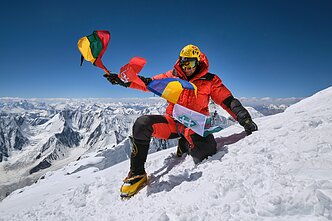
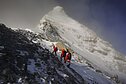





Lithuanian mountaineer Saulius Damulevičius was forced to turn back just 400 metres short of the summit of Mount Everest. During his descent, however, the country’s leading climber required assistance and was eventually airlifted by helicopter from Camp Two to a hospital.
Only a handful of climbers attempt to summit Everest without supplemental oxygen each year. Most, however, climb alongside a Sherpa, who helps establish camps, melts water and carries emergency oxygen supplies if needed.
Damulevičius, by contrast, climbs without guides or oxygen support – widely regarded as the most difficult and extreme style of mountaineering.
Two days after setting out from Camp Four at an altitude of 7,900m, Damulevičius attempted to summit Everest without supplemental oxygen or Sherpa support – an achievement considered one of the most difficult feats in mountaineering.
After reaching an altitude of 8,450m, considered a “death zone” due to the lack of oxygen, the climber decided to turn back and return to Camp Four (C4).
While mountaineering enthusiasts waited to see when he would begin descending further, Everest expedition operator Summit Climb posted on social media on Wednesday evening, claiming that one of its guides and a client had found Damulevičius barely alive in a tent at Camp Four.
However, traveller and mountaineer Tadas Jeršovas, who had been remotely assisting Mr Damulevičius during the climb, told LRT.lt that the account published by the agency was inaccurate and that the company had not in fact provided assistance.
“I spoke to Saulius, and he said none of that happened. The story spread very widely, so we had to deny it,” Jeršovas said.

Descent from the mountain
Damulevičius later did require help. After resting at Camp Four, he began descending to Camp Three, located above 7,000m.
“After starting his descent, he began feeling unwell and activated an emergency signal through his GPS device, an InReach communicator. I contacted Lithuania’s best-known mountain doctor, Kastė. We consulted about medication, and I passed the information on to Saulius.
“At the same time, I contacted all the agencies that still had teams on the mountain. [...] I knew Elite Exped was still on the mountain, preparing to climb Lhotse and would definitely pass Saulius. Seven Summit Treks also had people there.
“As far as I know, after some time, Saulius felt better, perhaps the medication worked, and he managed to descend to Camp Three on his own,” Jeršovas told LRT.lt.
Through the agency servicing Damulevičius’s Everest base camp operations, assistance was arranged and two Sherpas climbed from Camp Two to reach him.
“Two Sherpas arrived with oxygen. Saulius met them at Camp Three. They then helped him descend to Camp Two. He arrived there around 04:00 or 05:00. [...] From there, he was flown by helicopter directly to a hospital in Kathmandu,” the expedition guide said.
On Thursday, journalist Daiva Žeimytė-Bilienė, who had been documenting Damulevičius’s attempt to summit Everest without supplemental oxygen, shared video footage from Lukla airport showing the mountaineer speaking to his mother on the phone.
Damulevičius himself has not yet commented publicly on his condition.
Lithuania’s leading mountaineer has previously summited K2, the world’s second-highest and one of its most technically demanding mountains, without supplemental oxygen. He has also climbed several other peaks above 8,000m without oxygen support.

Newsletter
Every Friday morning.