




A country's attitude towards its deafblind citizens is a measure of how advanced it truly is, says specialist educator Dalia Taurienė. By that measure, Lithuania has a great deal of catching up to do.
More than thirty years after independence, Lithuania still has no functional system for identifying, supporting or educating people who have both sight and hearing loss. There is no national organisation representing deafblind people, no tactile version of the Lithuanian language, and no reliable figure for how many deafblind people actually live in the country.
Based on comparisons with other nations, specialists estimate the number at around 12,000 – the vast majority of them elderly.
"I never thought we would fail to find our own people and help them," said Taurienė, who has spent decades working with deafblind children.
A two-year-old with a rare syndrome
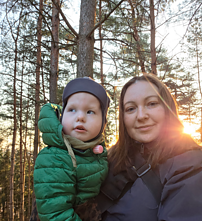
Edita Matonė is a family doctor from Kaunas, Lithuania's second city. She is currently on parental leave, caring for her two-year-old son Tadas, who was born with CHARGE syndrome – a rare genetic condition that affects multiple body systems simultaneously.
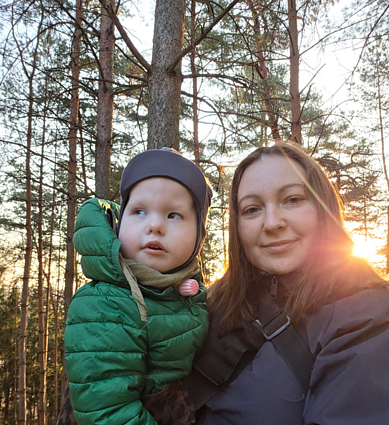
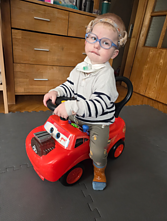
Tadas was born blind. Though some vision has developed as he has grown, he has multiple colobomas – an eye defect where large areas of his visual field are missing. He wears specially adapted corrective glasses but he can still see only partially.
He also cannot swallow properly, cannot be fed by mouth, and breathes through a tube inserted directly into his trachea. A separate tube delivers nutrition straight to his stomach.
His hearing loss was identified later, once the more immediately life-threatening conditions had been stabilised.
"When a child cannot eat through their mouth, nobody thinks hearing and sight are the most urgent concern," Matonė said.
Matonė's family threw themselves into finding ways to help her son but encountered a near-total absence of information about deafblindness in Lithuania.
"The doctors managed to fit cochlear implants – the most advanced option medicine can currently offer a deaf child. He can hear now, but that too brings its own challenges. With glasses, you can tell almost immediately whether someone sees more clearly. With cochlear implants, the road is long – establishing whether a child is actually hearing takes between six and twelve months. If there are other health problems as well, it can take even longer, and requires very specific educational support," she said.
Specialists do not know how to help and sometimes refuse to try
The family has encountered a system that is, at best, unprepared for a child like Tadas, and at worst unwilling to engage.
"Specialists know how to work with a child who cannot hear. They know how to work with a child who cannot see well. But there is nobody who knows how to educate a child with cochlear implants through touch. Some actively look for reasons not to work with him, because they do not know how. And there are no training courses where they could learn, yet parents still have to somehow raise their child" Matonė said.
When the family has been turned away, progress has only come through formal complaints.
"It is deeply painful that there is no cooperation. There are not many cases like Tadas', and sometimes specialists, frightened by the unfamiliarity, choose simply not to provide the service. Then parents have to become fighters – demanding, searching, writing complaints, and that takes enormous energy," she said.
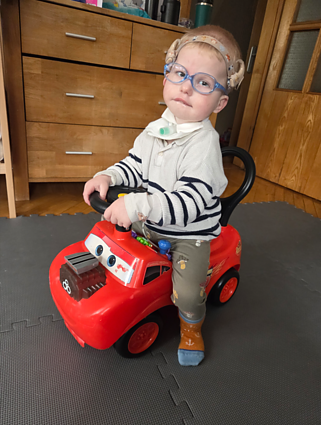
Matonė added that there is still a tendency among some professionals to suggest waiting – letting the child grow a little before intervening.
What kept them going, she said, was the advice of a specialist educator for the visually impaired, who urged them to find a means of communication as early as possible. A child who cannot express themselves, the specialist warned, may later develop serious psychological difficulties.
"Imagine any of us being unable to see or hear properly. How would you say that you want something? Anyone would feel anger. Later, that can turn into psychological problems," recounted the mother.
In the meantime, the family has developed their own tactile communication system with Tadas. A person entering a room may go unnoticed – his visual field is narrow and background noise masks footsteps – but when someone takes his hand, he recognises them immediately. Touch-based gestures tell him when they are going outside. He then leads the way to the front door himself.
No respite, no route back to work
Matonė is a qualified doctor currently on parental leave. The state, she said, has shown little interest in helping her return to work.
"The state invested in me as a specialist. I completed state-funded studies. But when I looked for ways to go back to work, the only suggestion was to place Tadas in a residential care or nursing facility. We want to raise our child, to give him comprehensive support and education at home, because we know he can learn more there than in an institution," said the mother. At home, she added, Tadas is in a familiar, adapted environment where he develops faster.
Lithuania has no specialists trained to work with people who have both hearing and visual impairments. Teachers for the visually impaired and those specialising in deaf education exist, but are in short supply – even in the private sector. Neither group provides home visits.
"We cannot get respite care at home in Kaunas for a child with complex disabilities – and if medical procedures are also required, that service simply does not exist here," Matonė said.
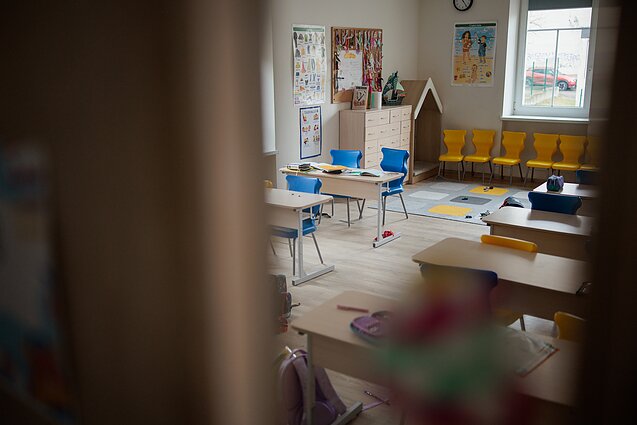
The city's social services department confirmed to LRT that home-based respite care involving medical procedures falls outside the scope of what local authorities are required to provide, and that families needing such support should approach their family doctor separately.
Some support does reach the family – a palliative care team provides nursing, psychological, physiotherapy and social work support, and a carer from a private agency visits regularly. But the carer cannot legally be left alone with Tadas; a parent must always be present.
Thirty years of falling behind
Specialist educator Dalia Taurienė draws a direct line between Lithuania's current failures and its Soviet past, when deafblind children were considered ineducable.
As far back as 1992, specialists from the Nordic countries came to Lithuania to help build understanding of deafblindness. The Nordic Council of Ministers has continued to fund visits and send experts ever since. Yet little has changed.
"There is no functional understanding of the person in Lithuania – only medical codes," Taurienė said. "We do not fully understand the consequences of deafblindness for a person's life."
In Norway, she noted, a child like Tadas would be monitored for a full year by a dedicated team of specialists. In Lithuania, no such individual attention is available.
Taurienė emphasises that every person with a disability is different, and that support must reflect that. "Sight is the most important sense both for learning and for communication – and when you combine hearing and visual impairment, the challenges are unimaginably complex."
She argues that Lithuania's entire approach to disability assessment needs to shift – away from the International Classification of Diseases used for medical diagnoses, and towards the International Classification of Functioning used across European social and education systems, which focuses on what a person can and cannot do in everyday life rather than on their clinical condition.
"Why have we not managed it? I do not know. Some are unmoved by the small numbers of deafblind children. Others are unmoved by the fact that most of them are elderly," she said.

There are thought to be around 190 deafblind children and young people under the age of 19 in Lithuania, around 1,600 people aged between 20 and 69, and more than 10,000 aged over 70.
First steps
The Agency for the Rights of Persons with Disabilities, which operates under the Social Affairs Ministry, acknowledged that Lithuania lacks an organisation to represent and advocate for deafblind people. Its director, Eglė Čaplikienė, said the agency was looking to the Lithuanian Deaf Association to take a leadership role in the interim.
She said Lithuania participated in April in a Nordic-Baltic forum on deafblindness and was working with specialists from the Nordic countries who had already navigated this path.
"We understand that ensuring a diverse range of future services is closely tied to the training and professional development of the specialists who work with and provide services to people with disabilities," she said.
The Social Affairs Ministry did not respond to LRT's questions on the subject.
Taurienė remains frustrated but not without hope. She notes, however, that even establishing a tactile form of Lithuanian – a language of touch used by people with both hearing and sight loss – requires first finding and connecting the deafblind community itself. That community, for now, remains largely invisible.
"It is said that if a country has a functioning system for its deafblind citizens, that country is advanced. There are very few countries in Europe that have not built such a system. I never thought we would be one of them."

Newsletter
Every Friday morning.