












How a remote military range is becoming central to NATO innovation
Like a bird of prey chasing its victim, the interceptor drone swoops in and neutralises its flying target. A few seconds later, a loud explosion rips through the air before the strong northern wind disperses the smoke.
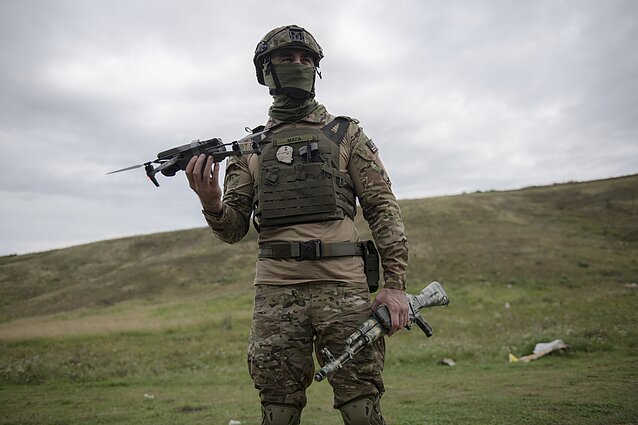
Applause ripples around the training range as military officers, engineers and defence executives, gathered earlier this week for live demonstrations of uncrewed systems and counter-drone technologies, take in the scene.
The Sēlija range, opened earlier this year after roughly two years of land clearing and construction, is located in dense forests of pine and silver birch, a two-hour drive southeast of Riga along dirt tracks that until recently led to nowhere of strategic significance.
It has now become NATO’s innovation range for uncrewed systems and counter-UAS technologies – one of five such facilities established under NATO’s Rapid Acceleration Action Plan, alongside sites in Estonia, Finland, Italy and the Netherlands – as allies race to test equipment under battlefield-like conditions and adapt to lessons from Ukraine.
For military planners and defence companies alike, the message is simple: modern weapons cannot be developed solely in laboratories or boardrooms.
Niks Gaurucs, an executive at Eraser, a Latvian military UAV manufacturer, said access to such training ranges means “almost everything to be successful”.
“You can have great ideas, you can try to manufacture them, but if you don’t have a place where to test them, how can you prove that you are good, that you can do the task, and do it successfully?”
‘I get goosebumps’
Across Europe, access to military testing areas remains complicated due to bureaucracy, or security clearance and insurance issues. This is especially true for smaller companies trying to refine rapidly evolving drone technologies.
Latvia has consequently gone the extra mile, according to Major Modris Kairišs, head of Latvia’s Autonomous Systems Competence Centre, with the government granting a special exemption for the Sēlija drone testing range to fast-track approvals and cut through bureaucracy.
It also allows companies and armed forces to simulate electronic warfare conditions and conduct high-altitude flights – activities that would be restricted or forbidden elsewhere.
For Christopher Müller, founder and chief executive of German company RDC Systems, Latvia offers opportunities difficult to find elsewhere.
“We have been lucky enough to have a good partnership here with the Latvian team. I get goosebumps because it’s really important for a small company like us.”
Germany has recently opened a new testing area, he said, but gaining access remains challenging. “There was a test on May 12 where we wanted to go, but it was not that easy.”
By contrast, RDC Systems has already visited Latvia three times this year alone.
During a previous NATO test event at Sēlija, Müller said Ukrainian drone operators evaluated competing systems side by side before companies received detailed NATO assessments of their performance.
For RDC Systems, the results carried both technical and commercial significance. Müller said NATO radar systems confirmed that the company’s aircraft achieved speeds it had previously struggled to prove publicly.
“We are currently the fastest drone in the world and we could only say that because the NATO radar confirmed this,” he said. “It was very important for us for marketing purposes, because nobody believes you when you say we are this fast.”
An existential issue for Latvia
Russia’s war in Ukraine hangs over virtually every discussion at Sēlija, where military officials from a dozen NATO nations across Europe, the US and Canada – as well as far-flung countries including Singapore – gathered.
“We are meeting at a time when unmanned systems are no longer a future capability,” said Major Gen. Andis Dilāns, Latvia’s undersecretary of state for logistics. “They are already shaping the modern battlefield every day.”
For Latvia, which borders Russia and Belarus and sits on NATO’s eastern flank, the issue is existential.
“That is why Latvia is investing not only in acquisition of unmanned systems, but also in building the ecosystem needed to test, adapt, integrate and scale them,” Dilāns said.
He described Sēlija not just as a military base but as a meeting point for industry and armed forces. The range is expected eventually to host around 1,500 Latvian conscripts and allied troops, including elements of NATO’s multinational brigade in Latvia.
“Testing matters because no system can be acquired properly only on paper or in a laboratory,” Dilāns said. “Capabilities must be tested against the real terrain, real operational conditions, and real tactical challenges.”
Tarja Jaakkola, NATO’s assistant secretary general for defence industry, innovation and armaments, said the alliance is trying to accelerate the movement of new technologies from prototypes to frontline use.
The purpose of NATO innovation ranges, Jaakkola added, is to “de-risk new technological products by providing accessible operational experimentation opportunities to our innovations”, to then “transfer these new products from the range to the hands of our soldiers, from the company pitch book to our arsenal, from an exhibition stall to the battlefield”.
This week’s demonstrations also highlighted how quickly Sēlija is becoming embedded within NATO planning. On Wednesday, Latvia and the Netherlands signed a letter of intent allowing Dutch armed forces to regularly use the site for drone and counter-drone exercises and testing.
Meanwhile, NATO is hoping to roll out “innovation badges” to companies that use the ranges to attest that they have undergone battlefield-like testing. The alliance also wants to scale up production of this equipment, often developed by start-ups that are just a few years old, by matchmaking them with civilian manufacturers that have spare industrial capacity.
This story appeared originally at Euractiv, partners of LRT English.

Newsletter
Every Friday morning.