















LRT English Newsletter – March 6, 2026.
Though not unexpected, the US-Israeli strikes on Iran may well represent the final nail in the coffin of the “rules-based international order”, one so emphatically championed by Lithuanian leaders of whatever political stripe and invoked in their calls for supporting Ukraine and their tussles with China. So one would expect them to condemn this blatant violation of international law and, per the post-WW2 consensus, the greatest of crimes, the crime of aggression. Yet one would be wrong.
Instead, Lithuanian leaders, political and military, have unambiguously endorsed the US-Israeli strikes, reserving their condemnation only for Iran’s retaliation on countries hosting US military bases, even calling them “unprovoked”.
Parroting the talking points emanating from the White House (and receiving hardly any pushback), Lithuanian leaders argued that the US-Iran negotiations over Tehran’s nuclear program had failed (they were ongoing when the strikes began), that the Iranian regime is terrible, that this is a war to bring peace and stability. From themselves, they added to the list the gravest of crimes: that Iran supports Russia.
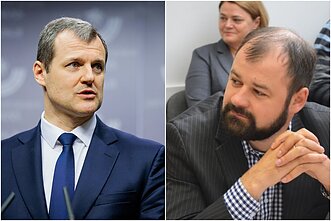
In this, they did not stray much (or at all) from the line of most other European and EU leaders. Foreign Minister Kęstutis Budrys only expressed criticism that the EU statement came a little too late – and concern that focus on the Middle East may divert attention from Ukraine.
As for legality – well, President Gitanas Nausėda only had to say that international law merits a “broader view” in this particular case.
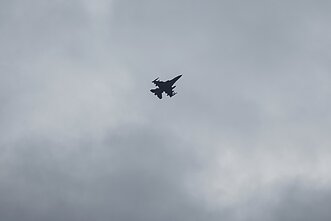
The commander of Lithuania’s armed forces went so far as to suggest that Vilnius might assist the US in its campaign against Iran, for example, by offering its territory for US bombers and fighter jets (this brings to mind Lithuania’s previous complicity in US crimes when, in the mid-2000s, it hosted a CIA “black site” where terror suspects were tortured). The offer, however, is not his to make – although the president’s chief foreign policy adviser had earlier made a similar point: if the US asks, Lithuania will comply.
WHOSE NUCLEAR UMBRELLA?
That loyalty to Washington extends, naturally, to the nuclear question. When Emmanuel Macron announced this week that France would expand its nuclear arsenal and proposed a European deterrence framework, with eight countries including Germany, Poland and the UK already signed up, Lithuania's answer was swift and unsurprising: thanks, but we're staying under the American umbrella.
Senior presidential adviser Asta Skaisgirytė put it plainly, “If Russia fears anything, it fears the US nuclear deterrent, not anyone else’s,” adding that the US nuclear arsenal is also NATO's nuclear arsenal – the protection Lithuania sought when joining the alliance in 2004 and continues to trust today. Defence Minister Robertas Kaunas welcomed France's initiative as an addition to European security while making clear it changes nothing for Vilnius. President Nausėda agreed, saying Paris' plans complement NATO's nuclear umbrella but cannot replace US protection.
ESCAPE FROM DUBAI
After Iran's retaliatory strikes on the Gulf sent shockwaves through one of the world's busiest aviation hubs – hitting Dubai International Airport directly and triggering the cancellation of at least 20,000 flights – the first Lithuanian citizens made it home on Thursday morning. A chartered flydubai flight touched down in Vilnius, carrying 170 passengers in total, including 49 Lithuanian nationals alongside travellers from Poland, Estonia, the Netherlands and elsewhere.
Further evacuations are likely to follow as authorities estimate that around 2,000 Lithuanian citizens are currently in the region – more than 1,000 of them in the UAE alone – and Lithuania's Foreign Ministry and National Crisis Management Centre are already working on plans to bring more of them home as the situation in the region continues to deteriorate.
MIGRANTS WANTED, NOT TOO MUCH
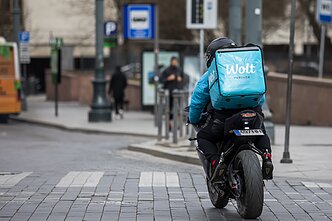
Draft legislation submitted to the Seimas this week would halve the number of hours foreign students are permitted to work, from 40 to 20 per week, with food delivery and ride-hailing platforms required to actively monitor compliance. The parliament's defence committee chairman described the current rules as a “loophole that should be closed” – a stance notably at odds with the Education Ministry, which simultaneously announced state internship scholarships for talented foreign students, explicitly aimed at drawing them into Lithuania's labour market.
President Nausėda appears to side with the restrictionists. His proposed new category of temporary work permit would allow migrants to work for up to two years for a single fixed employer – no job changes, no family reunification, no path to permanent residency, and a mandatory six-month departure before any return. The initiative seeks to balance immigration control with the needs of businesses, he said.
Meanwhile, the European Court of Human Rights has begun examining a lawsuit brought by a Belarusian woman married to a Lithuanian citizen, whose temporary residence permit – initially granted on family reunification grounds – was revoked due to her years of employment at a Belarusian state broadcaster deemed a security threat. The outcome could force an uncomfortable reckoning between Vilnius's security-first approach to migration and its obligations under European human rights law.
Also, Ukrainian refugees residing in Vilnius should know that starting September, they will require a valid, personalised Ukrainian card to use the city’s public transport for free.
NEMUNAS DAWN CAMPAIGN FINANCING
It may come as little surprise that Nemunas Dawn – the party pushing to raise Lithuania's legal ceiling on cash transactions – has found itself at the centre of a cash-for-donations scandal.
A joint investigation by five Lithuanian outlets found that at least five party members, including Environment Minister Kastytis Žuromskas, donated to the party using cash deposited into their bank accounts shortly beforehand, despite those accounts previously holding insufficient funds. The donations total at least €13,500.
At the heart of the affair sits party vice-chairman Robert Puchovič, who declared nearly half a million euros in cash whilst holding nothing in any bank account. At least 17 donors linked to him – including family members, neighbours, childhood friends, and business associates – gave nearly €60,000 to the party in total, with some receiving transfers from Puchovič before making their donations.
SCAMS AND SHADY TRANSACTIONS
With residents sometimes losing €321,000 to fraudsters in a single day, Lithuania's central bank decided it has had enough, and it is now proposing a package of legislative changes that could fundamentally shift who bears the cost when scammers strike.
The headline measure is straightforward: if a bank fails to flag and stop a suspicious payment, it picks up the tab with Lithuania’s residents also gaining the right to claw back funds already transferred to fraudsters. Scammers are currently siphoning tens of millions of euros out of Lithuanian accounts each year, and the Bank of Lithuania has decided that giving commercial banks some skin in the game is the most effective way to sharpen their attention.
EDITOR’S PICKS:
– The persona behind the silver face – learn more about Lion Ceccah, Lithuania’s Eurovision pick
– You’ve certainly heard about the Kaunas-Vilnius rivalry. But what if we considered the country’s two largest cities a regional metropolis – the Kaunavilnis twin city?
– Driving on Lithuania’s roads feels like a rollercoaster? Welcome the pothole season.
– Ever seen a snowflake this close?

Newsletter
Every Friday morning.