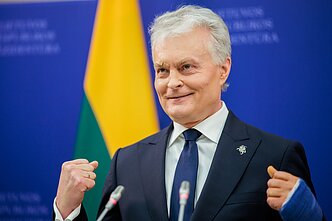











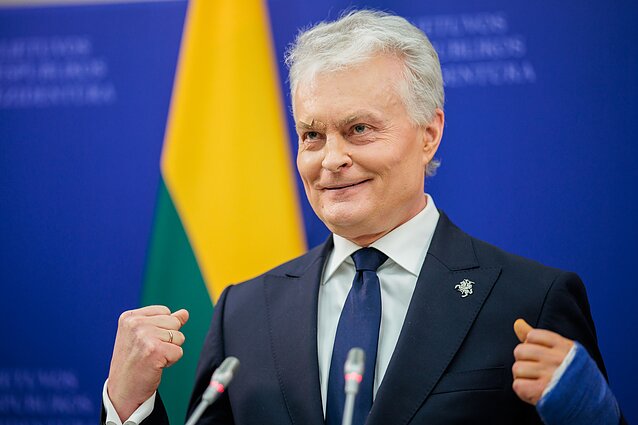
Lithuanian President Gitanas Nausėda says his country understands the United States’ military action in Iran and has condemned Tehran’s retaliatory strikes on Persian Gulf states.
“We understand the objectives of the United States in carrying out this military operation, because all diplomatic efforts made to stop the development of nuclear weapons in Iran, unfortunately, did not yield the expected result,” Nausėda told reporters following a State Defence Council meeting on Tuesday.
“Of course, the situation within the country, acting extremely cruelly towards local population, could not be tolerated,” he added.
Commenting on whether US and Israeli attacks were illegal, Nausėda said the Middle East conflict requires a “broader view” of international law, both to assess the risks if Iran acquires nuclear weapons and to consider the country’s record of brutal human rights violations.
He added that Lithuania had been informed of Washington’s planned actions. “We, along with Poland and other allies, had this information,” he said.
According to the president, Lithuania advocates for a peaceful resolution to the conflict and for Iranian authorities to respond to calls for diplomacy.
“I do not rule out that such a path is still possible, but to achieve it, we certainly cannot follow the path Iran has chosen – attacking sovereign states in the Persian Gulf that are in no way related to this conflict,” Nausėda said.
He cited Bahrain, Qatar, the United Arab Emirates, Oman, and other regional states, calling Iran’s attacks “a brutal violation of their sovereignty and a direct threat not only to residents of those countries but also to visitors in the Persian Gulf region.”
The Middle East countries that suffered Iran’s strikes host US military bases.
The US and Israeli strikes on Iran began while Tehran was engaged in negotiations with Washington over its nuclear and missile program.
Iran had acceded to a nuclear deal (JCPOA) in 2015 that would have limited its nuclear program, but the US withdrew from it in 2018 under the first administration of President Donald Trump and reimposed sanctions.

Newsletter
Every Friday morning.