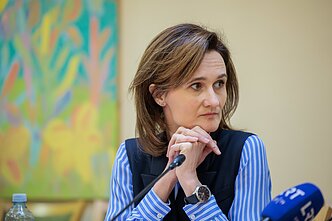



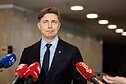







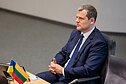



Lithuania’s incoming Culture Minister Šarūnas Birutis says the country should not censor everything linked to Russian culture, arguing that it also belongs to Lithuania’s Russian-speaking citizens who are not to be blamed for the Russian government’s actions.
“The stick has two ends. We are well aware that the Russian nation is not the same as the Kremlin. In one way or another, they have been our neighbours for millennia and will probably be our neighbours in the future,” Birutis told the news agency Elta on Thursday.
Since Russia’s full-scale invasion of Ukraine in 2022, there has been a dominant anti-Russian sentiment in Lithuania’s public sphere. In late 2022, the Russian Drama Theatre was renamed the Old Theatre of Vilnius and, the following year, the Pushkin Literary Museum in the Lithuanian capital lost reference to the Russian poet in its name.
The National Opera and Ballet Theatre removed ballets by Sergei Prokofiev and Igor Stravinsky from its repertoire, while Lithuanian cinemas boycotted Hayao Miyazaki’s last film because its distributor in the Baltics had alleged links with Russian companies.
There has also been a drive to discourage teaching Russian as a foreign language in Lithuanian schools and, at one point, Education Minister Gintautas Jakštas suggested that the country should phase out secondary education in the Russian language, despite the fact that Russians are the second biggest ethnic minority in Lithuania with around 14,000 students attending Russian schools.

According to Birutis, the designated culture minister, stigmatising Russian culture alienates Lithuania’s own Russian-speaking citizens.
“Many people of Russian ethnicity live in Lithuania. This is quite natural,” he is quoted by Elta. “They are Lithuanian citizens and are probably loyal to Lithuania as their homeland. Therefore, to immediately put a negative label on their ethnicity and their culture, I think, is completely wrong, inadequate and politicians should not behave in such a way.”
He also believes that there should not be a blanket ban on Russian artists coming to perform in Lithuania.
“Not all performers are the same. Many Russian performers have emigrated and there are some who are not supportive of the Kremlin regime,” Birutis said.
Early last year the outgoing culture minister, Simonas Kairys, argued that everything to do with Russian culture should be put in a “mental quarantine”.
In December last year, the parliamentary Committee on Culture even appealed to the government to set up a commission to evaluate Russian artists coming to perform in Lithuania. However, the government decided against it.
Filip Kirkorov, Khabib Sharipov, and Natasha Koroliova are among Russian performers who have been blacklisted in Lithuania.

Newsletter
Every Friday morning.