








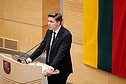

Lithuania’s Education Minister Gintautas Jakštas has said that the country should phase out secondary education in the Russian language, following an example of neighbouring Latvia and Estonia.
Russians are the second biggest ethnic minority in Lithuania, with around 14,000 students attending Russian schools.
“Our neighbours, the Latvians and Estonians, have not only renounced schools where the language of instruction is Russian, but they are also going down the path of not teaching Russian as a foreign language. [...] We should learn from our neighbours. One thing is that we should focus on EU languages, so that the education of ethnic minorities takes place in their own language, and we might have bilateral agreements with other countries, if they are a friendly country, such as Ukraine,” Jakštas told the radio Žinių Radijas on Thursday.
The Ministry of Education, Science and Sport is currently looking into ways to suspend the use of Russian as a language of instruction, he said, with a proposal expected over the next few weeks.
“We need to start thinking about what those solutions would be. It is too early to say what they would be. We are now immersed in the assessment of schools, and I hope to have a proposal over the next few weeks,” Jakštas said.

According to the minister, schools in Lithuania should not use the languages of “unfriendly countries” as languages of instruction.
Moreover, he argues, teaching all subjects in minority languages makes it harder for students to integrate into society.
Jakštas said, however, that Russian schools would not be closed, especially as there is a shortage of schools in Vilnius and Klaipėda, but the language of instruction should be changed, either by teaching more subjects in Lithuanian or by switching to Lithuanian education, but that would be done for children just starting their education.
“If we wish to start making changes, it should be done gradually, starting with the formation of new classes,” Jakštas said, adding that it should not be difficult for teachers at Russian schools to switch to teaching in Lithuanian because they speak the state language.
Discussions about minority schools were triggered by a recent incident where teenagers at a Russian school fired a pneumatic weapon at a classmate, presumably because they disagreed with his stance against the war in Ukraine.
According to Jakštas, however, his proposals should not be linked with the incident.
“I do understand that those children are remorseful for what they did. You can be wrong and we can’t put labels on them,” he said.

Meanwhile, Vaiva Vėželytė-Pokladova, head of the National Minorities Policy Analysis and Information Division of the Department of National Minorities, told the Žinių Radijas radio she opposed proposals to close down the schools of one particular ethnic community.
“If we talk only about Russian-language schools, we would be against the marginalisation of one nationality. Closing schools of one nationality and completely denying children the opportunity to cherish their nationality would certainly not be a decision that should be made at this time,” she said.
Under the existing law, local authorities in areas with traditionally large ethnic minorities guarantee education in their languages if the local communities request it.
Ethnic minority schools mostly operate in southeastern Lithuania where children receive education in their languages – mostly Polish and Russian – in nearly 100 schools in nine municipalities.
According to the National Agency for Education, over 47,000 children attended non-Lithuanian educational establishments, from kindergartens to schools, in the academic year of 2020–2021.
Around 14,000 pupils are now attending general education schools with Russian as the language of instruction, mostly in Vilnius, Visaginas and Klaipėda.

Newsletter
Every Friday morning.