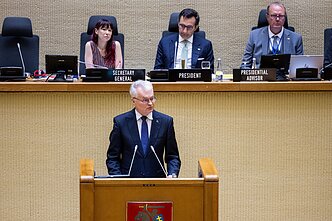













On Friday, Lithuanian President Gitanas Nausėda took the oath of office and began his second five-year term as the head of state. His second term should not differ much from the first, political analysts say. The main difference, however, will be Nausėda’s increased partiality.
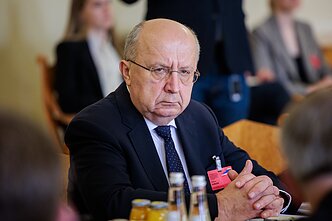
“We already have a partisan president. I understand that he does not have a party ticket, but we can clearly see the president’s support to certain parties and one party in particular,” said Rima Urbonaitė, a lecturer at Mykolas Romeris University (MRU).
Nausėda ran for president as an independent candidate but has previously expressed his support for the Social Democratic Party of Lithuania (LSDP). He even said he would like to see LSDP leader Vilija Blinkevičiūtė as the next prime minister. The party is leading in the opinion polls ahead of Lithuania’s parliamentary elections due to take place in October.
According to Urbonaitė, it is by supporting one or several parties that Nausėda will strengthen his power.
“Both by, let’s call it, collaborating and cooperating with certain parties, and if such support of parties and such cooperation is successful, he can strengthen his position by appointing certain people to certain positions,” she explained.

Virgis Valentinavičius, an associate professor at MRU, also said that during the second term “we will see the same” Nausėda.
According to him, the president will continue to try to interfere in the work of the government and will do so even more actively. In his words, the head of state will strive for a more obedient government than the current one.
“The principle is simple, and it has won him a lot of popularity – he points fingers at the unsolved problems of the government and says that the government is to blame here, and he points fingers at the solved problems and says that it’s thanks to him. We will see more of that,” Valentinavičius said.
Professor Ramūnas Vilpišauskas of the Institute of International Relations and Political Science at Vilnius University also believes that Nausėda will strive to remain as popular as he is now.
“The more popular he is, the more likely he is to influence political processes and the more seriously he is taken as a political figure by the ruling majority in the Seimas, the government, and other actors. Even when there is no longer a need to think about re-election, there is still a need to think about one’s popularity,” the political analyst said.

Matas Baltrukevičius, associate analyst at the Vilnius Institute for Policy Analysis, points out that Nausėda is at odds with the current government, which has led to various tensions. Therefore, there will be a different situation after the Seimas elections in the autumn.
“It is his great hope that the Seimas elections will change the situation, that another government will be formed and that it will be possible to work in a less confrontational environment, with better mutual understanding, and that this could lead to some results, not only in foreign policy,” Baltrukevičius said.
The analyst does not rule out that if the Social Democrats come to power, Nausėda’s word will become more important. But, he said, there is no ideal relationship between the president and the prime minister.
“In the short term, yes, because it would be useful for the Social Democrats to show immediately that we are not like the former rulers, that we are trying to mobilise, we want to agree, and that this is going to be a different era,” Baltrukevičius said.

After Nausėda’s inauguration, Prime Minister Ingrida Šimonytė returned the powers of the government to the president, as required by the constitution. The president, as provided for by law, entrusted Šimonytė’s government with a temporary mandate.
Political analysts doubt whether the cabinet of ministers will be reappointed in full. This is especially so given Nausėda’s statements during the presidential election campaign that he sees the return of powers as an opportunity to change the composition of the cabinet.
“It will be very difficult for him to back down. In other words, if not a single minister is replaced after the return of powers, it means that those loud announcements about an almost radical change in the composition of the cabinet were empty,” said Urbonaitė, a lecturer at MRU.

Newsletter
Every Friday morning.