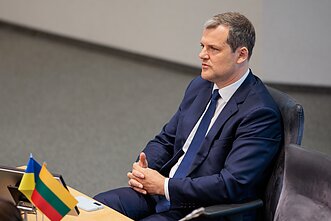
















Parliament Speaker Viktorija Čmilytė-Nielsen has drawn up a draft resolution to turn to the country’s Constitutional Court regarding the compatibility of some provisions of the Istanbul Convention with the fundamental law of Lithuania.
Lithuania signed the Council of Europe Convention on Preventing and Combating Violence Against Women and Domestic Violence – or the Istanbul Convention – back in 2013, but its parliament has not ratified it amid opposition from conservative groups, claiming that the document introduces non-binary notions of gender.
“Amid growing doubts that some articles of the Convention may possibly run counter to our constitution, I think we need to ask the Constitutional Court to look into the individual doubt-raising articles and give its verdict,” the speaker told reporters on Wednesday, hoping that the appeal will be backed by the whole parliament.
Under the draft resolution, the Constitutional Court would be asked whether the Istanbul Convention’s norms on gender – as opposed to biological sex – gender-based violence against women and the inclusion of information on non-stereotypical gender roles into the official education curriculum, among other things, are in line with the Lithuanian constitution.
Further reading
“I believe and hope we’ll have support for this from both Istanbul Convention enthusiasts and sceptics as the Constitutional Court is the impartial arbiter in this case and it can give its verdict,” Čmilytė-Nielsen said.
The draft resolution has also been signed by Prime Minister Ingrida Šimonytė, Eugenijus Gentvilas, elder of the Liberal Movement political group in the Seimas, Vytautas Mitalas, elder of the Freedom Party group, Orinta Leiputė, elder of the Lithuanian Social Democratic Party group, and Radvilė Morkūnaitė-Mikulėnienė, elder of the Homeland Union – Lithuanian Christian Democrats group.
Lithuania signed the Istanbul Convention on June 7, 2013, but its ratification has stalled.
Experts from the Council of Europe say Lithuania could benefit from recommendations on curbing domestic violence. The Catholic Church and some politicians, however, argue that the Convention may require Lithuania to change its concept of gender and introduce “unacceptable” attitudes towards homosexuality.
Čmilytė-Nielsen says the parliament is now split fairly equally regarding the ratification of the document.

Newsletter
Every Friday morning.