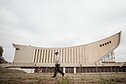















Lithuania’s ruling Social Democratic Party is divided over the future of the former Vilnius Concert and Sports Palace, with one camp favouring state control and symbolic national use and another pushing for transfer of the site to city authorities.
The debate centres on the Soviet-era structure built in 1971 and located on the grounds of a former Jewish cemetery, an issue that has complicated redevelopment plans for more than a decade.
Senior party figures including Vytenis Povilas Andriukaitis, Kęstutis Vilkauskas and Rimantas Sinkevičius support keeping the site under central government control and transforming it into a national conference centre and symbolic memorial space.
Their vision includes commemorating Lithuania’s pro-independence Sąjūdis movement, which held its founding conference at the Sports Palace, victims of the January 13, 1991, Soviet crackdown, and the restoration of part of the former Šnipiškės Jewish cemetery area.

By contrast, current party leader Mindaugas Sinkevičius and Prime Minister Inga Ruginienė favour transferring the property to Vilnius city authorities and developing it as a museum or memorial site, arguing that the state should avoid additional financial obligations.
The disagreement highlights long-running uncertainty over the future of the building, which the state took over in 2015 after the bankruptcy of its previous owners.
Initial plans to convert the site into a conference centre stalled amid objections from Jewish community groups, citing religious concerns over redevelopment of a historic burial ground where Jewish cemeteries existed since the 16th century.

Judaic law places strict limits on disturbing burial sites. Later proposals included a museum or memorial dedicated to Lithuanian Jewish history.
Ruginienė initially supported the idea of a conference centre but later questioned its economic viability, with government assessments citing high reconstruction costs, limited parking and technical constraints due to the protected status of the building.
A group of about 20 Social Democratic lawmakers recently proposed that the government proceed with redevelopment as a conference centre, arguing that more than 70% of Lithuanians support the idea, according to unspecified surveys.
At the party congress, Seimas Speaker Juozas Olekas backed the proposal, saying national landmarks such as the Palace of the Grand Dukes and the planned National Stadium demonstrate the state’s ability to deliver major projects.

“This object should unite us,” Vilkauskas said, recalling historical events held at the site, including the Sąjūdis congress and wakes for the January 13 victims.
Supporters argue the state could share costs with the municipality and eventually deliver a nationally significant venue.
However, the party’s new leader Sinkevičius said the project risks overstretching public finances, noting ongoing commitments such as the planned “Tautos namai” cultural centre, estimated to cost more than 100 million euros.
“Concentrating on multiple large national projects at once would be a mistake,” he said.
Vilnius Mayor Valdas Benkunskas said the city is open to taking over the site but criticised the lack of political consensus, calling it a sign of weak leadership.
He said the building is in poor condition and “an eyesore for everyone”, adding that a conference centre would not be viable due to size limitations and preservation requirements.
“The building is simply too small for a competitive international conference centre,” he said, adding that the city is already planning its own separate conference facility near the parliament building.
The dispute is now set to be decided by a narrower Social Democratic Party council.

Newsletter
Every Friday morning.