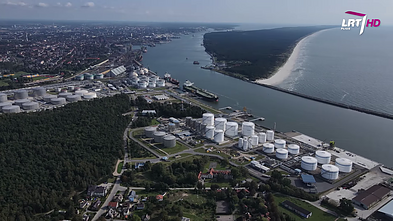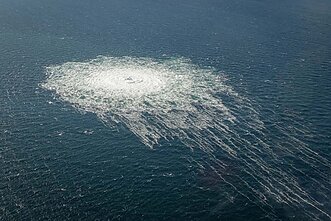













Following the Nord Stream gas leak incidents in the Baltic Sea, Lithuanians are worried if their Klaipėda LNG terminal is safe from sabotage.
Danish Prime Minister Mette Frederiksen said on Tuesday that the leak in the Baltic Sea was “deliberate” and not a result of an accident.
Lithuanian experts point out that while the Klaipėda facility is indeed a potential target, the government is taking extraordinary measures to protect it.
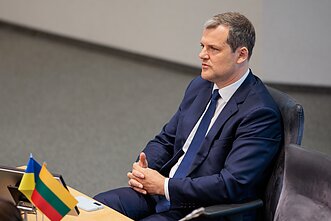
“In military terms, every such facility is high-risk and must be given military and intelligence attention. It is a target for all military adversaries,” energy expert Saulius Kutas tells LRT.lt.
The Klaipėda LNG terminal case, however, is different from the incident at sea off the coasts of Sweden and Denmark.
“I wouldn’t think that there is such a threat as in the open sea, in international waters. It is difficult to get there from territorial waters and the enclosed bay,” Kutas says about the terminal located in the Curonian Lagoon just off the coast of Klaipėda.

The risk of air attacks on the terminal should be addressed, he adds.
The expert hesitates to assess the potential damage that would be caused by a gas leak, if any.
“It depends on how much gas there is. It is difficult to say, because it is not clear how much gas would be in the terminal,” he says.
Security up since February
Klaipėdos Nafta (Klaipėda Oil), the state-owned company that manages the terminal, notes that the level of security for the company’s entire infrastructure was increased after Russia launched the invasion of Ukraine in February.
“Since the beginning of the war, LNG carriers arriving in Klaipėda have been escorted by the Naval Forces and officers of the Lithuanian Police Anti-Terrorist Operations Team Aras. Taking into account the situation, the overall threat level has not changed at the moment, and we have received no such indications from the institutions responsible for national security,” Orinta Barkauskaitė, the company’s spokeswoman, has informed LRT.lt.
On Wednesday, Defence Minister Arvydas Anušauskas assured the media that liquefied natural gas (LNG) was being stored properly.

“These facilities are always protected. There are always security drills, and the military is always involved, for example, when escorting LNG ships,” he said. The minister would not comment on concerns that the Klaipėda LNG terminal might not be protected under water.
“I will not specify what is being secured, what is being done. In any case, what needs to be done has been done,” he assured.
Meanwhile, Energy Minister Dainius Kreivys commented that the protection of the terminal, in his opinion, should be strengthened.
“Since the war broke out, we have taken measures to strengthen the security: both in of our interconnections with Sweden, with Poland, and of the terminal [...] Now the question is whether we need to protect it even more strongly. In my opinion, there is a need to do so,” Kreivys said, noting that discussions on this issue would continue.
“This is a matter for discussion by the cabinet and for discussion with the defence minister and the chief of defence,” Kreivys said.

Weak spot under water?
However, fears voiced in public that the terminal should be better protected are not new. The issue discussed in the parliamentary Committee on National Security and Defence in 2012-2016. At that time, Lithuania was preparing to receive the terminal and it was ready for operation.
Artūras Paulauskas, who chaired the committee, recalled that a special unit of the Public Security Service (VST) was created in Klaipėda to protect the terminal. He said that the main problem discussed was that the terminal’s site is easy to monitor, but the underwater part is more vulnerable.
“External security above water was well organised, with a lot of technical surveillance measures and many private companies with cameras. The only question was how the situation underwater was handled. We found out that the divers of the VST look from time to time, but they do not do it regularly,” says Paulauskas.
He said that the Committee then instructed the military to carry out underwater monitoring, but he could not say who was currently doing it.
Meanwhile, Anatolijus Didenko, commander of the Klaipėda unit of the VST, tells LRT.lt that the terminal’s protection has been reinforced after the Nord Stream incident this week.
According to him, fears that the terminal may be vulnerable to underwater attacks are based on outdated information, and since 2014, underwater protection has been reinforced, with the assistance of the military.
“I can reassure the population that the terminal is safe, protected by our services as it should be, and as of today the protection has been further strengthened,” Didenko said.

Newsletter
Every Friday morning.