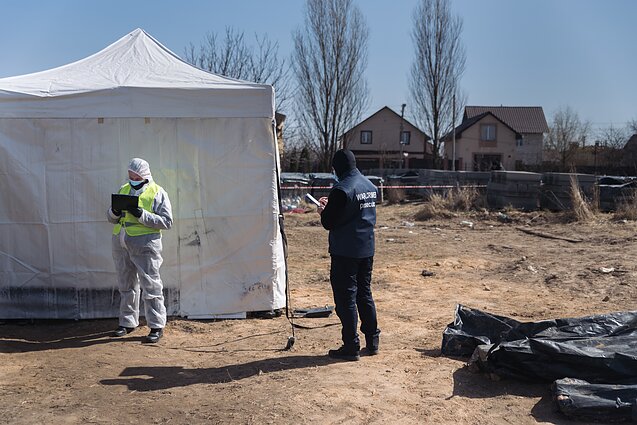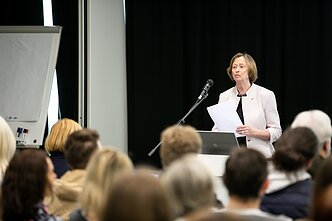















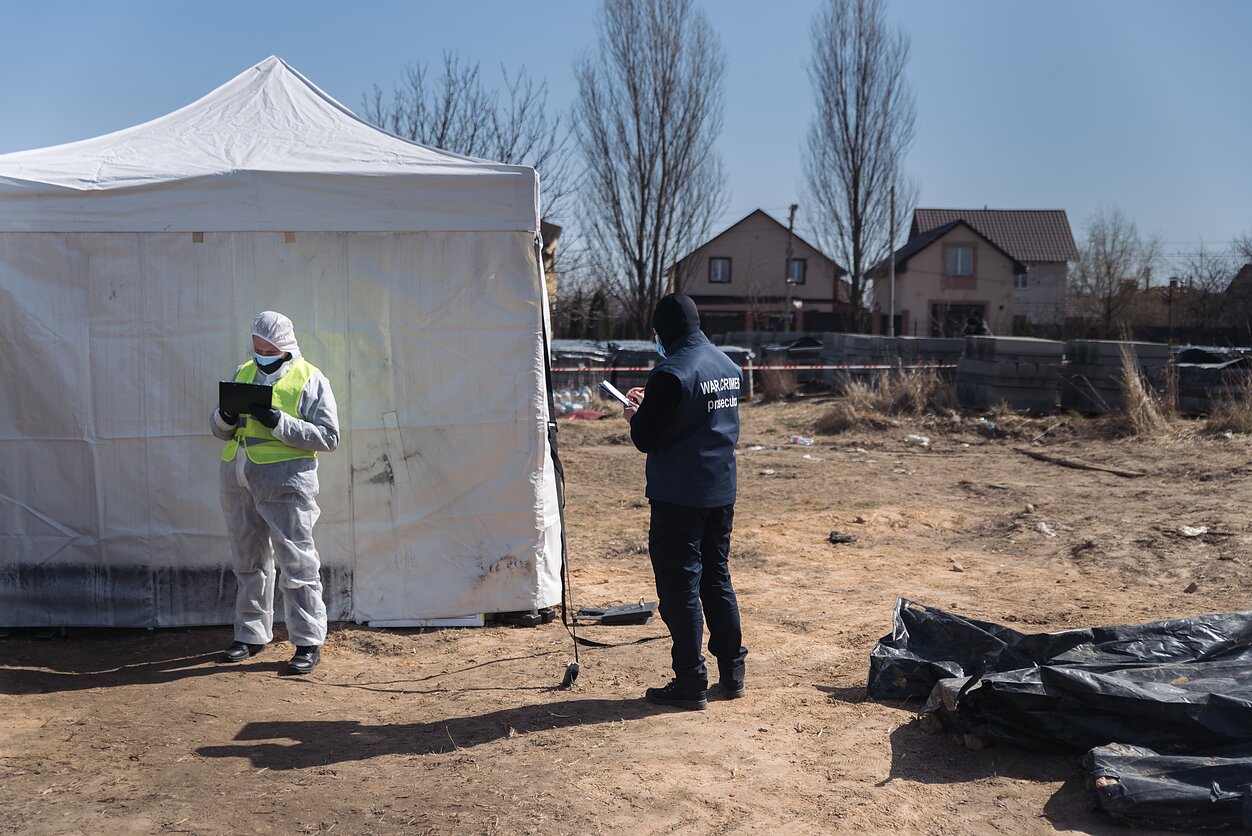
The killings in Bucha revealed the scale of Russia's atrocities in Ukraine. Lithuanian professor Danutė Gailienė, psychologist and researcher of collective trauma, discusses the roots of these crimes.
The interview was first heard on a podcast by Vilnius University, Mokslas be Pamokslų. It was edited for brevity and published with permission by LRT English.
According to Gailienė, war and the rules of war are simpler than everyday life, because an ordinary soldier is not personally responsible for his actions. He or she is only obeying orders from the commander.
In Ukraine, Russian soldiers have the generals’ blessing to engage in killings and know they will not be held accountable. Additionally, looting is seen by the soldiers as compensation for frustrations of failing to achieve military successes.
But to commit such crimes, a soldier still needs to “turn off” their empathy mechanism, according to Gailienė.
“Pathological ideologies help to do that. In Russia, people have been indoctrinated by criminal doctrine for decades. Few people are able to resist this immense influence.”
Read more: In the footsteps of Russian soldiers. 'There were locals who handed over their own' (III)

“The vast majority obey ideological propaganda, cave in to pressure from the authorities, and, being free of personal liability, stop resisting, get accustomed to the atrocities or even contribute to them,” she said.
“This moral destruction of people is a terrible thing that does not go without consequences. They will not stop the violence when the war ends. They will get drunk constantly, they will spread aggression, and their own lives will probably be sad and tragic,” Gailienė added.
The psychologist recalled the Nuremberg trials where 24 officials of Nazi Germany were convicted of war crimes. On the sidelines, a team of psychiatrists and psychologists worked with the accused for years.
“All the professionals and the public were very hopeful that once the analysis was complete, it would be possible to answer the question of what the Nazi personality is. And when the specialists began to summarise the results of their observations and research, they were greatly disappointed to be unable to describe a typical Nazi. Perhaps some of them were more neurotic, some had specific characteristics, but most of them were ordinary people, the only thing that stood out was their low level of empathy,” Gailienė said.

Since these discoveries were made, there has been increasing pressure on psychologists to explain brutal behaviour and its causes. However, experts have long known that a person is so complex and diverse that it is impossible to explain this behaviour with diagnoses, categories, or labels.
“When right-wing extremist Norwegian Anders Behring Breivik, who killed 77 people in cold blood, was tried, a psychiatric examination was arranged to examine whether he was sane, whether he had the legal capacity, and whether he understood what he was doing. The first examination found paranoid schizophrenia and a panel of experts leaned towards saying he did not have the legal capacity. But due to disagreement among the specialists themselves, a second expert examination was commissioned, which found that he did, after all, have the legal capacity, and arrived at several other diagnoses: autism, sociopathy, narcissism, etc,” Gailienė said.
According to her, this showed once again that there is no single answer and that those diagnostic labels are just names and constructs. However, in the case of Russian crimes in Ukraine, it is more reasonable to consider indoctrination, pathological ideologies, and moral dissociation – the so-called duality.
According to the professor, to discuss the causes of violent crimes, one has to keep going back to Nazi psychological examinations and an assessment of the historical past in Germany.

A famous American psychoanalyst Robert Jay Lifton, who studied the psychological dimensions of war and genocide, tried to understand where inhumane cruelty comes from.
“He conducted a study about Nazi doctors who performed the most horrific experiments on prisoners in the camps. He talked to them, researched them, and discovered the duality of personality that manifests itself like this: one side of you doesn’t know what the other is doing,” Gailienė said.
“They seemed to be divided into two parts: in the camps, they, as doctors, conducted cruel experiments, were primitive and vulgar, but when they returned home, for vacation, for example, they again became quite refined, educated German doctors,” she added.
It is difficult for a person to overcome duality and, according to the psychologist, historical traumas and events show that analogous things can be said about societies as about a person.
“There are already some historians, anthropologists and psychologists trying to pinpoint what exactly happened in Russia and turned it into such a cruel nation, and one of the reasons is the pathological narrative,” the professor said.
“Even studies on terrorists show that the cruelty is based on ideology, lack of empathy, and the fact they do not bear personal liability. Once these mechanisms are ‘turned off', they start seeing other people as objects, as if they could do whatever they want with them.”

Newsletter
Every Friday morning.