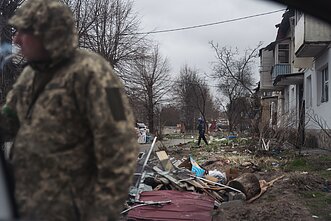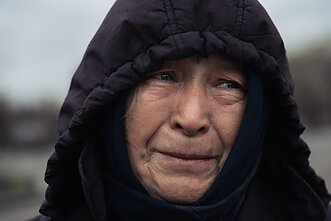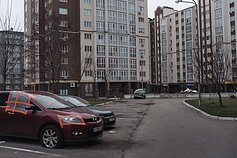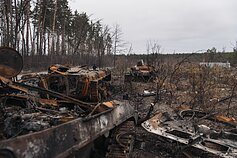












As Russians withdrew, people who had fled returned. They found their towns destroyed, their loved ones hiding in basements, bearing witness to executions and tortures. This is the story of occupation – about those who could return, those who were forced to stay, and those who had to endure and witness Russian detentions, humiliations, and killings.
Read the first and second parts of the story.
Serhii returned a day after his town had been freed. He was yet to learn the name Bucha would soon ring out as a shorthand for Russia’s crimes against Ukrainian civilians. Never a “special operation” and no longer just a war, the invasion is turning into what Ukrainians had feared all along – an attempted genocide, already recognised as such by parliaments in Latvia and Estonia. More countries are set to follow suit.
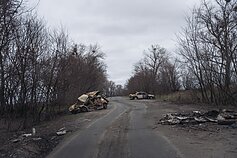
“At first, they didn't let us enter [Bucha] because there were so many dead bodies,” he recalls. “There was a bus full of dead bodies. Every five to ten metres, a car stood with open doors, dead people inside.”
“Those who left during the day, made it. In the evening it was already too late,” he adds. “When you saw cars shot at, with ‘children’ written on them, you understood.”
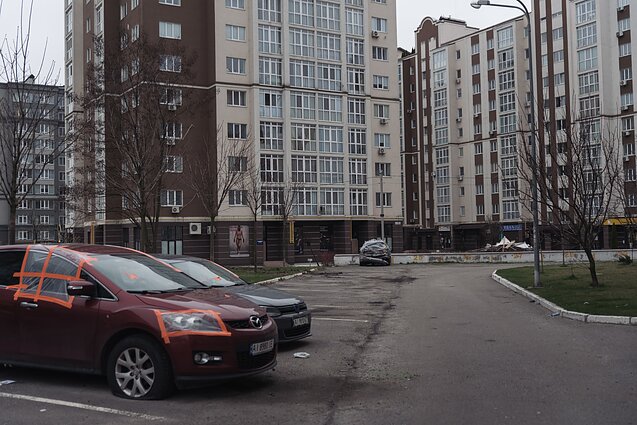
By mid-April, just several weeks after liberation, queues of people waiting to get back to Irpin, Bucha, and Borodyanka – the cluster of towns outside Kyiv that were the first suburbs to be occupied – stretched into hours. The Russians were gone.
Banality of evil?
Hannah Arendt, a journalist sent to cover the trial of Adolf Eichmann in Jerusalem, coined the term “banality of evil” to describe what she had witnessed. She found Eichmann neither inherently evil nor twisted. Rather, a grey bureaucrat and – abnormally – normal.
In Bucha, the violence against elusive Nazis became a massacre of civilians, the suppression of Ukrainians as a nation. Around the same time, an editorial published by Russia’s state-owned RIA Novosti agency laid out the genocidal necessity to destroy “a significant part of the masses”, dubbed by some as the “manifesto of Russian fascism”.
The killings around Kyiv followed a template of post-occupation repressions, including the destruction of grain silos and food warehouses, triggering in today’s Ukraine the embedded collective trauma of the Holodomor, the Soviet-made famine that killed millions.
At home in Russia, sedated masses were applauding their army.
“The new regime posed to us then nothing more than a very complex political problem, one aspect of which was the intrusion of criminality into the public realm,” Arendt wrote of Nazi crimes in the run up to the war. “In brief, what disturbed us was the behaviour not of our enemies but of our friends, who had done nothing to bring this situation about.”
Serhii and others in Bucha, as well as in towns and villages across Ukraine, reeled in in shock from their friends and relatives in Russia, who told them that they were being fired upon by “Nazis”; that there were no massacres. But already for years, they watched their close ones in Russia turn away from them, pulled into the omnipresent propaganda, which for almost a decade spewed hate against Ukrainians on TVs, in schools, and in the public realm.
“Hence the question addressed to those who participated and obeyed orders should never be, ‘Why did you obey?’ but ‘Why did you support?’,” wrote Arendt.
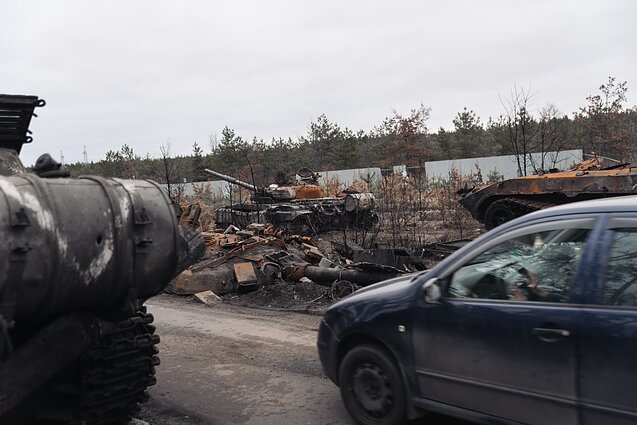
Was it this kind of evil, enabled by a decade of hate and carried out in cold, banal calculation? A process undertaken by the frontline troops with overt as well as tacit support of their superiors, or even families, at home, as intercepted phone calls reveal. A process that shed Russia’s façade to reveal an interior stuck in the 20th century. Or was it an explosion of pointless, mindless violence? One that would have little to do with bureaucratic “banality” of pre-planned exterminations, something that Arendt had observed in Eichmann.
The implausibility of Bucha violence induces a dissonance in your head, as you attempt to process the beautiful scenery, the spring colours, and the idyllic displays of life – such as the elderly tending to their gardens with the first spring warmth – unfolding next to open mass graves.
But it wasn’t only the Russian army that killed, or supported the killings.
“There were locals who spoke with the Russians and simply handed over their own people,” said Ilya, a 20-year-old student who spent the occupation sheltered in his Bucha home.
“I don’t know if they were paid for this or what. They said a person served in the ATO [war in Donbas], gave them the address, the Russians came and shot him without a word.”
He says he personally knows four people that have been executed. “They either put them in a car and took them away or shot them on the spot.”
On April 18, Russian President Vladimir Putin bestowed awards upon the butchers of Bucha, praising the 64th Motorised Brigade for “mass heroism and bravery”. As the unit received the upgraded title of a “Guards” brigade, bodies – many of them shot at point-blank range – were still being exhumed in the Kyiv suburbs.
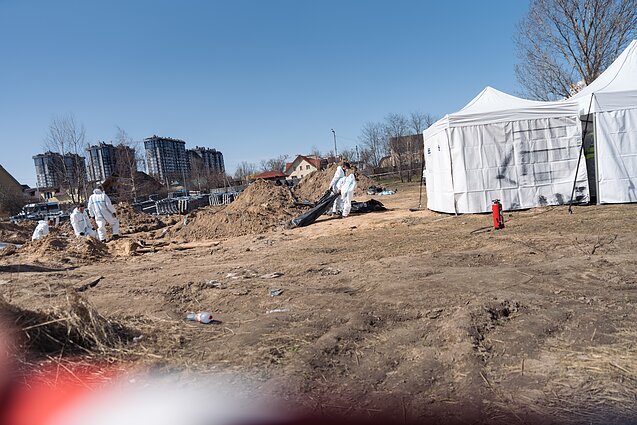
In the hot April sun, the smell of bodies intertwines with the stench emanating from heaps of rubbish piled nearby; alcohol bottles lie strewn on the side. People in white overalls are dragging body after body from the mass grave.

These volunteers have already been digging in shifts for the past week. They answer in brief, curt sentences. Those who have only just arrived to help, crouch down to smoke, staring into the gravesite, their voices suppressed.
No one could imagine this would happen, they say. “We didn't know that they would wage war against civilians,” adds Vitaly, one of the volunteers.
Ukrainian officials, with an entourage of reporters, arrive at the site. We watch from across a red tape the digging give way to interviews and a swarm of photographers. They are excavating with an international oversight, including from the world press, officials say, in an effort to counter disinformation from Russia.
Kremlin officials, backed by a sprawling propaganda network, allege that the killings were staged, using a mind-binding technique to ‘debunk’ videos that are fakes created by Russia in the first place.
In front of the mass grave, a police representative, Andrei Novikov, stands next to visiting American politicians. One of them holds a scarf to her face to dampen the stench.
“A mother and two children were buried here. They tried to leave, but were shot in the car while trying to flee,” Novikov lays out the details. “The father managed to jump out. The 34-year-old woman and two children, aged 4 and 10, were burned alive.”
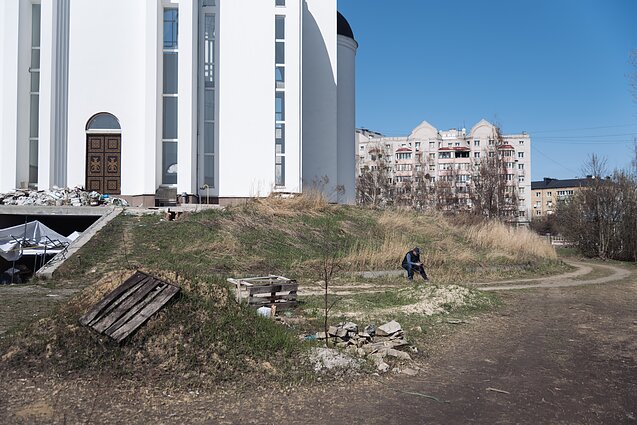
A few metres away, the mayor of Bucha, a twin town with Lithuania’s Palanga, watches the exhumations.
“The first grave contained 40 civilian bodies, all with gunshot wounds to the chest area and the back of the head,” says Anatoliy Fedoruk. “Another mass grave is being investigated, which is supposed to contain 56 bodies, some of which have already been taken to the morgue for examination.”
“Of the 53,000 inhabitants of the town, some 3,500 remained during the occupation. Practically one in five was shot by the Russian soldiers,” he adds.
By late April, Ukrainian officials say over 1,000 bodies have been collected from the areas surrounding Kyiv.
“I am extremely grateful that [Palanga mayor] helped our citizens at such an important moment. Today, as far as I know, around 90 Ukrainian citizens, also from Bucha, have found refuge in [Palanga],” he adds. “We will never forget this.”
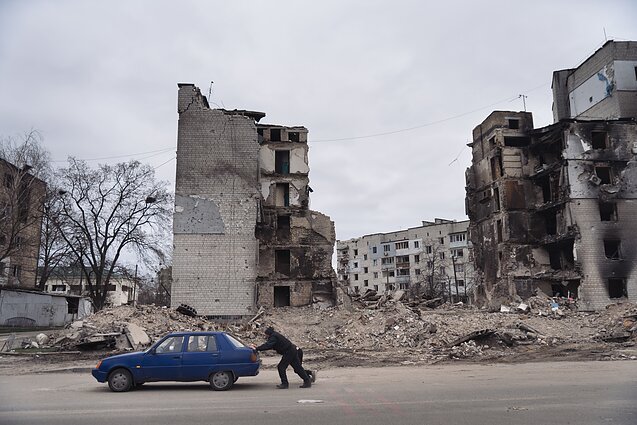
In Borodyanka nearby, scenes of destruction have also become centrepieces of political visits to Kyiv. In response, Ukrainian President Volodymyr Zelensky began calling for concrete support, saying the country should not become a prop for “tragic selfies”.
What was once a flashy neighbourhood, flanked with spas and expensive shops in nearby Irpin, is now submerged in debris. Around it, dust is being kicked up by reconstruction effort, hundreds of people with shovels in hand clearing away the damage.
Just several days in, the area is already open to traffic, roads and buildings have been de-mined, fragments of Soviet-era housing removed and private homes repaired.
Two men walking past are making their way home. “There's no work now, we used to work at a furniture factory. The only option is to go serve in the military,” one says. It’s a good option, adds his friend.
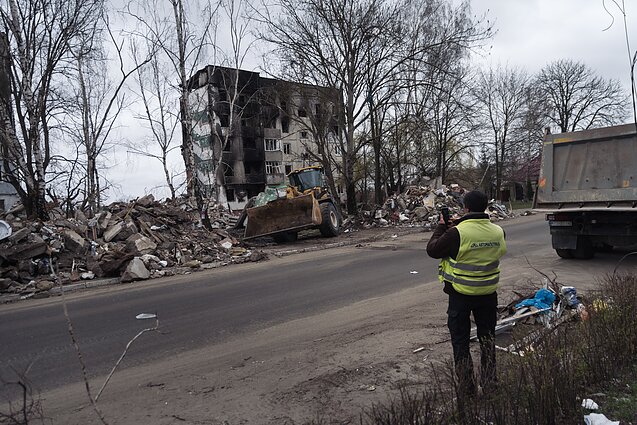
A woman, Vera Ivanova, waits for humanitarian aid in the town centre. Heavy machinery around her is lifting the remnants of a 12-storey building.
“On March 17, diedushka had a stroke as explosions got worse and worse. He died,” she says. “I have lived in Borodyanka since 1976, I was in my 20s when I came. Now I will be 66. I have lived here my whole life, these are our homes.”
Following liberation, a man was looking for his relatives. He shouted over the fence to Ivanova. “‘Have you seen my mother?’ I ask where was she? He says she should have been at the bomb shelter. Keep searching, I say,” recalls Ivanova. Many people got buried under the rubble, she adds.
After spending weeks without radio, television, or even mobile connection, she asks what is happening elsewhere around the country. “Where else is the enemy – Kherson and Kharkiv?” Also in Mariupol, we answer. She looks up in prayer.

‘Russian troops did a safari’
Humanitarian aid has been flowing to the liberated areas, but once there – it dilutes, as scarce resources end up being divided among thousands that need medicines and other supplies. Heating, water and electricity is yet to be restored.
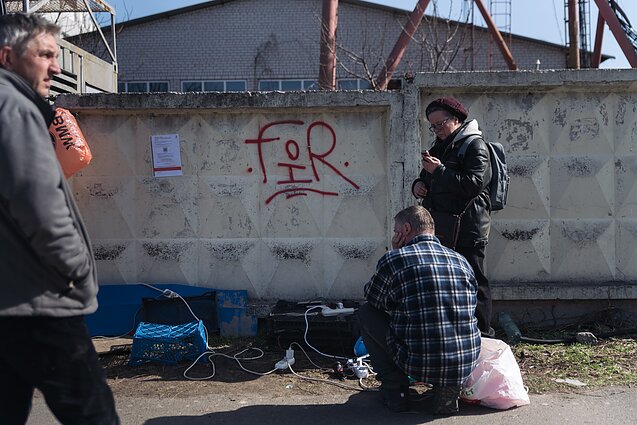
On the side of a road, a dozen people are charging their phones. The generator is filled up daily with petrol to allow people to reach their relatives, says one man.
Among those waiting for the phone to charge is Arina, a paramedic. She stayed in Bucha throughout the occupation.
On March 9, she started receiving calls from her patients, asking her how to treat gunshot wounds. “They said [the Russian troops] did a safari, started shooting at their feet to see who would run faster,” she says. The Russians were laughing, her patients told her, although the story is impossible to verify.
Others were killed on the spot.
She recalls details of the mass repressions, something which had been forewarned in a leak published by the Bild tabloid in Germany in the run up to the invasion. The report alleges that Russia was preparing concentration camps for Ukrainian activists, with secret services braced to unleash a wave of repressions modelled on the anti-regime protest putdown in Belarus. Later, the mayor of Bucha confirmed that the Russian troops had a list of people to kill.
The invasion plans laid out in the report came to fruition. Reportedly, Russia also established a “concentration camp” in the Kharkiv region, aiming to torture Ukrainian people into submission, according to Ukraine’s Ombudsman Lyudmyla Denisova. The claim, for now, is impossible to verify.
In Bucha, a glimpse of the bleak future under occupation played out in the weeks before the Russian military was pushed out of the Kyiv suburbs.
“They simply walked around and asked who you were. One woman said she worked in a nursery. They simply took her away and killed her,” says Arina. “They killed teachers, also doctors.”
“They said they were freeing us from Nazis”.
Text and pictures: Benas Gerdžiūnas
Video report: Augustinas Šulija

Newsletter
Every Friday morning.