















The number of Lithuanians emigrating to the United Kingdom, Norway and Germany has fallen in recent years, according to data from Lithuania's State Tax Inspectorate (VMI). At the same time, there are signs of a growing, if modest, trend towards so-called tax haven destinations.
Traditional destinations losing ground
It is worth noting that VMI figures reflect only the number of people who formally declared their departure to a given country in a given year – not the total number of Lithuanians living there. As both the State Data Agency and the Migration Department explained to LRT.lt, that broader data is held only by the authorities of the destination countries themselves.
Official Lithuanian statistics show that overall emigration has increased in recent years, most notably to Belarus and within the "other countries" category, while those choosing the UK, Norway and Germany have fallen.
VMI data tells the same story. Last year, 6,299 people declared their departure to the United Kingdom – a drop of 34% compared with 2023. Departures to Norway fell by 19% to 3,060, and to Germany by 24% to 2,653.
Indrė Genytė-Pikčienė, chief economist at Artea bank, noted that these countries have historically dominated Lithuanian emigration patterns.
"Beyond economic motives, their popularity has been shaped by language skills, cultural similarities, well-established Lithuanian communities, and the ready availability of practical information about settling there.

The primary driver, of course, is economic. Despite Lithuania's rapid income growth in recent years, the wage gap remains substantial. Lithuania ranks sixth from the bottom in the EU for hourly earnings in the business economy, roughly half the EU average, while Germany, the UK and the Nordic countries sit near the very top, well above it," she said.
She pointed to several economic factors that may have contributed to the decline in emigration to these destinations.
"Technological change is reshaping labour markets – automation, the pursuit of efficiency, and the growing influence of artificial intelligence on demand for highly skilled workers. These developed economies have also faced a more difficult macroeconomic environment, with sluggish growth persisting even after central banks began cutting interest rates.
This is largely structural – driven by a loss of competitiveness in the face of significantly cheaper imports from the Far East and China in particular," she said.

Evaldas Stankevičius of Kaunas University of Technology (KTU) linked the decline in UK-bound emigration specifically to Brexit.
"Free movement for EU citizens ended on December 31, 2020. From January 1, 2021, a points-based system has been in place – newly arriving EU citizens can no longer simply come and work as they once could. This is very likely a long-term factor in the decline," he said.

The falls in Norway and Germany he attributed to reduced pull factors. "Some of the earlier migration wave has already run its course, some people are returning home, and Lithuania's own labour market has become more attractive in recent years," he said.
The Poland factor
Among the VMI data, Poland stands out as the country that saw the sharpest rise in declared Lithuanian departures between 2023 and 2025 – up 49%, from 334 to 496.
While Genytė-Pikčienė cautioned against drawing broad conclusions from those figures – pointing out that only seven more Lithuanians declared departure to Poland in 2025 than in 2024 – the other two economists LRT.lt spoke to said the trend was worth watching.
"Poland looks like one of the more interesting developments. The numbers are not yet large, but the growth is notable. Possible reasons include geographical proximity, lower relocation costs, the convenience for those working in logistics, trade or services on a regional basis, and Poland's growing labour market and wages.
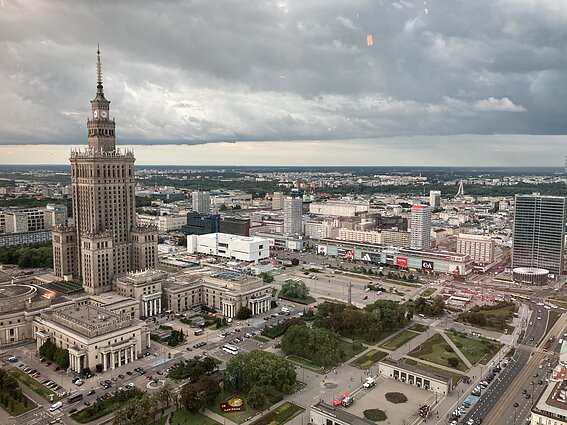
In 2025, the median gross salary in Poland was around 6,883 to 7,262 złoty – roughly €1,611 to €1,700 per month. Poland is no longer a cheaper alternative; it is increasingly a genuine labour market in its own right," said Stankevičius.
Marius Kušlys, economist at ISM University of Management and Economics, noted that while income levels in Poland are similar to those in Lithuania, the cost of living is lower.
"Poland attracts certain foreign investment and, given its size, has more to offer ambitious professionals. We are talking about people who feel there is simply not enough room to grow in Lithuania," he said.

The wealthy choose tax havens
Among the more striking details in the VMI data are the declared departures to low-tax jurisdictions. The number of Lithuanians declaring their move to the United Arab Emirates, for instance, has grown by roughly 10% each year, reaching 283 in 2025.
The UAE levies no federal income tax on individuals and charges businesses a nine per cent corporate tax above a set threshold.
Nerijus Nedzinskas, managing director at PricewaterhouseCoopers, said it is wealthy Lithuanians who tend to opt for such destinations.
"People who are completing large transactions – selling businesses, trading in securities – can choose where to be resident," he told LRT.lt.

Stankevičius of KTU urged perspective, however. Even combining declared departures to the UAE, Cyprus, Malta, the Netherlands Antilles, the British Virgin Islands, the Bahamas, Panama, Monaco, Singapore and the Isle of Man, the total comes to around 600 declarations in 2025 – just 2.2% of all departures.
The economist suggested that while some of these exotic destinations may well be linked to tax planning, particularly among higher earners or those with international business interests, the scale of it suggests this remains a niche phenomenon rather than a mainstream trend.
Nedzinskas added that proximity is also a factor in destination choice.
"Yes, people do choose the Netherlands Antilles or the Virgin Islands or Thailand. But closer options are growing in popularity too – the UAE, Portugal, Spain. The exotic islands are attractive, but they are far away and can be inconvenient. The UAE or Portugal are much closer and easier to get to," he said.

Kušlys agreed that the phenomenon is unlikely to become widespread.
"We are talking about dozens of individuals. It will never become a mass trend, because it involves real costs – and the benefit only outweighs those costs when the income is substantial. These are people with large earnings and businesses operating across multiple countries, for whom declaring residency abroad and saving on tax actually makes financial sense," he said.

Newsletter
Every Friday morning.