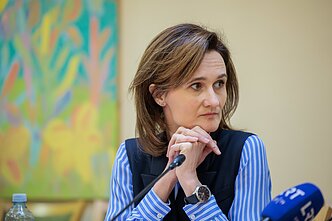
















Lithuanian Prime Minister Inga Ruginienė said Tuesday that Lithuania made a strategic mistake by allowing a Taiwanese representative office to open in Vilnius under the name “Taiwanese”, arguing the move was not coordinated with the European Union or the United States and led to a sharp deterioration in relations with China.
“I think Lithuania really jumped in front of a train and lost,” Ruginienė told BNS in an interview.
She said that while other European countries host Taiwanese offices, they did so after coordination and by using the name “Taipei Representative Office”, allowing them to maintain working relations with Beijing.
“That was probably Lithuania’s big mistake – thinking that if we acted on our own and did something first, the world would suddenly appreciate it,” Ruginienė said. “We tried it, we have the Taiwanese office, but the world did not appreciate it. No one appreciated it.”
According to the prime minister, Lithuania’s approach toward China should be based on a unified European position and a clear focus on national interests.

“If we are shaping relations or plans, our country’s interests must be the number one priority – what is beneficial for Lithuania and its people,” she said. “If it is not beneficial, why run alone, detached from the entire European Union, down a path that leads nowhere? This example showed that international relations require a different tactic.”
Relations between Vilnius and Beijing have remained strained for several years, with both sides unable to agree on restoring diplomatic representation following the dispute over the Taiwanese office’s name. Since mid-May last year, there have been no accredited Chinese diplomats or other staff members in Lithuania.
In June, then-Prime Minister Gintautas Paluckas said a proposal to restore relations had been submitted to China, but no response has been received.
Following a change of government, Ruginienė’s cabinet program includes a commitment to restore diplomatic relations with China to the level of representation seen in other EU member states.
“Turning the clock back is a very complicated process,” Ruginienė said. “If we manage to align certain elements at a technical level, step by step, as outlined in our program, we see a real possibility to normalise relations. That does not mean we will suddenly embrace each other.”
She said Lithuania has begun taking “small first steps”, including correspondence with Beijing, but stressed that any effort to normalise ties must be coordinated with the EU and the United States.
“After relations were damaged and ties were completely cut, normalising them requires a very difficult and long path,” Ruginienė said. “Restoring what was destroyed is extremely challenging, but we are gradually moving toward not being enemies, but at least having more normal, technical working relations.”
President Gitanas Nausėda previously said restoring relations with China requires willingness “from both sides”, while warning that Lithuania sees risks in overly close cooperation with Beijing. In an interview aired Tuesday on Žinių Radijas, he compared China’s role to that of Belarus, saying Beijing enables Russia’s actions in Ukraine and that excessive dependence on China has already caused problems for Europe.

Newsletter
Every Friday morning.