

Valdemaras Klumbys, a senior researcher at the Lithuanian History Institute, writes a three-part opinion article about the growing polarisation in society and how domestic propaganda is becoming more dangerous than Russian narratives. Below is the first installment, and the original article (in Lithuanian) is available here.
Kremlin’s propaganda, which is talked about the most, does not seem to be very effective – only 7 percent of voters opted for Eduardas Vaitkus in the presidential election, and openly pro-Russian ideas are only spread by marginal political figures.
Of course, these trends need to be monitored, the reasons for the spread of such ideas examined, and they need to be countered, but they do not pose the greatest threat to Lithuania.
For a long time, a significant amount of attention and effort in Lithuania has been devoted to strengthening society’s resilience to hostile propaganda, with a constant emphasis on developing people’s critical thinking.
When one looks at what is actually being done, it becomes clear that what is most often cultivated is not critical thinking, but a critical attitude toward hostile propaganda and the ability to detect it.
However, this is not critical thinking, but simply the strengthening of one’s own propaganda.
After all, critical thinking means a critical attitude toward all information, including that provided by one’s own side, the ability to disagree with like-minded people’s claims, and to criticize allies.
The increasingly widespread demands for absolute unity in society, the treatment of any differing opinions as hostile or harmful, the application of labels, and the simplification of complex issues also point precisely to a lack of critical thinking. And they testify to the growing dominance of propagandistic thinking.
It is precisely the spread of this kind of thinking in Lithuania at present that poses a greater threat than Kremlin propaganda, because it causes far greater harm to society than the latter.
It is ironic (but inevitable) that propagandistic thinking is nurtured by our own propaganda and agitation, which takes shape in the fight against Kremlin narratives and influences.
Its emergence does not require any special state policy ≠ when threats increase, society naturally prepares for defence and strengthens its “immunity.”
At first glance, such domestic propaganda seems harmless. On the contrary, it appears necessary in the struggle against hostile influences. Even if it does not seem to strengthen critical thinking, at least it weakens Russia’s influence.
All the more so because the propaganda operating in Lithuania is not the kind we usually imagine when we hear this word – the sort of propaganda disseminated in an organised way by (usually undemocratic) state propagandists. This is done with centrally defined goals, directions, and selected means, completely dominating the public sphere, with instructions coming “from above” on how to evaluate things, what may be discussed, and which topics must be kept silent.
Nor do such key elements of classical propaganda as state censorship and punishment for deviants exist in Lithuania.
When propaganda takes hold in the public sphere, it does not necessarily involve coercion or visibly obvious repression. Nor is there a need for a state or any other structure to issue orders.
Participants in the public sphere simply know how one is supposed to speak, which evaluations are better to present, and what is better left unsaid. They know this because they already live in propaganda and have absorbed its rules.
Some do not even notice it, others adapt, still others simply take advantage of it, and there are also those who resist.
We may rejoice that propaganda increases resilience (although, as we will see, it also weakens it).
But here lies the problem – commendable goals do not eliminate the method by which they are pursued: a person gripped by propaganda becomes unreceptive to any ideas that do not conform to the propaganda that has taken hold of them. Those ideas do not necessarily have to be hostile; it is enough that they simply do not fit into the picture of the world (if you like, the matrix) created by propaganda.
It is also very rarely remembered that propaganda affects all societies in the same way regardless of their political systems or declared goals. That is, the results of democratic, anti-totalitarian propaganda are the same as those of dictatorial or totalitarian propaganda.
I do not mean what the propaganda proclaims (ideology, ideas about state greatness, the dictatorship of the proletariat, or mandatory inclusivity), but precisely the changes in society.
Therefore, I will focus on how propagandistic pressure functions and what the main (by no means all) results of its impact on society are.
I emphasise that I have singled out troubling trends related to certain topics, not everything that is discussed in the public sphere. I will also not address social networks – by locking people into bubbles of like-minded individuals, they actually destroy the deliberative public sphere and therefore do not belong to it. It is still shaped more by traditional media and major news portals.
One consequence is the dominance of propagandistic thinking.
Thus, the not-yet fully formed classical deliberative public sphere in Lithuania is being displaced by an agitational public sphere, where arguments are irrelevant and only propaganda and agitation matter – tireless dissemination and support of the single correct (of course, one’s own) opinion without any reservations or concessions, accompanied by a constant search for enemies and their exposure.
The most visible and increasingly discussed result is the division of the world into black and white, leaving no room for any shades of gray. How could it be otherwise if the impact of hostile propaganda is constantly emphasised and its agents are sought within Lithuania?
“Whoever is not with us is against us”, a slogan beloved by the Bolsheviks after the revolution, perfectly reflects the essence of any propaganda. Our agitators usually do not speak so openly yet, but this is the logic of propaganda, which demands an either-or choice.
Thus, society becomes polarised, if we use the term popularised by Ainė Ramonaitė. This increasingly entrenched way of thinking is also evidenced by the troubling situation in the public sphere (not to mention social networks).
Even in traditional media, there is a growing amount of speaking in a patriotic unison, blunt agitation, where it is simply indicated how it is correct to think and speak, what must be condemned and what should be supported, instilling a sense of righteousness and hatred toward opponents/enemies.
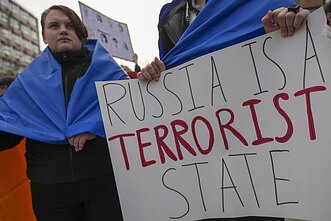
It is natural that propaganda becomes particularly pronounced when the discussion turns to Russia. It is evil, therefore its culture is also an instrument of evil, and thus Russia’s – Russian – culture must be fought as well.
Everything is very logical – propaganda in general loves “logic”. Under existing circumstances, there is only one logical step, and no other is possible.
For example, the media widely and uncritically cover the inadequate indignation of musicologist Lina Navickaitė-Martinelli over concerts by Russian performers in Lithuania. Inadequate because her indignation is caused solely by the fact that they are Russians.
The Constitution clearly prohibits discrimination on the basis of nationality or citizenship, but agitators seem to think otherwise.
Writing “russia” with a lowercase letter or calling it “Muscovy” is not much different from Russian propagandists’ favourite designation of Ukraine as “state 404,” meaning nonexistent.
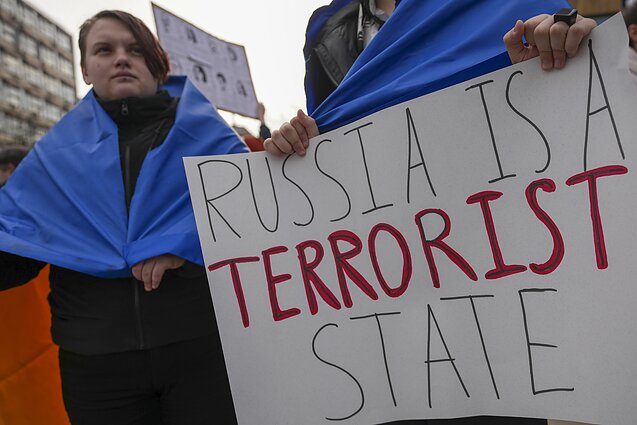
This is just one of many examples of how our “democratic” propaganda does not differ from the Kremlin’s dictatorial one.
Such thinking does not remain on the level of ideas; it affects very concrete decisions. A few months ago, it emerged that our border guards are returning Russians fleeing military service from the Kaliningrad region back to Russia.
Anyone who has followed the war in Ukraine even slightly has long known that in Russia, conscripts are “encouraged” by all kinds of means to sign contracts with the army (those who do are immediately sent to the front).
And these “encouragements” can take many forms: from persuasion to threats, psychological abuse, and outright physical torture. Such recruitment is an important source that allows Russia to maintain a non-shrinking army in Ukraine despite enormous losses and thus sustain a constant tempo of offensives without mobilisation, which Putin is clearly avoiding.
And Lithuania, it turns out, supports such efforts by the dictator. After all, returns mean that those who were thinking about fleeing abandon such plans. By the way, it is possible that those returned are condemned to punishment or even torture – after all, fleeing to an enemy country means betraying the motherland.
Did this moral blindness of Lithuanian officials provoke outrage among supporters of Ukraine? I have not heard of it; as far as I understand, this policy continues to this day.
From the standpoint of common sense, supporting Ukraine and Russian opposition figures while at the same time returning to Russia people fleeing the war (which opposition figures, incidentally, urge to be done) and thereby weakening its military power seems foolish; from a moral standpoint, hypocritical.
The reason for such irrational behaviour and moral deafness is propaganda. The image it spreads of the Russians as inevitably evil determines that the usual standards do not apply to them. And common sense does not apply in this case, because the logic of propaganda is at work.
In other words, the dehumanisation of enemies – Russians – is taking place.
This is also served by the frequent use in the public sphere of “maskoliai,” “ruskeliai,” “ruskiai,” and various other contempt-promoting epithets. Do they, in our propagandists’ view, strengthen the resilience of Lithuania’s population? I am inclined to doubt it, but they undoubtedly fuel ethnic hatred.
And, frankly, I understand those Visaginas residents who vote for pro-Russian candidates. When you are treated as if not an enemy, then at least suspicious and unreliable because of your nationality, when your nationality is constantly insulted publicly, it cannot fail to provoke a reaction in return.
People simply begin to look for politicians who claim to defend them. And this is where influencers and politicians appear who repeat Putinist narratives about the persecution of Russians in the fascist Baltic states. Only they seem to be defending simple national dignity.
This can encourage even Russian citizens of Lithuania who thoroughly disliked Putin to change their views. Thus, Putinist narratives can gradually take hold in the minds of such offended people.
And this, in turn, further increases hostility among Lithuanians (“they vote for those who openly support Putin!”), which in turn increases Russians’ alienation – a vicious circle starts spinning, and confrontation and polarisation grow. In this way, a previously quite loyal Russian national minority may become less loyal.
How does the public broadcaster LRT behave under such sensitive conditions? It publishes the recollections of a person who no longer lives in Visaginas and has not even been there for quite some time, recalling the Soviet period and the time of the restoration of independence, focusing on the hostility of Russians toward Lithuanians in that city back then.
The article is not an interview, so it ostensibly should meet journalistic standards. However, it recounts only one opinion and the arguments of only one side. For me, as a historian, these recollections are an interesting source.
As in all memoirs, there are contradictions in them. For example, if there was such great ethnic hostility, why was equipment for establishing a Lithuanian school sought at the nuclear power plant? After all, it was staffed almost exclusively by Russians.
I do not in any way accuse the person remembering, nor do I claim that she lied – all people remember subjectively and inaccurately. Moreover, I believe that the events described did indeed take place. During the Soviet period, people who arrived from the USSR often really did feel like masters, and during the restoration of independence, ethnic tensions and even hatred in eastern Lithuania truly were significant.
But where is a more detailed look at the later decades? Why are only anti-Lithuanian actions recounted – were there really no others?
If there was such enormous Russian hostility toward Lithuanians, how did the woman recalling these events receive the title of Honorary Citizen of the city of Visaginas, where the majority of residents are Russian-speaking (Lithuanians make up about a quarter)?
Why, after all, were radicals not elected in this city, unlike in Klaipėda? Why did the journalist not bother to find out the opinion of Russian-speaking residents of Visaginas? Why was there no attempt to delve into the processes taking place in Visaginas, to speak with experts from various fields? Where is even minimal analysis?
What we have is an article that stirs ethnic tensions, if not hatred, whose title itself scares readers in a purely propagandistic way: “We missed the time to improve relations.” So what should be done – dig a ditch around the city and fill it with crocodiles?
By the way, this article demonstrates that stirring suspicion, distrust, closed-mindedness, intolerance, hatred, and xenophobia can be done not only in a crudely blunt way that is done by the populist Remigijus Žemaitaitis. It can also be done more subtly, without insults.

And this is a much more effective path, because it does not repel people for whom insults are unacceptable. I believe that the journalist did not consciously aim for this, but this is how propaganda works.
The article in question completely fails to meet journalistic standards, yet it is an excellent example of propaganda. It tells of unpleasant experiences that provoke the reader’s indignation; they are told by a woman who is easier to sympathise with, moreover, a teacher, a school principal – a person with authority – which increases trust in the narrative.
And thus the article becomes an effective tool of agitation: by arousing fear, it in fact strengthens Lithuanian cohesion.
But here lies the problem: not only ethnic Lithuanians live in Lithuania, and it is precisely the responsibility of the dominant nation to prevent ethnic discord from growing stronger. This is especially important when living in such a tense situation.
Moreover, such an approach pushes Lithuanian residents of non-Lithuanian origin out of traditional media: what Russians would enjoy listening to talk about “ruskies,” the need to ban Russian culture, and the like? Does traditional media even delve into the problems of ethnic minorities, or does it reflect the difficulties faced by Russian-speakers after 2022? What is being done to retain Russian-speaking readers?
Texts and programmes that openly address painful topics would have a greater impact; perhaps even some who hate the authorities would slightly change their views. But most importantly, the silent majority would hear about their problems in traditional media rather than in various pro-Russian information channels that cultivate only hatred.
At the same time, such texts would reduce propagandistic fragmentation in society, because they would allow Lithuanians, instead of seeing alien “Others”, to see various people who have quite justified grievances and dissatisfactions.
Russian-speakers themselves simply do not dare to raise even slightly sharper questions because of the pressure of our propaganda – it is very easy to accuse them of disloyalty and other sins.
The same applies not only to ethnic minorities, but also to other less-heard groups in society. If they do not hear their voice in traditional media, they can easily find bloggers and politicians who speak about the silenced problems – one should not be surprised if these turn out to be mouthpieces for Putinist narratives or populists like Žemaitaitis.
And it is difficult for traditional politicians to offer a more nuanced picture and narratives that take into account the interests of various minorities: minorities may not be tempted, and some of one’s own supporters may turn away.
Unfortunately, when propaganda has already written off in advance everyone who thinks even slightly differently than “required”, this means that the battle has already been lost.
I would advise listening to the data repeatedly presented by Ramonaitė, showing that the “Vilnius bubble”, which is precisely what shapes our propaganda, is very small.
Thus, if the same prior dismissal of all dissenters continues, our propaganda will simply lose, without any need for Russian interference.
I can already imagine the thoughts of some readers: it is no coincidence that this article appeared at such a time, Klumbys has joined in discrediting LRT, and also supports politicians’ desire to control the public broadcaster. He also defends Russian culture – basically some kind of “vatnik”.
However, in the current situation of pressure on LRT, I must emphasize that any attempts by politicians to interfere in the activities of the public broadcaster or to restrict journalists’ freedom of action have never led to anything good and are simply harmful.
But such attempts also cannot be an indulgence that prevents criticism of shortcomings in journalists’ work – without criticism, development is impossible.
I will not write more arguments as to why I am not an enemy, because attempts to argue or explain things to a person gripped by propagandistic thinking are ineffective: a different opinion is automatically rejected, and its author is attributed all the traits of an enemy.
Some may not even have read the article this far, because they immediately sensed that it was “hostile scribbling”.
Propaganda that unites people by dividing the world into black and white very easily manufactures enemies – it is enough to step even slightly away from the propagandistic narrative, and accusations begin to loom. Some of those who experience this respond with reciprocal hostility and seize upon corresponding ideas.
Propaganda becomes even more threatening when patriotism is added to the us-versus-them division. But more on that another time.

Newsletter
Every Friday morning.