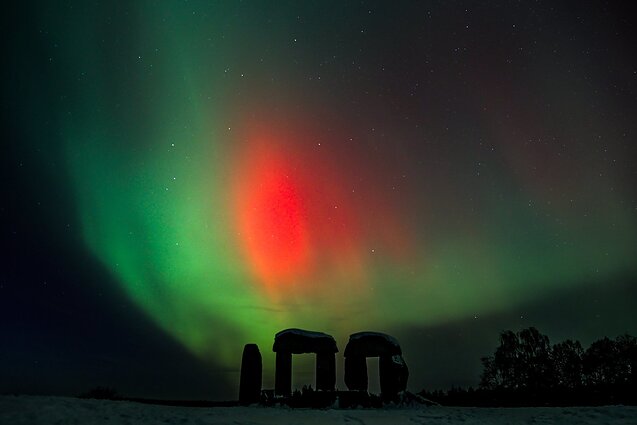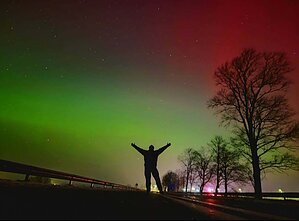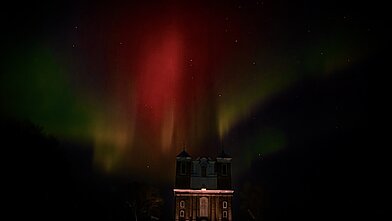













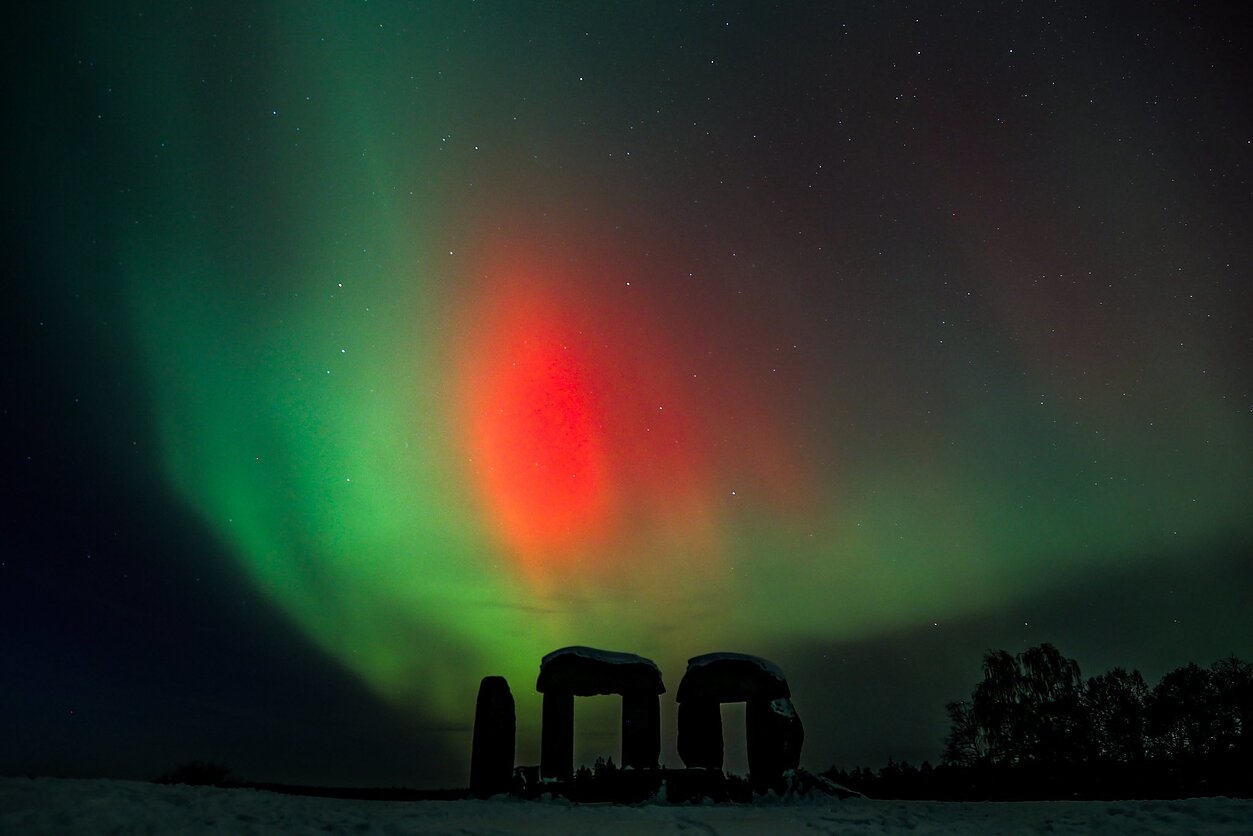
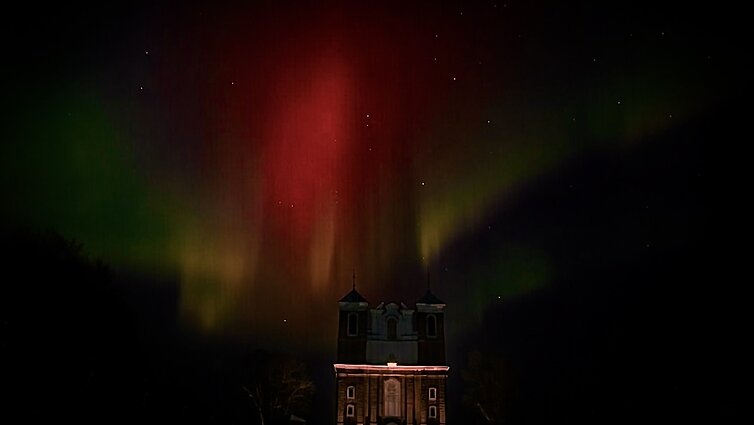
Colourful northern lights illuminated Lithuania’s skies overnight, prompting residents to share photos on social media showing the night sky glowing in shades of green and red.
According to SpaceWeather.com, Earth’s magnetic field on Monday was hit by a stream of charged particles from the sun known as a coronal mass ejection, or CME. The impact triggered a very strong G4-level geomagnetic storm.
Geomagnetic storms are classified on a scale from G1, the weakest, to G5, the strongest.
The colour of the aurora depends on which atmospheric gases are excited by charged particles and at what altitude. Oxygen produces greenish-yellow or red light, while nitrogen emits blue hues.
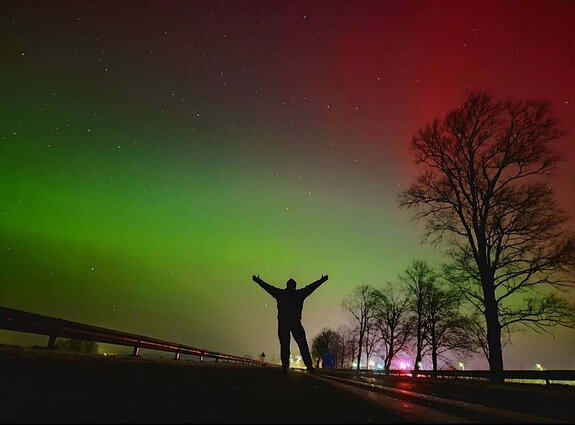
When electrons collide with oxygen above about 240 kilometres, reddish tones are visible; at altitudes of roughly 97 to 240 kilometres, green colours dominate.
This event was notable for the speed of the CME, which travelled from the sun to Earth in about 25 hours, far faster than usual. By comparison, most CMEs take three to four days to reach Earth.
With an estimated speed of about 1,660 kilometres per second, the CME ranks among the fastest few percent observed over the past 30 years, SpaceWeather.com said.
Since the launch of the Solar and Heliospheric Observatory, or SOHO, in 1995, its instruments have recorded thousands of CMEs, most of them slower than 1,000 kilometres per second. The fastest CME on record, observed July 23, 2012, reached speeds of 2,900 to 3,500 kilometres per second.
Northern lights are typically visible near the polar regions, but they can be seen at lower latitudes, including Lithuania, during periods of heightened solar activity. The sun operates on roughly 11-year cycles, during which activity rises and falls. As solar activity increases, sunspots and solar winds become more frequent, raising the likelihood that charged particles and CMEs will reach Earth.
Although the peak of the current solar cycle was reached in August last year, aurora activity is expected to continue. Vilnius University astrophysicist Vidas Dobrovolskas previously told LRT.lt that the current cycle has been 20% to 25% stronger than forecast.
“Compared with last year, the probability of seeing auroras will gradually decrease through the end of the decade,” Dobrovolskas said. “Because auroras can only be predicted a few days in advance, it is not possible to speak about specific dates. However, both this year and the coming years are still considered a period of increased solar activity, so we will certainly see auroras again.”
The next minimum in solar activity is expected to occur in 2030–2031.

Newsletter
Every Friday morning.