












Plans to establish a new military training ground in southern Lithuania have met resistance from local residents. Government and military officials are trying to assuage their concerns, while claiming “misinformation” is what’s fuelling fears about environmental and health hazards.
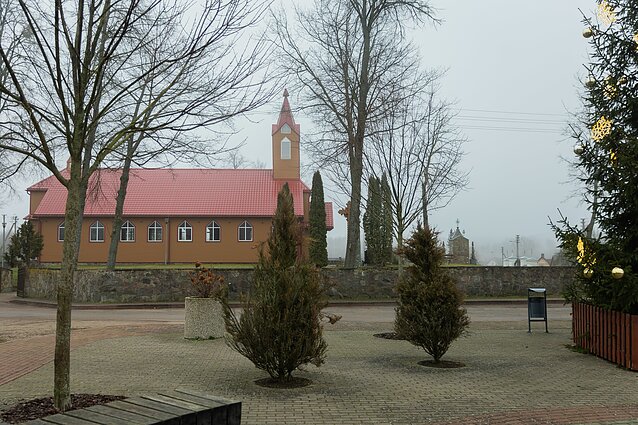
The State Defence Council decided December 15 to establish a new military training area in Kapčiamiestis. The location is in the southern tip of the country, close to the Belarusian border and the crucial Suwalki Gap that connects Lithuania to Poland – and the Baltic states to the rest of NATO.
However, the decision was not welcomed by the Kapčiamiestis locals. Although less than a month has passed since the decision, tensions have already flared up. President Gitanas Nausėda is expected to visit Kapčiamiestis next week, while a large delegation from the military and the Defence Ministry are visiting it Friday night.
A meeting held in Kapčiamiestis last month between ministry and military officials and residents failed to dispel concerns. Community representatives said many questions remained unanswered, including whether Lithuania needs another training area at all, why Kapčiamiestis was chosen and what alternative locations were considered.
Officials have promised more detailed answers at Friday’s meeting, including how the military would integrate into the area and what changes residents could expect.
The planned training area would be divided into two sections by a road. The eastern part would be used for manoeuvre exercises without live fire, allowing residents and businesses to continue operating there. In some places, the boundaries of the training area have already been adjusted.

Several firing ranges are planned in the western section, raising safety concerns if residents remain nearby. Officials say the ranges would be built in areas where forest has already been partially cleared and that protected natural areas would not be affected.
Only a small number of residents may need to relocate, with the ministry pledging fair compensation for any land or homesteads acquired.
“This would be a minimal number of homesteads,” Lt. Col. Aurius Daškevičius said. “We understand how sensitive this issue is and how painful it can be for people, but we will seek compromise and respond to expectations so that the number of property owners affected is as small as possible.”

Kapčiamiestis community chairwoman Raminta Karauskienė said information presented by officials has changed in recent weeks.
“What we are hearing now differs from what was said publicly before Friday’s meeting,” she said. “We now hear that the training area will likely be divided – about 40% for firing ranges and 60% as a training territory. Three weeks have passed, and we see that the information has changed.”
Military analysts say misinformation about the project is spreading and fuelling anxiety among residents.
“There are claims that all forests will be cut down, that the entire training area will be cleared, or that there will be no training area at all – just forest cleared and sold for profit,” said Auksė Ūsienė, an analyst with the military’s Strategic Communications Department. “There is also manipulation of historical memory and even comparisons to January 13 [1991], with claims that firing ranges will be near homes and harm residents’ hearing.”

State-owned forests were cited as a key reason for deciding to double the size of the Tauragė training area by expanding it into Jurbarkas district, where officials say there is no private land and all territory consists of state forests. The location is also considered strategically important due to its proximity to the Kaliningrad region. Near Viešvilė, the training area would expand by nearly 3,000 hectares.
“This expansion also helps us act as a deterrent, because it allows us to discreetly concentrate larger forces if it became necessary to repel potential aggression,” said Armed Forces Commander Raimundas Vaikšnoras.
Residents attending the meeting in Jurbarkas earlier this week expressed mixed views.
“There are positive aspects for plants, but for animals it is a disturbance, especially for capercaillies,” one resident said.
“Maybe a training area is more important than mushrooms and berries,” another attendee said.
Others complained about existing noise and access restrictions, while some dismissed concerns outright.
Several hundred soldiers would train at the new range at a time, taking part in manoeuvre and tactical movement exercises. The Defence Ministry says the project would create opportunities for local businesses and has pledged increased funding for infrastructure.
“I cannot name exact amounts right now, but it should be around 30 million euros over a certain period for infrastructure development,” Defence Minister Robertas Kaunas said.

Jurbarkas district Mayor Skirmantas Mockevičius said funding is expected for roads, health care and other infrastructure in both Jurbarkas and Pagėgiai districts.
Pagėgiai district Mayor Vaidas Bendaravičius urged officials not to overlook municipalities bordering training areas, noting that promises made in 2024 during the establishment of the Tauragė training area have yet to be fulfilled.
“We have concrete plans and funding sources identified for road paving,” Kaunas said. “Things will definitely move forward.”
A final decision on expanding the Tauragė training area is expected to be taken by the parliament, Seimas, Seimas during its spring session.

Newsletter
Every Friday morning.