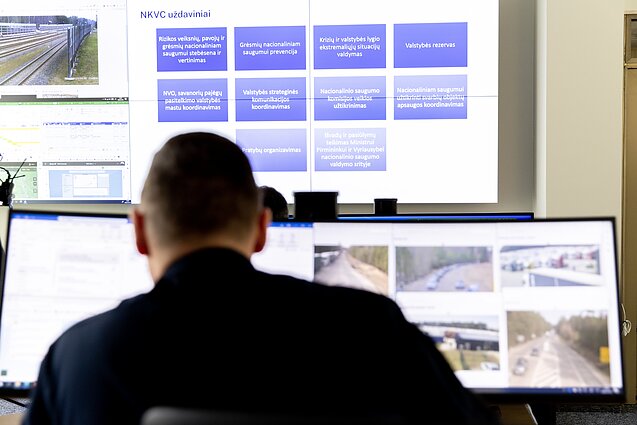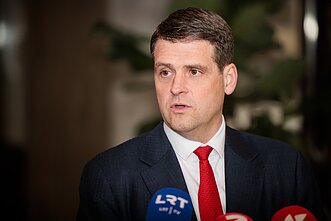












In an interview, Darius Buta, chief adviser at the National Crisis Management Centre (NKVC), gives a glimpse into the efforts to manage crises in the country – from war preparation to dealing with natural disasters and simple weather storms.
What does work at the National Crisis Management Centre (NKVC) look like?
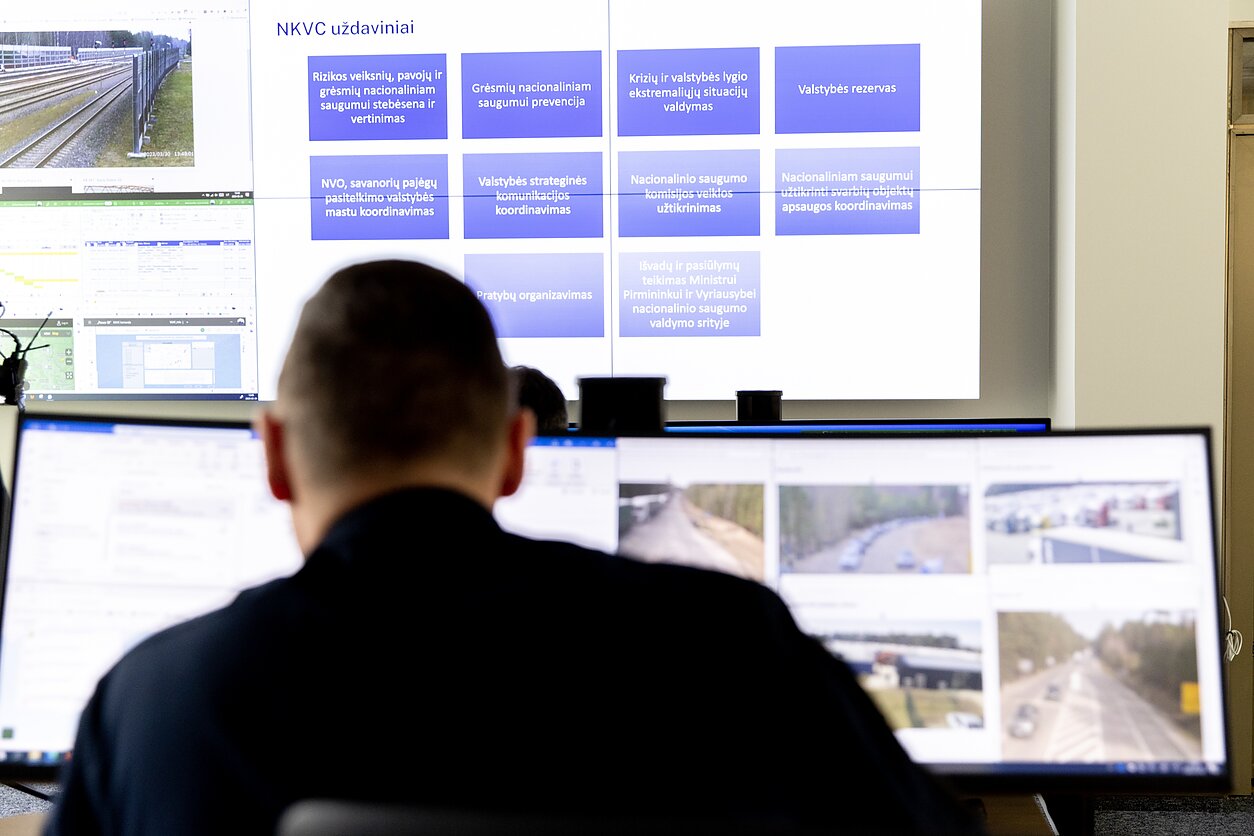
We began operations on January 1, 2023. Before that, there was a Threat Prevention Group within the Office of the Government. When setting up the centre, we assessed the experience of various countries, including Finland, the United Kingdom, and Israel.
In critical situations, it is vital that even if someone panics or does not know how to act, people’s lives and property are protected, and instructions are followed.
We are not a militarised state. In a crisis, people might say: “I will only perform my functions and nothing more.” But in critical situations, you have to do more. Administrative authority, however bureaucratic it may sound, is necessary in such cases.
The centre provides a lot of information to the media about major events – from floods to evacuations from hotspots. Is there a risk in the media becoming too close to state institutions?
The centre is not an institution that usurps the work of others. We do not aim to do everything ourselves or influence institutions that are already working well. The priority is that people stay alive and property is protected. Our main role is coordination.
Communication is one of the tools for managing crises, sometimes the main one. At times, you cannot do much, for example, during a natural disaster. But you can warn people in advance and tell them what to do. It is important that institutions do not issue conflicting recommendations.
Imagine a war situation, where there is an evacuation from one municipality to another, and mayors give different instructions: Vilnius says go to Šiauliai, but Šiauliai says it cannot receive people. Who should people listen to? Our task is to ensure the state acts in a coordinated way so that lives and property are protected.
Almost anything can become a crisis: floods, smuggling balloons, Lithuanians stranded abroad. How do you define a crisis?
This may surprise you: Lithuania has almost no crises. Legally speaking, an incident may qualify as an emergency event, which can escalate into an emergency at the municipal level, or at the national level if it affects two or more municipalities.
A crisis is declared only if existing resources and measures are insufficient to manage the emergency. At present, there are around five emergency situations in Lithuania, but none has been declared a crisis.
One such situation was declared a long time ago and is linked to landslides on Gediminas Hill in Vilnius. Others relate to natural phenomena, one to instrumentalised migration, and another to an attack from Belarus [using smuggling balloons].
Crises can be caused by people, by nature, or – most dangerously – deliberately by people. I would say quite openly that such crises are often triggered by our adversaries beyond our eastern borders.
These are the most dangerous and the hardest to predict. That is why coordination with services, intelligence and international partners is crucial, as they can warn us in time about potential threats.
We see what is happening across Europe, particularly in countries supporting Ukraine. Since 2024, Russia has begun kinetic operations in Western countries; there have been injuries, arson, acts of sabotage. These are the situations where the most preparation is needed to avoid consequences.
Russia’s involvement can be difficult to prove and takes time. What can we say with certainty today?
It is not that difficult to prove. As the saying goes: if it looks like a duck, quacks like a duck and walks like a duck, it is probably Zakharova [the Russian foreign ministry spokesperson].
We have seen the IKEA arson attack and the self-igniting parcels from DHL. Our law enforcement and intelligence services work very well with international partners, and these cases are already in court. We know the methods used to recruit people, including minors.
We may not know every detail because of ongoing investigations, but it is quite clear who is behind it. Even with the DHL parcels, the media have already identified those responsible.
Russia’s intentions are clear: to reduce support for Ukraine among states, citizens and NGOs. At the same time, the aim is to weaken the will to resist, undermine trust in institutions, and promote an idealised image of Russian culture and traditions.
[...] British researchers studying behaviour in crises have found that people are far less likely to panic than we think.
People act to save themselves, their loved ones, their animals and their property. The worst thing you can say is “Don’t panic” – it can make people feel they should start panicking. Instead, people need guidance that encourages them to act in ways that protect themselves and others.

In crises, institutions must be the first to provide information, so that disinformation does not mislead the public. As the saying goes, if you do not speak, others will speak for you.
If a crisis is caused by hostile actors and accompanied by disinformation, and the state does not communicate first, there will be serious problems. The approach developed by these researchers is based on transparency: the state should say what it knows, what it does not know, and what it is doing to change the situation.
For example, in an evacuation, people need to know where to go and how to get there. You may not know everything, but you can plan and clearly tell people when and where further information will be provided. We are now seeking to formalise this approach through a government resolution.
Many people are concerned about military threats and are discussing how to prepare. Is it possible to prepare?
We say people fear war, but look at how much property is being bought. I am not sure if that is the best indicator, but how many people are truly afraid?
We have experienced occupation, we know how to resist, we have a partisan history, and we know how we tore apart the Soviet Union. If necessary, we will tear it apart again.
As for preparedness, Vilnius municipality and the Ministry of National Defence have issued excellent guides on how to prepare for Day X [an invasion]. The Fire and Rescue Department and the Interior Ministry also provide information. There is the website LT72.lt and a mobile app, which people should use. Residents of Vilnius can also use the Kovas app.
Have there been cases where social media messages could have had dangerous consequences?
Every day. There are three main criteria for assessing disinformation: the target, the source and the context.
For example, if someone claims that tanks in Belarus are moving toward Lithuania, we need to ask where this is being shared. Is it on a Telegram channel with 800 pro-Russian users, or is it spreading more widely? Context matters too – is this about current events or something from 20 years ago?
And, of course, the content: are the tanks actually moving? You need to assess whether a response is necessary. Sometimes responding can cause more panic than the original message.
We have had to debunk misinformation. It is sometimes unclear what motivates people with money and influence to raise certain issues at particular moments.

Do you mean people who do not explicitly mislead but raise doubts by saying, “I’m just asking questions”?
When concerns arose about the safety of the Zaporizhzhia nuclear power plant in Ukraine, one individual began posting claims that something had happened, based on questionable sources. People trusted him and began to panic – we had to respond.
Or well-known business figures sharing claims from Telegram that Poland had closed its airspace with Belarus and Ukraine. We need to understand that Ukraine is at war, and messages may be aimed at different audiences – domestic, Russian or Belarusian.
Not everything should be shared in Lithuania. [...] Claims about airspace closures, military movements, or imminent threats can cause unnecessary alarm. In crises, people with large audiences must act responsibly and not exploit the situation.
If you want to criticise institutions or the government, that is your right. But you should consider whether it is the right moment. Last year, during an evacuation from Israel, about 150 people had registered for a flight. One person then claimed the government was risking lives and said they would not fly – that could have influenced others.
If you board the flight after calling it a terrible idea, was that really the right moment to say it? Criticism can wait. Crisis communication is not commentary on crisis management – it is part of managing the crisis itself, and it can affect people’s lives, property and safety.
There is growing concern about misinformation and fake profiles online. How can we tell whether it is foreign influence or simply public concern or dissatisfaction?
For the state and institutions, it is important not to label people as vatniks [pro-Kremlin] when discussing sensitive issues, such as the Kapčiamiestis military training ground.
Engagement with the public is crucial: providing answers, being prepared, responding appropriately. Some analysts suggested this was an information attack, but it was not state institutions saying that. Russia will always exploit events in Lithuania, whatever they are – a plane crash, a gas station explosion. We should not give Russia too much credit.
It is striking how quickly Russia reacts to events in Lithuania.
Of course. They have significant resources and pay close attention to Lithuania. They monitor social media and the press very closely. That is why we must anticipate their reactions and be prepared.
If information circulates only in small, marginal groups, should it be addressed?
No democratic state has, or should have, the capacity to monitor everything. We must consider how social media platforms have created echo chambers.
Societies are becoming polarised, and even without malicious intent, social media can amplify this. We need to assess the impact on democracy and national security.
Do fringe groups promoting questionable ideas have a major impact? Perhaps not. But if information emerges about something serious – such as potential nuclear contamination – it must be addressed. As I said, the key factors are content, context and source.

Newsletter
Every Friday morning.