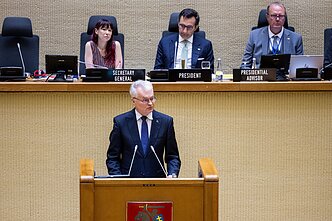














Recognising Palestine will not bring peace to the Middle Eastern region, Lithuanian President Gitanas Nausėda said on Tuesday.
"Israel opposes it, saying this alternative is not acceptable today. Whether it will be tomorrow is a big question. Recognition of a Palestinian state in an ultimatum-like or forced way is possible, but it is unlikely to bring peace to the region right away," Nausėda said in a comment from New York on Tuesday.
"That is why Lithuania honestly states that what is happening in Gaza is unacceptable, that Israel bears a heavy share of responsibility, but recognition today does not look to us like a guarantee of peace," he added.
The president noted that most countries agree that the two-state solution is probably the only viable option in the long run.
"Of course, only if both states recognise each other and respect each other's sovereignty. Unfortunately, that is not the reality today," he said.
Nausėda stressed, however, that Israel bears responsibility for the "horrible humanitarian situation" in Gaza.
"This cannot be denied, and one cannot turn a blind eye to what is happening. Nor can one ignore other actions, such as the rapid building of settlements and attempts to entrench themselves in the West Bank," he said.
On Monday, French President Emmanuel Macron officially recognised the State of Palestine at the United Nations.
Speaking at a summit not attended by Israel and the United States, he called for an end to the war in Gaza.
Monaco, Belgium, Andorra, Malta, and Luxembourg also announced their recognition from the podium of the General Assembly on Monday.
On Sunday, the United Kingdom, Canada, Australia, and Portugal recognised a Palestinian state, adding diplomatic pressure on Israel as it continues its war in Gaza.
Currently, three-quarters of UN member states recognise the State of Palestine. Spain, Ireland, and Norway recognised a Palestinian state in May 2024, and Sweden did so more than a decade ago.

Newsletter
Every Friday morning.