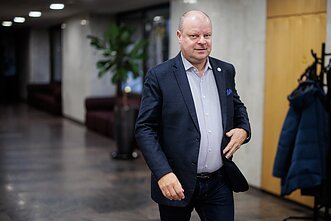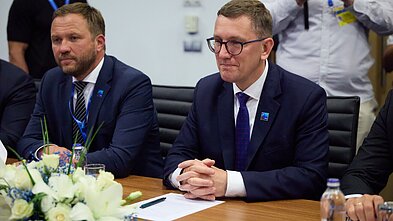


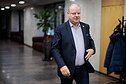
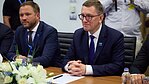




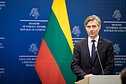


If the European Union failed to extend its economic sanctions against Russia and Belarus, it does not make sense for Lithuania to impose such sanctions alone, Prime Minister Gintautas Paluckas said on Thursday.
"We need a regional solution on sectoral sanctions. If we have no regional solution, sectoral sanctions do not make sense," the prime minister told reporters at the Seimas on Thursday.
In such a case, he added, such sanctions would be ineffective, would generate economic damage and would not produce the desired result.
"This is why we need to agree on them, or at least to discuss them if there are circumstances where countries in the region are willing to accept sectoral restrictions," he said.
If the EU fails to extend its economic sanctions and Lithuania fails to reach an agreement with its neighbours on their application, Lithuania would not impose the restrictions alone, Paluckas said.
Earlier in the day, Lithuanian lawmakers postponed the debate on the government's proposal to provide for the possibility of introducing national economic sanctions against Russia and Belarus.
The amendments to the Law on Restrictive Measures Due to Military Aggression Against Ukraine were initiated by the Foreign Ministry and have been approved by the government.
The bill would authorise the Lithuanian government to impose two types of sanctions: asset freezes and sectoral restrictions.
In both cases, the lists of sanctioned individuals and companies would be drawn up by the Cabinet.
According to the Foreign Ministry, these restrictive measures would be used only as a last resort, if the EU suspended sanctions on Russia and Belarus or if member states failed to reach an agreement on extending them.
Vilnius wants other EU members bordering Russia or Belarus to adopt similar national measures in such a case. This would prevent goods from the two countries from entering the bloc by land.
The EU has adopted 17 sanction packages against Russia since February 24, 2022, when Moscow launched its large-scale invasion of Ukraine. These sanctions target both specific individuals and the Kremlin's economic sectors and companies.
Lithuania has also imposed its national sanctions on Russian and Belarusian citizens. These include entry restrictions, limits on issuing residence permits, and additional security checks for those arriving from outside the EU.
Russian and Belarusian citizens are also prohibited from bringing or taking Ukrainian currency into or out of Lithuania, and the import of agricultural products and feed originating from Russia or Belarus is banned.
Russian citizens without residence permits are also barred from purchasing real estate in Lithuania.

Newsletter
Every Friday morning.