







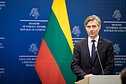

Lithuanian President Gitanas Nausėda has called for an urgent review of the previous government’s decision to prohibit the export of thousands of dual-use goods by air to all but ten third countries.
“I think we need to fix the situation very quickly and reach the elementary conclusion that, firstly, this is geographically inadequate, and secondly, it targets groups of goods that would be very difficult to classify as dual-use items,” he told TV3 on Monday.
The Economy and Innovation Ministry is also proposing an urgent relaxation of the restrictions, which were approved by Prime Minister Ingrida Šimonytė’s cabinet in early December.
According to Nausėda, there are many questions about why decisions that are difficult to explain in logical terms were made in the final days of the outgoing government.
“[These decisions] are directed not only against the countries to which we apply sanctions – that’s beyond doubt – but also against states where our businesses export goods, and which, at least externally, have nothing to do with Russia or its war against Ukraine,” the president said.
Meanwhile, Seimas Speaker Saulius Skvernelis said that economic sanctions on Russia must be effective but should not place a disproportionate burden on Lithuania.
“When it comes to sanctions, we need to ensure they are effective and actually work, but that Lithuania – our businesses and economy – does not bear the full brunt alone. We should not stand out from other countries and cripple our economy in this way,” Skvernelis told reporters on Tuesday.
“Even our own defence funding depends on how the country’s economy and businesses perform and develop. Exports are one of the main criteria showing how our economy is doing,” he added.

Skvernelis said the previous government’s decisions to restrict such exports are illogical and have to be revised.
Economy and Innovation Minister Lukas Savickas said after meeting with business representatives last week that an agreement had been reached to adjust the export restrictions.
The minister emphasised that the restrictions should not harm exporters of high-value-added products while ensuring compliance with sanctions.
He noted that the restrictions, which took effect in January, could cost businesses around 250 million euros in annual revenue, with the high-tech sector being the hardest hit by the ban.
As of January 1, the export restrictions apply to all third countries except the US, Japan, the UK, South Korea, Australia, Canada, New Zealand, Norway, Switzerland, and Iceland.

Newsletter
Every Friday morning.