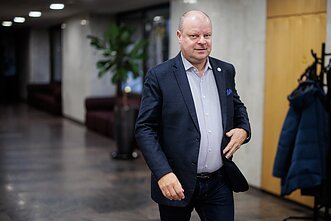













Lithuania withdrawing from the Ottawa Convention banning anti-personnel mines would “untie the hands” of the country's armed forces, Lithuania’s Chief of Defence General Raimundas Vaikšnoras said on Friday.
“We see what is happening in Ukraine, that if you follow the rules and the adversary doesn't, then you automatically end up in a loser’s position,” he told reporters on Friday.
“That is what needs to be done, if there is political will to do it, I am only in favour of it, because it unites our hands,” Vaikšnoras said. “If we do this, it would be easier.”
Last December, then-Defence Minister Laurynas Kasčiūnas called for a discussion on Lithuania's withdrawal from the Ottawa Convention.
The new defence minister, Dovilė Šakalienė, said she intended to rely on military advice.
“We have already talked [with the minister], everything that we are discussing and that is broadly stated has been discussed and agreed upon,” Vaikšnoras said.

Over 160 countries, including most Western nations, have signed the 1999 Ottawa Convention, which seeks to eliminate anti-personnel mines.
China, Russia, the United States, India and Pakistan are not parties to this convention.
By signing the convention, countries commit not to use, develop, produce, acquire, stockpile, or transfer anti-personnel mines.
Last July, the Lithuanian parliament voted to denounce the Convention on Cluster Munitions.
Lithuania submitted the withdrawal documents to the UN secretary-general in early September and will formally exit the convention in March. From that point, the country will no longer be subject to restrictions on acquiring, transporting, and using cluster munitions.

Newsletter
Every Friday morning.