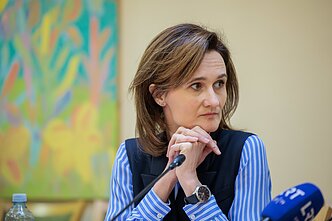


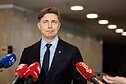





Lithuania's support for Georgia and sanctions against its politicians are not intended to interfere in the country's domestic politics, Foreign Minister Kestutis Budrys said on Monday.
"This isn't about domestic politics or backing any particular political group. It's about Georgia's promise, made a year ago and not fulfilled, to hold free and fair elections, a condition for them to further develop their relations with the European Union and for implementing the country’s EU candidate status," he told reporters.
Budrys was responding to a question about remarks by Nemunas Dawn leader Remigijus Žemaitaitis, who said that Lithuania should not be interfering in the internal affairs of other states.
"This is solely about that [Georgia breaking its promises], not about us trying to steer internal political processes," the minister said.
According to Budrys, "lumping together" these different issues causes harm.
"Elections, democratic standards, the OSCE, the election reports, European integration – this is what we are talking about, as well as about people who organise the beating of peaceful protesters in the street and putting them behind bars," he said.

The minister also noted that in pushing for broader sanctions, it is important to find more like-minded countries.
Mikheil Kavelashvili, a former footballer and far-right loyalist of the ruling Georgian Dream party, was sworn in as Georgia's new president during a parliamentary ceremony on Sunday.
Thousands of people protested outside the parliament against the inauguration amid concerns it would exacerbate the political crisis marked by massive pro-Europe demonstrations. Outgoing President Salome Zourabichvili and the opposition have declared Kavelashvili's election "illegitimate".
On the eve of the inauguration, Lithuanian President Gitanas Nausėda warned that "Georgia risks repeating the Belarusian scenario" as the ruling party stalls the country's European integration process.
He added that Lithuania "strongly supports the European Parliament's call for new parliamentary elections in Georgia".
On Saturday, thousands of Georgians formed a human chain in central Tbilisi in support of the country's EU integration, marking the start of a second month of daily protests.
Tens of thousands of people have regularly taken to the streets since late November after Georgian Dream decided to halt EU accession talks. Police have increasingly resorted to force and intimidation tactics to disperse the protests.

Newsletter
Every Friday morning.