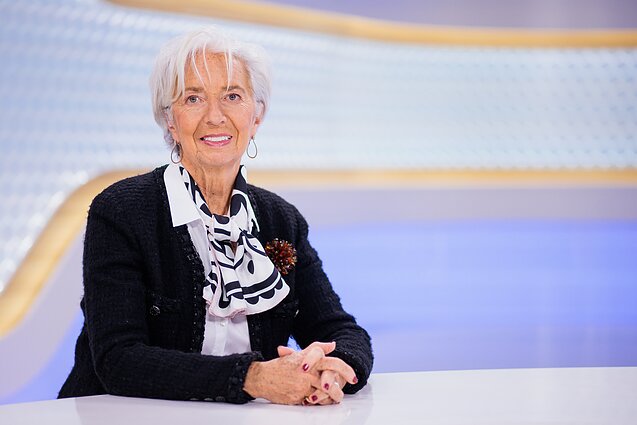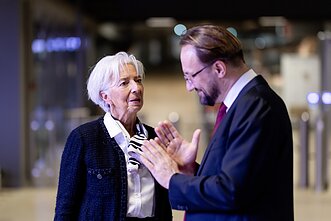
















Next year, Lithuania’s economic growth will be higher than that of the euro area, and other countries have a lot to learn from the Baltic state, Christine Lagarde, the president of the European Central Bank (ECB), said in an interview with LRT TV.
Inflation in the eurozone has returned to a normal level but economies stagnate, production is in recession, businesses do not rush to invest. In such circumstances, should – and could – the ECB reduce the interest rates faster?
As you know, we have reduced inflation. And if you remember the days when inflation was in this country [Lithuania] north of 22 percent, now it has gone down significantly, and our projection for 2024 is around 1 percent. So that was step number one – bringing inflation down, which I think we have almost completed and achieved with a little more work to do.
But we are certainly seeing our target. We have, as you know, reduced interest rates by a hundred basis points, which is down by 1 percent, and it is now standing at 3 percent. So, the mandate and mission that we have – to keep price stability – is being delivered. That’s our task. The task of the central bank is to make sure that we have price stability.
Now, what we anticipate in terms of growth for the economy in the euro area is indeed growth in 2024 of 0.7 percent and growth in 2025 and 2026 of 1.1 and 1.4 percent, respectively. It will be much more than that in Lithuania, which has much better numbers. But of course, with inflation being down, wages continuing to increase and catching up with inflation, we hope that consumption will resume and that this will drive growth going forward.

What is a bigger problem or challenge for the ECB – stagnating industry or inflation?
Our mission is to reduce inflation so that we can procure to the citizens of the euro area price stability, which we have defined as sustainable 2 percent, medium term. The key number to have in your mind is 2 percent. So, we are focused on that.
Of course, there is an interaction between economic activity and inflation, and we are attentive to that because we want inflation to be defeated and we want price stability to be offered to European citizens. As I said to you earlier, we do not see a recession in the euro area. We certainly do not see a recession in Lithuania – on the contrary. And we just hope that this recovery, which is now coming about, will strengthen over the course of time as people recover confidence, as real income rises, and as inflation is brought down.
Under what circumstances the ECB would return to zero, or even negative, interest rates? Or is it outright impossible and a negative interest rate was actually a mistake?
Going forward, I do not think that we will be returning to negative interest rates. And I believe that the rate will be probably a little higher than where it was before. We don’t foresee rates going down as much as they were in the past. Things have changed, and the situation has changed.
Europe is trying to remain competitive in this rapidly changing world. What methods would you envisage to increase this competitiveness? And what role would there be – if any – for the ECB?
The role we can play is very simple and straightforward: price stability. Because if you know that prices will be stable, then you can invest, you can consume, you can employ, and you have certainty about prices going forward.
Competitiveness is an area where we need to raise our game. We need to improve our productivity. Our productivity, which is how much you produce per hour worked, to keep it very simple, has been declining over the last 30 years. We need to recover better productivity. We need to be more efficient. And I think that we should be inspired by Lithuania because Lithuania has been focused on the areas where it has a competitive advantage, has invested in the areas which are driving the games, like information technologies, biotech, and areas where startups can actually flourish and succeed. So, I very much hope that Lithuania can inspire the rest of us.
But the Lithuanians have worries about next year. Even though the wages have increased perhaps the fastest in the EU, the prices are rising as well, and our economists say that next year, the prices will not stop rising, especially for services. What do you think? Is there an end in sight?
Inflation has come down even in Lithuania, especially in Lithuania, I would say, because you were at a very high level. You went up to 22 percent. Now, the inflation projection for 2024 is 0.8 percent, largely because energy prices have gone down. Food prices have not increased by as much. And our projection for next year is a little over 2 percent for Lithuania, which is close to the target where we think prices can be regarded as stable.
So, you will have prices in Lithuania, as well as in the euro area, at that sort of stable level. And then wages have increased significantly in 2024, north of 8 percent. And the projection for 2025 is again another high increase of about 8 percent. By then, we should have come to the completion of what I call the catching-up process.
When prices increased a lot, wages were gradually increasing because there was a time lag between the two. Now we are close to catching up, especially with the wage increase that is expected for next year. And I hope that as people experience lower inflation in the range of 2 percent, they will appreciate that wages have caught up and don’t need to increase by as much as they did in the last couple of years.

What would you suggest to the Lithuanian people – to save and see what happens next year, or spending is also possible?
It’s a personal choice whether you want to save, whether you want to consume, whether you want to invest. I think it’s a factor of your age, your family situation, your income. It’s a known fact that higher income-earners tend to save more because when you have a low income, you just have to spend because you need to put food on the table, you need to pay for the rent, you need to pay for heating.
But I would say that contrary to what we have seen up until now, where savings were very high, I hope that we will see less by way of saving and more in terms of investment and consumption, because we are returning to the recovery of the economy. We have unemployment, which is still standing at a very high level. And people should feel confident that if we increase our productivity, if we work harder and better, if we focus on the segments of the economy where we can leverage our assets, then things will improve.
Are there any risks or pitfalls that people should pay attention to next year?
Next year, we should really be attentive to the developments outside Europe. What will happen with the horrible Russian war in Ukraine and the threat as a result. What will happen in terms of geopolitical development and trade development in the United States, which is a destination for quite a lot of our exports. What will happen in the relationship between the US and China.
But we should be inspired by an environment where there are quite a lot of threats to actually build strength for ourselves and make sure that we provide for our security, make sure that we stay united together, that we focus on improving our economies, removing the barriers that we inflict upon ourselves in order to be a bit more solid on our feet without expecting others to give us a hand.

Newsletter
Every Friday morning.