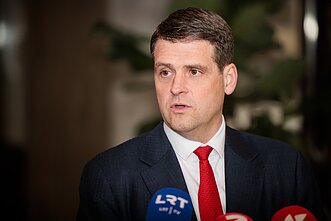




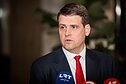




Lithuania’s new Culture Minister Šarūnas Birutis said last week the country should separate “culture from politics” and not discriminate against the Russian language. This view sparked condemnation as well as support from people in Lithuania.
Speaking to the Elta news agency, Birutis also said Lithuania has always been a neighbour of Russia and the Russian people do not represent the Kremlin. However, according to a prominent Lithuanian analyst, Russia and China hawk, Marius Laurinavičius, these words mirror the Kremlin’s disinformation.
“The first narrative says to separate culture from politics, the second says that the Russian people are not the Kremlin, and the third – we have been neighbours for thousands of years,” Laurinavičius told LRT.
This aims to encourage appeasement with the Kremlin, rather than calls to “fence off from this mafia regime”, he added.
Further reading
“We need to realise that culture, like all other tools, is used by the Kremlin as a tool to fight us,” said Laurinavičius, adding that this was part of the struggle for the hearts and minds of the population.
However, some people supported the minister.
“[Birutis] realises that the Russian language is a tool like any other language. There are no bad nations, there are bad and good people everywhere,” Markas Šliamovičius, who organises concerts of Russian-speaking artists in Lithuania, told LRT.
According to him, Russian performers who travel to Lithuania condemn the war in Ukraine and have faced repressions because of it.
“[They] understand and show great sympathy for the dying Ukrainians,” Šliamovičius said, adding that they engage in fund-raising activities for Ukraine.
Meanwhile, theatre performances continue to rely on Russian authors, he added, often without identifying the Russian roots of the performances.
“Now the Compensa Concert Hall [in Vilnius] is filled with Nutcracker and Swan Lake performances, which do not indicate the authorship of Tchaikovsky,” Šliamovičius said.
These plays continue in Vilnius despite an earlier ban on Russian productions in the National Opera and Ballet Theatre.

Ultimately, anti-regime voices should be allowed to perform in Lithuania, Šliamovičius said, adding that they attract not only the Russian diaspora but also the Lithuanian-speaking population.
Pavel Lavrinec, associate professor at Vilnius University and head of the Slavic Studies Department, criticised the statements made by Birutis.
In isolation, talking about good neighbourly relations and separating the regime from the people make sense, Lavrinec said.
“He also noted that many Russians live in Lithuania, they are citizens of Lithuania, and loyal citizens of Lithuania, loyal to their homeland. You cannot argue with that either,” Lavrinec added.
It is also better to distance the country from the current dominant Russian culture, which often promotes pro-war voices.
“If the Russian culture [involves] films and TV series that glorify violence, then this is the culture that led to war crimes in Ukraine. This culture has no place here in Lithuania,” Lavrinec said.
‘View not in line with Lithuania’s community’
On Wednesday, the Lithuanian Section of the International Association of Art Critics (AICA) published an open letter criticising Birutis, saying his calls to separate “culture from politics” could not be more untimely due to the ongoing Russian invasion of Ukraine.
“In other Central and Eastern European countries, the 'Russian culture' that pervades the public space is clearly trying to prevent efforts to break out of its sphere of influence and integrate into European political culture,” the letter reads.
“It is reasonable to ask why the minister first expressed concern about the culture associated with a state hostile to Lithuania and expressed a view that was not in line with the mood of Lithuania's cultural community,” it said.

Commission to be set up
On Tuesday, Birutis clarified that he was against bringing current Russian culture to Lithuania.
“I am very clear: I am against bringing the culture of the current Russian state here at all, especially at this time. How are we going to ban it? I think that together we will figure out how to do it, which has not been done so far,” he said.
Following Russia's annexation of Ukraine's Crimea in 2014, Russian artists who expressed support for the Kremlin and have performed in the occupied peninsula or in the Donbas were banned from coming to Lithuania.
This included several prominent Russian artists, like Filip Kirkorov.
However, some pro-war artists have still appeared in Lithuania, despite calls from the government to ban their shows.
Previously, the parliamentary culture committee proposed to set up an inter-institutional commission to assess whether specific Russian or Belarusian performers should be banned from performing in Lithuania.
However, such a commission has not been set up yet.
“Talking about banning the Russian language, banning religion in Lithuania, we will certainly not do such things,” Birutis said, adding that the commission would be eventually set up.

Newsletter
Every Friday morning.