









LRT English Newsletter – October 18, 2024
We are in the middle of the two rounds of Lithuania’s general elections: last Sunday’s vote results (that, provisionally, distributed 78 out of 141 seats in the Seimas) can give a general idea of what the future government might be, but it is yet to be confirmed or upended by run-offs in 63 single-member constituencies. Here are our main takeaways:
– The social democrats (LSDP) are clear winners of the party list vote, snapping 19 percent and 18 seats (and two more outright victories in single-member constituencies). The party’s leader has already indicated she is planning to lead the formation of the next ruling coalition.
– The potential junior partners for this “centre-left” coalition are the Democratic Union “For Lithuania” (it finished fourth with 9 percent of the vote) and the Farmers and Greens Union (LVŽS, with 7 percent).
– Now, there are several complications with this plan. First, as things stand now, their combined seat count is not enough for a majority. So unless the three parties do well in the run-offs (spectacularly well), they’ll need to look for one more coalition partner.
– Then there are uncertainties with the LVŽS. A ruling party two election cycles ago, this time it barely crossed the 7-percent threshold to get any seats. What’s more, its margin is less than 300 and it is still possible, in theory, that once all the mailed-in ballots are tallied, the party could be pushed below the threshold.
– Even if it’s not, getting the two junior coalition partners to work together can be a challenge – the Democrats “For Lithuania” (it’s a mouthful) is a new party founded by former prime minister Saulius Skvernelis that splintered from the LVŽS, leaving behind some resentment on both sides. Both Skvernelis and LVŽS leader Ramūnas Karbauskis have hinted they find the prospect of working together not to their liking.
– Instead, Skvernelis has indicated that he’d prefer to work in a coalition with the Liberal Movement, which is part of the current centre-right government. Its leader, Seimas Speaker Viktorija Čmilytė-Nielsen, has not ruled it out, but nor has she given any positive indication.
– On the centre-right side of the spectrum, the current ruling conservative Homeland Union (TS-LKD) party is a close second after the first round and only 1.4 point behind the social democrats. So, the conservatives have been adamant that they can still stay in power, even suggesting a “rainbow coalition” with the social democrats (the latter and most observers reject the idea as a campaign ploy).
– What really killed the prospects of keeping the current conservative-liberal coalition is that its third member, the Freedom Party, scraped barely 4.5 percent and did not win any seats. In 2020, it campaigned on promises to pass same-sex partnership law and decriminalise cannabis but failed on both counts, while its doctrinaire pro-market and anti-tax stances could not compensate for the lost voters.
– The elephant in the room is the Dawn of the Nemunas party, which finished third. While the social democratic leader has, after some public pressure, rejected a coalition with the party, its maverick leader Remigijus Žemaitaitis insists, with some validity, that no centre-left coalition is possible without him. Žemaitaitis has been demonised by the conservatives, who led an impeachment against him over anti-Israeli and antisemitic Facebook posts and even suggested that other parties should form a “cordon sanitaire” to exclude his party from power. Now, some observers suggest this demonisation is what prompted his relatively sudden rise.
– Finally, there is the president who has never vibed with the current government and does not hide his glee about it being voted out of power.
* Note on terminology: It is generally agreed that “left” and “right” in Lithuania (and in much of post-socialist Europe) do not so much refer to substantive policy positions as to parties’ relations among themselves. In Lithuania, “the right” is populated by the conservative TS-LKD and any party that would go into a conservative-led coalition; “the left” are all those who would not.
ANATOMY OF A SCANDAL
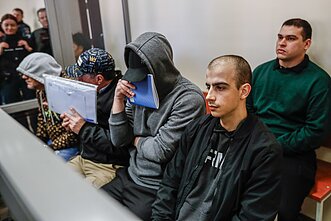
On Wednesday, 15min.lt broke the news that businesswoman Inga Trinkūnaitė, her partner Vilhelmas Germanas, and Midaugas Navickas, the businessman husband of former social security minister Monika Navickienė, have been detained as part of an investigation around the fintech company Foxpay.
Precious little is known about the investigation and what the suspicions are, but prosecutors promised more information on Friday.
Some background: Foxpay, run by Trinkūnaitė, has won lucrative public contracts to handle online payments for government agencies; the state audit has since concluded that Foxpay’s pricing was inflated. Germanas, who has criminal convictions for financial crimes (under his previous name, Vilius Židelis), has been closely involved in Trinkūnaitė’s businesses, which violates the impeccable reputation clause demanded by the banking regulators.
Navickas was reportedly involved in both of their businesses. Moreover, he tried to sell an office building near Vilnius Airport to Trinkūnaitė. Since the airport is critical infrastructure, businesses operating within its zone are screened for national security risks – and the authorities blocked the transaction.
These intricate relationships have cost Minister Monika Navickienė her post. While she insisted that she had not been involved in public tenders for financial services, the last straw was the revelation that she once took a personal trip to Dubai on Trinkūnaitė’s jet.
President Nausėda has called this the biggest political scandal in years, while Prime Minister Ingrida Šimonytė, whose cabinet Navickienė was forced to leave, maintains the case is a legal matter and has nothing to do with politics.
BUDGET
The government has presented its most important piece of legislation of the year, the state budget bill. Discussions will now start in the Seimas, but the final vote will be taken by the new parliament.
The proposal – which has been kept under wraps until the last moment – includes generous appropriations for defence and promised raises of pensions, benefits and public sector pay. On the other hand, it provides precious little for the country’s dilapidating roads, while the intelligence service VSD insists it won’t have nearly enough to be able to catch all foreign agents.
Once adopted, the state budget will have to be implemented by the incoming government. The current finance minister says it will have little room to make changes, since the budget already maxes out on the deficit allowed by the EU.
EDITOR’S PICKS
– Lithuania’s Generation Z, people born after 1995, is entering the labour market with different expectations from their employers. Whether they like it or not, they have to adapt to changing attitudes towards work.
– Since the Second World War, Moscow has been paranoid that the West has plans to attack Russia. Ultimately, this fear has fed into the Kremlin's current policy. “They are paranoid and always will be, because they think the West is technically better, richer, so why not attack the weaker one?” said John Hughes-Wilson, a military intelligence expert, historian and a retired British colonel.
– It’s October and pumpkins are everywhere. The yellow vegetable is growing increasingly popular with Lithuanian farmers – but are they expanding pumpkin fields for the right reasons?
– Although the suicide rate in Lithuania is decreasing year on year, it remains high among people aged over 60. What could be behind this?
Written by Justinas Šuliokas
Edited by Ieva Žvinakytė
Would you like to contribute to LRT English? Please send your suggestions, submissions, and pitches to english@lrt.lt

Newsletter
Every Friday morning.