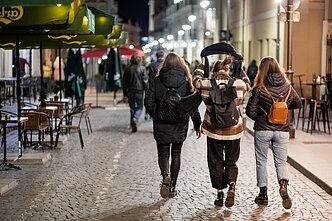











Drink-spiking still takes place in Vilnius clubs and bars, and can be used for more reasons than sexual violence.
Reda Jureliavičiūtė, co-founder of a sexual violence prevention organisation Ribologija, says that people may be drugged for a variety of reasons. While drink spiking is most often linked to sexual violence, motives can also include revenge, “a joke”, or intent to injure or assault.
She recalls a case in which a young man was drugged and woke up half-naked in the city centre, with his bicycle stolen.
“Men are more often drugged to be robbed or harmed. So we cannot say a man is 100% safe and a woman is 100% not. Anyone can be unsafe,” she told LRT.lt.
She describes drink spiking as close to a “perfect crime”, as it is difficult to prove and evidence is often lacking. Victims frequently remember little or nothing.
“Offenders do everything to ensure the person they target never realises what happened. They often remain unseen. Even if someone is drugged, robbed or raped, they may not remember it at all, or only recall fragments. That makes it harder to seek help or go to the police.
Victims often do not know who harmed them. They might remember a face, but that is not enough. Offenders are often not caught. Sometimes the perpetrator is someone the victim knows – a partner or someone they are dating. In such cases, even when the identity is known, people may not go to the police in order to protect the offender,” she says.
She notes that systems are not well-equipped to handle such cases. These crimes are often invisible in statistics, and detecting substances requires a rapid response, which can be difficult given the victim’s condition.
“If someone wakes up feeling unwell, nauseous, in pain, unable to get up from the floor, it can be very hard to seek help. Sometimes people don’t remember the incident and don’t understand what happened, so it takes time before they reach out,” she says.
Victims are also often left with feelings of guilt, shame and disgust.
“Many people don’t know what happened. They carry on thinking it was their fault, that they drank too much alcohol. They don’t understand why they behaved the way they did. That can lead to intense self-blame, doubt and uncertainty.”
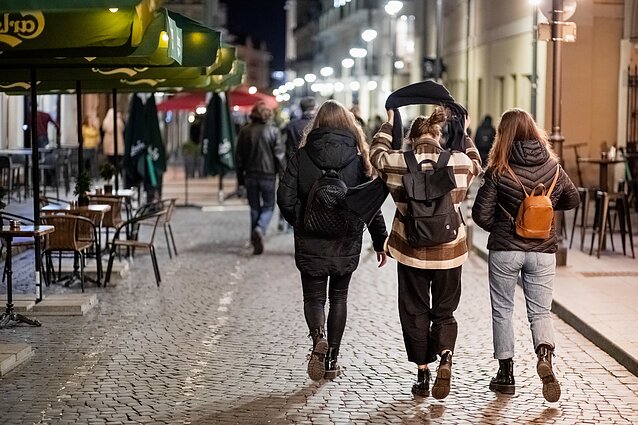
How spiking happens
A Vilnius resident, Lukas (not his real name), says he believes two men tried to spike his drink at a concert.
“Even if you arrive sober, even if you don’t take anything, you still can’t really feel safe. There will be people who will pour drugs into your non-alcoholic drink,” he says.
Lukas attended an electronic music event. The night ended with him filing a statement with the police.
He arrived early, bought a non-alcoholic drink and stepped outside for a cigarette.
When he returned, he placed the bottle on a table and turned towards the cloakroom to hang up his jacket. Shortly afterwards, two men came in from the main hall.
“They were only interested in the bottle. One of them blocked the table with his body, while the other took something out of his pocket and started pouring it into the bottle. It all took up to 10 seconds. He emptied it in and lightly tapped the bottle against the table so it would mix,” Lukas told LRT.lt.
Realising what was happening, Lukas approached them.
“They were both older and bigger than me, so at first I asked politely: ‘Guys, what are you doing?’ There was no response. The one who poured something into the drink ran straight to the toilet without even turning around. The other followed. Then I raised my voice and shouted, with swear words: ‘What are you doing?’ They replied ‘nothing’ and locked themselves in a cubicle.”
Lukas suspects the men poured drugs into the drink and disposed of them in the toilet.
“The way they ran to the toilet, frightened, and the way they came out afterwards – so confident. The difference was very obvious.”
He immediately told a bartender what had happened and handed over the bottle. During the concert, he says, the same men repeatedly approached different women, which he found suspicious, so he began watching them.
“One of them came up to me and said he wanted to apologise. I asked what for and what they had poured, but he just stayed silent. I realised I wouldn’t get an answer, so I took out my phone and started filming him. He didn’t like that – he covered his face and ran away. Then his friend came over, not to apologise but to accuse me of something, saying I was offended,” Lukas says.
He later contacted the police and gave a statement. However, the men offered a different version of events, claiming they were thirsty and wanted a drink from the bottle they had seen. With no evidence, the police dropped the investigation.
Lukas says it did not occur to him at the time to keep the drink and hand it to the police for testing. Everything happened quickly, and there was no security or CCTV at the venue, so proving who tampered with the drink would have been difficult.
Now he believes the men were not targeting him specifically, but assumed the drink belonged to a woman.
“They didn’t realise it was my bottle. I think they thought a woman in the toilet would come back for it, and they would watch her. If I had drunk it, I think they would still have enjoyed it. People like that like to control others, to dominate – probably with a sexual motive,” he says.
He adds that the incident made him feel unsafe.
“Even if you arrive sober, even if you don’t take anything, you still can’t really feel safe.”

Newsletter
Every Friday morning.