











Lithuania still has a Russian-gauge railway running through the country. Should it be dismantled?
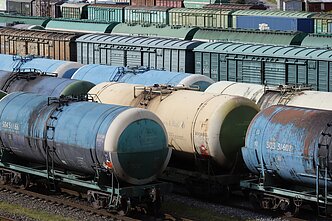
The principal argument for removing the Russian-gauge railway concerns the threat to Lithuania's national security. In case of a conflict, European reinforcements would be slower to arrive, as the local network uses a wider gauge. Meanwhile, Russia could move its military more easily, as it has done so in Ukraine by utilising the same tracks.
And as much as Lithuania may wish to act, there is little it can do alone. Dismantling the gauge would require European approval, and replacing it with a new line could cost hundreds of millions of euros – possibly more.
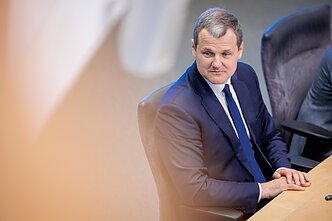
"The question of transit to the Kaliningrad region could not be raised, because there are international agreements and treaties that oblige us to ensure the carriage of goods to the Kaliningrad region," said Algirdas Butkevičius, who served as both Prime Minister and Transport Minister.
"If there is a territory that does not share a land border with the main country, transit access must be guaranteed. That was the requirement of the European Commission," he said.
Butkevičius added, however, that a decision had been taken to raise tariffs on carriers using the transit route. Russia has also invested heavily in freight transport by sea.
"When the geopolitical situation was different – particularly with Belarus, but also with Russia – when the volume of freight to the Kaliningrad region was considerable, we applied higher tariffs for rail transport and Lithuanian Railways received substantially greater revenues, whilst we were able to offer our own carriers much lower tariffs," he said.
But the situation has changed, however, and the issue should be raised at the political level without delay.
"But beginning with coordination with the European Commission, so as not to create unnecessary tensions with respect to Lithuania," he told LRT.lt.

Šimonytė: This is high on the escalation ladder
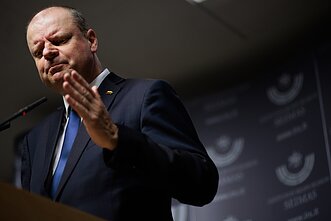
Former Prime Minister Ingrida Šimonytė told LRT.lt that it is understandable that Lithuania would prefer the Russian-gauge line not to exist at all, or to be replaced by a European-gauge alternative.
" [One can recall] the considerable tensions that arose not over the question of changing the gauge, but over the question of applying sanctions – those that the EU had approved for Kaliningrad transit," the former Prime Minister said.
Further reading
The Transport Ministry has confirmed that rail transit between the Kaliningrad region and other parts of Russia is not currently suspended or blocked, with the exception of sanctioned goods; the carriage of military or dual-use goods and technologies is prohibited.
According to Šimonytė, it is clear that the Kaliningrad transit question is an acutely sensitive one: "This sits very high on the escalation ladder. I am not saying it is impossible – for example, once Rail Baltica is complete – to return at least to the question of introducing the European gauge there.

"But it must be clearly understood that yes, there is a threat, as there are many other threats, but responding to those threats and taking decisions involves actions with very different degrees of freedom," she said.
Šimonytė does not, however, rule out the possibility of Lithuania approaching EU institutions and opening discussions on phasing out the Russian-gauge line.
"One must still appreciate that this is a decision that will not come cheaply. We can already see how the Rail Baltica budget has grown since the project was first conceived, and how much financial strain we face, how many expectations are tied to the new EU financial framework in order to see Rail Baltica through to completion," she said.
No case for action
Current Transport Minister Juras Taminskas told LRT.lt that authorities have not identified any urgent threats connected to the Russian-gauge infrastructure.
"But as long as no such threat has been identified, there is no reason to dismantle it – because dismantling is quick and relatively inexpensive, whereas rebuilding afterwards takes considerable time and costs taxpayers a great deal of money," Taminskas said.
No such discussions are currently underway., the minister said.

Newsletter
Every Friday morning.