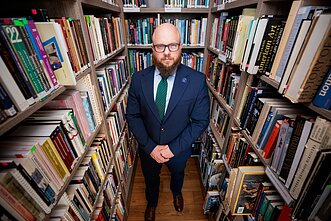










The Lithuanian Social Democratic Party (LSDP) hopes to form a ruling coalition of around 80 MPs from the three parties currently in opposition, says LSDP vice-chairman Gintautas Paluckas.
He stressed that the option of a minority government was not on the table.
“We believe that after the second round, we will have enough seats to form a ruling coalition of the three main opposition parliamentary parties plus one or two members of the Seimas who have not joined a [parliamentary] group,” Paluckas told reporters in the Seimas on Tuesday.
“The goal in general is to form a stable ruling coalition with 80 members, because in that case we can expect to do normal, serious work,” he said.
According to the Central Electoral Commission (VRK), the Social Democrats won the first round of the Seimas elections last Sunday, with the Conservatives (TS-LKD) in second place by a small margin and the Dawn of the Nemunas (Nemuno Aušra) party in third place.
Paluckas reiterated that the Social Democrats do not see any points of contact with the Dawn of the Nemunas party.
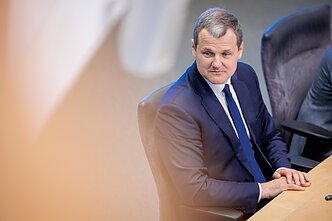
The Social Democratic leader, Vilija Blinkevičiūtė, has indicated she favours forming a coalition with the Democratic Union “For Lithuania” and the Lithuanian Farmers and Greens Union (LVŽS). So far, the three parties won 32 seats, but 63 are still up for grabs in the second round of voting on October 27.

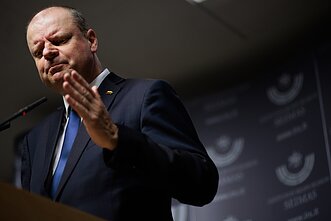
Meanwhile, Saulius Skvernelis, leader of the Democratic Union “For Lithuania”, said on Monday that a ruling coalition with the Liberal Movement would be more predictable than working with the LVŽS. Skvernelis was associated with the latter during the last two election cycles, but left to form his own party after falling out with the LVŽS leadership.
Ramūnas Karbauskis, LVŽS chairman, has said that working with the Democrats would only be possible if Skvernelis were not in the government.
According to Paluckas, both the Democrats and the LVŽS would have to adjust their platforms and personal demands as the coalition negotiation process continues.
“The Farmers and Greens are incredibly conservative in the area of human rights, in the cultural sphere, but certain social and economic attitudes overlap strongly with both the Democrats’ and our platform,” he said.
Further reading
Skvernelis has expressed doubts about the compatibility of his party’s agenda with political forces other than the Social Democrats.
According to Paluckas, a coalition of four parties is worse than a coalition of three.
“The more participants at the table, the harder it is to reach an agreement, and then certain processes of political physics or chemistry begin to take place – political opportunism, an attempt to differentiate oneself from the others,” he explained.
Blinkevičiūtė announced on election night that Skvernelis and she had decided to form a ruling coalition. She said on Monday that she would prefer a ruling coalition with the Democratic Union “For Lithuania” and the LVŽS.

Newsletter
Every Friday morning.