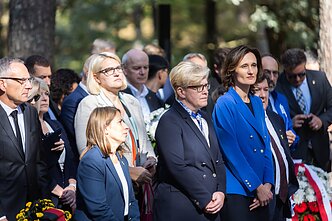













Top politicians and Jewish community leaders warned about “thriving” anti-Semitism as they commemorated the National Memorial Day for the Genocide of the Lithuanian Jews on Monday.
Faina Kukliansky, chair of the Jewish Community of Lithuania, called for the education of people who “have a conscience” and “respect other people”.
“Antisemitism is thriving if we do not fight it with all possible means,” she said at the Paneriai Memorial near Vilnius, the site where up to 100,000 people were killed between 1941–1944.
The National Memorial Day for the Genocide of the Lithuanian Jews is marked on September 23, the day when Vilnius Ghetto was liquidated in 1943.
During World War Two, the Nazis and their local collaborators killed 90 percent of Lithuania’s 208,000-strong Jewish community.
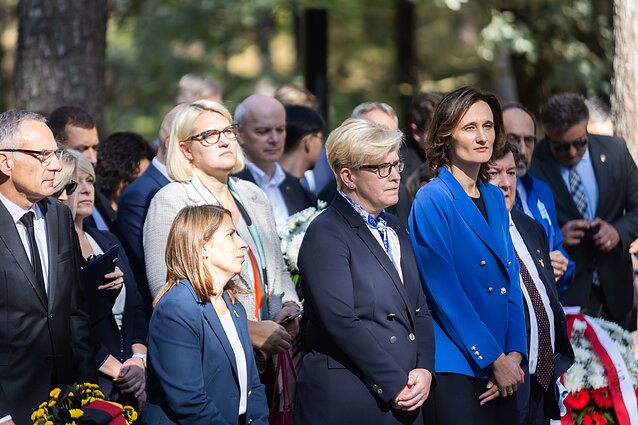
“The hatred that destroyed millions of lives in the past is still alive today,” Prime Minister Ingrida Šimonytė said at the event. “This hatred of otherness is also making anti-Semitism stronger in various parts of the world. This is unfortunately not a legacy of the past, it is still today’s reality.”
She mentioned the politician Remigijus Žemaitaitis who was stripped of his parliament seat after the Constitutional Court decided he violated the constitution by posting anti-Semitic statements on social media.
Further reading
“A politician who violated the constitution by making anti-Semitic statements is running for parliament. And he has supporters. Therefore, today it is our duty to understand the consequences of spreading such ideas for Lithuania and for society,” Prime Minister Šimonyė.
“Each one of us must stand up for humanity and justice, and oppose hatred and discrimination, because only this way will we be able to prevent new tragedies and create a world in which genocide will no longer have a place and the life and dignity of every human being will be valued,” Šimonytė continued.
Parliament Speaker Viktorija Čmilytė-Nielsen said the country was going through turbulent times when “the established world order is being put to a huge test”.
“And it is not just Russia, which has been waging the biggest war in Europe since World War Two and has been waging a full-scale aggression against Ukraine for almost two and a half years. Regional conflicts are smouldering in various parts of the world, threatening to unleash global mechanisms. We are moving into a new era of security and control, characterised by rising tensions and an increasingly unpredictable future,” Čmilytė-Nielsen said.
In the face of military conflict, she said, there is an inevitable temptation to put humanity, dignity, compassion and the values of humanism on the back burner, to “put humanism on hold” until we can defend ourselves and achieve victory.

Newsletter
Every Friday morning.