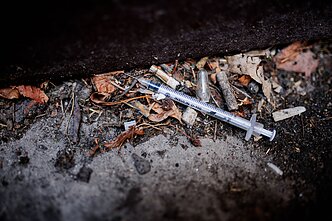









The head of the Lithuanian police says that the number of minors suspected of drug-related offences is increasing. The government is therefore preparing a common response plan to be offered to all schools. Seven schools in the districts of Vilnius, Alytus, and Klaipėda are taking part in a pilot initiative.
For some time now, students at the Putinai Gymnasium in Alytus have been under closer surveillance for smoking and drug use. The school is one of the seven participating in a major drug prevention initiative.
According to the headmistress, Daiva Sabaliauskienė, the hunch was confirmed: students do bring electronic cigarettes and possibly psychotropic substances to the school.
“During a lesson, a boy threw away packet as he was going to a check-up,” she tells LRT TV. “It could have been weed. The police are investigating further.”
The police say minors not only use drugs at school, but some even sell them to their peers.
“We are seeing an unfortunate trend – which is one of the reasons for these initiatives – that the number of juveniles suspected of committing offences related to the disposal of narcotic substances is increasing in the country,” says Police Commissioner General Renatas Požėla.
Sabaliauskienė, the headmistress of the Putinai Gymnasium, says that the first thing she did was to assess the security of the school. She did not build a fence around the school, but upgraded some of the surveillance cameras and installed more particulate matter detectors.

These measures have been effective, she says.
“When the particle detectors are triggered, we can react by looking at the cameras to see which pupils were moving where at a certain moment. After that, we have talks. If the talks don’t help, we can check their bags,” she says.
The campaign against drugs in schools also includes a special hotline for anonymous reporting of drug dealing. The hotline, which was launched in Lithuania in February, has received more than 300 reports and led to 30 pre-trial investigations.
“Good news is that we don’t see any minors being involved in organised crime groups,” says Police Commissioner General Požėla.
Until now, schools have been dealing with the problem of drug use however they could, but soon they will be offered a common response and support algorithm.

“There will be a government resolution with three messages at the heart of it, which will allow us to identify, respond and assist according to a common algorithm of action,” assures Interior Minister Agnė Bilotaitė. “That is very important because it has not been available in our schools yet. Each school, each municipality used to decide and take measures according to their own best knowledge.”
Rita Sketerskienė, director of the Department of Drugs and Tobacco Control, says there are many ways that different schools and countries approach the problem.
“We have to set ourselves a goal, what we want to achieve. If we need to prove that yes, there is a problem, sometimes a surface swap helps to change the school headmaster’s mind,” she says.
The current initiative also includes guidance for parents on how to recognise if their children are taking drugs.

Newsletter
Every Friday morning.