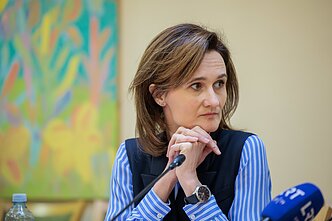













Following the introduction of a ban on cars registered in Belarus from entering Lithuania, the number of passenger busses travelling between the two countries should also decrease, says Lithuanian Interior Minister Agnė Bilotaitė.
Dozens of passenger buses travel between Lithuania and Belarus every day. Passengers waiting for a bus to Minsk at Vilnius bus station say the journeys are difficult and long, but they need to go visit their relatives or to work.
“My parents live in Belarus. We try to visit them every two months. When it will no longer be possible to go by car, there will be even more people going by bus. It will be more difficult because it’s already difficult,” a passenger told LRT RADIO.
According to the driver of the bus to Minsk, Bidnev Navoichik, all 49 seats are often filled, and most of the passengers are Belarusians.
“Most Belarusians go to work and home. The border guards work very well on both sides. Every hour, 2–3 buses arrive. At the border, you have to wait for 7–12 hours because they have a lot of work to do, and they can serve 50 people in 35–40 minutes,” the driver says.

What plan?
On July 18, Lithuania started enforcing a ban on passenger cars with Belarusian registration plates to enter the territory of the European Union.
Further reading
According to Interior Minister Bilotaitė, there is also a plan to reduce the number of passenger buses travelling between the two countries.
“There is a plan to reduce bus trips. The Transport and Communications Ministry is responsible for this. To my knowledge, they have put in place certain actions to reduce the traffic. For our part, we have closed the border checkpoints, which has reduced the flows,” she said.
At the beginning of March, Lithuania closed two border checkpoints – at Lavoriškės and Raigardas – on its border with Belarus, leaving only two border checkpoints open.

Stanislovas Lingys, a representative of the Transport and Communications Ministry, said, however, that there is no plan to reduce the number of bus trips. A decision taken in March to halve bus trips to Belarus is now being implemented.
“The ministry is currently monitoring the change in passenger flows and only when it has sufficient data on the change in flows, will it be possible to find solutions. These flows could increase due to fewer people travelling by car. We cannot yet talk about when and how much this will increase. Certain requirements will come into force a little later,” he explained.
Already halved
Arūnas Indrašius, the head of the passenger transport company TOKS, said he has not heard of any new plans to reduce the number of buses going to Belarus. Since March, their numbers have already halved, he stressed.
“Right now, no new permits are issued, and the old ones are not renewed. Some permits are still valid, so they are still operating, but there is a reduction in the number of trips. After the March decision, many passenger companies withdrew because their permits had expired,” Indrašius said.

According to Genius Lukošius, director of the Lithuanian Transport Safety Administration, 35 out of 58 bus trips to Belarus are still available, and the plan is to have 29.
“We have noticed that in the very beginning after the decree, there were attempts to misuse the permits by putting several buses on the road with one permit. Such fraud affects the operator itself because the tickets were sold. This has happened on both sides, but the first such attempts were made in Belarus,” Lukošius said.

Newsletter
Every Friday morning.