














Beavers create wetlands with their dams and help increase biodiversity. However, they can also cause harm when they flood fields or forests. Lithuania is one of the few countries in the European Union where beaver hunting is permitted. This attracts tourists.
Dusk falls, a warm spring day is coming to an end. In the district of Ignalina, not far from the Belarusian border, a group of hunters gather. Hunting licences are checked, equipment and rifles are prepared.
Michael, Martin, and Gilbert from Germany are each assigned a guide from a local hunting club. They have travelled to Lithuania for beaver hunting since it is not permitted back in Germany.
Gilbert says he also likes the nature experience: “The population density is not as high as in Germany. Here you have many more open areas and hunting grounds. We don’t have that at home.”
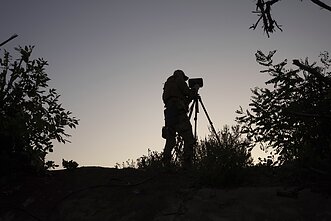
The group splits up. Gilbert and his Lithuanian companion Edmundas set up their hide on a meadow where beavers have dammed up a creek. They have a good view of the pond from here. If the water surface is moving, this may indicate a beaver swimming their way.

While the German hunters are interested in the meat of the beaver, their primary interest lies in the fur. Gilbert would like to make a waistcoat. Beaver fur has excellent insulating properties, he says: “It’s breathable and it warms at the same time.”
He already has enough fur for his waistcoat – the previous evening, he had shot two beavers. If he is successful again tonight, he’ll give the fur to a friend. However, his main objective is spending a nice evening in nature and observing animals: “Maybe we’ll see some that don’t exist at home in Germany.”
Low-profile attraction
Officially, hunting trips are not actively promoted as a tourist attraction in Lithuania. Accordingly, the national tourism promotion agency Lithuania Travel does not keep statistics on how many hunters come every year.
But tour operators say they regularly send groups of hunters to Lithuania and the other Baltic states. Besides Germany, they come here from countries like Denmark, Poland, and the Czech Republic.

Beavers are a strictly protected species in the European Union. At the beginning of the 20th century, they were considered extinct in large parts of Europe, including Lithuania.
It was only through reintroduction and protection that the population recovered. According to the Ministry of Environment, there are more than 47,000 beavers in Lithuania today.
Lithuania is one of the few EU member states that have exemptions from the strict rules on beaver protection. Hunting is not restricted, and hunting clubs only have to report how many animals they want to shoot during a season.
But is the hunting really necessary?
Professor Alius Ulevičius, ecologist at Vilnius University, emphasises how important beavers are for biodiversity: “The beaver is a so-called keystone species, it is an ecosystem engineer.”

Beavers’ dams create wetlands and habitats for many other animals, such as fish, amphibians, waterfowl, insects, and even other mammals. From an ecological point of view, there is no need to hunt beavers, the scientist says: “The beaver population in Lithuania is as it should be.”
But in other respects, a limit has been reached. Ulevičius speaks of “socio-economic capacity”. What he means is that too many beavers are causing problems: they flood the land of farmers or forest owners.
In such conflict areas, he recommends regulating the population through hunting. In other areas, however, beavers should be protected, the ecologist says. “About 10 to 15 percent of beaver sites are very valuable and, in my opinion, beavers should be left for biodiversity and ecosystem infrastructure.”
Gilbert from Germany says he makes sure he only hunts in areas where agriculture could be damaged. The meadow where he and Edmundas are hiding tonight is surrounded by farmland. “I don’t feel guilty about hunting here.”

When it is almost dark, he shoots his third beaver. It weighs around 30 kilos. Shortly afterwards, an even bigger specimen appears. But this beaver is allowed to live. He has shot enough, Gilbert says.
For the rest of his time in Lithuania, he doesn’t want to hunt anymore, only observe nature: waterfowl on the lakes or foxes, badgers, and wolves roaming through the woods.


Newsletter
Every Friday morning.