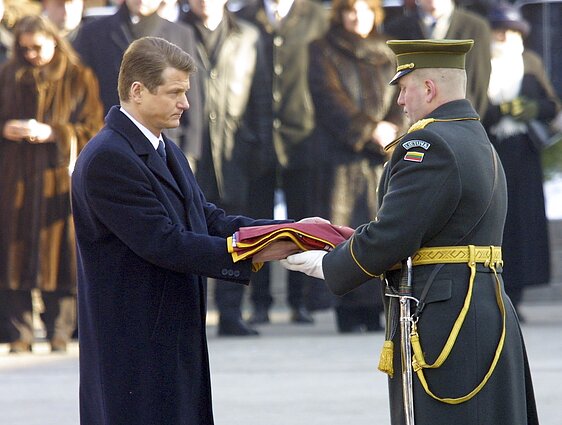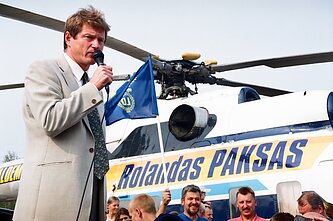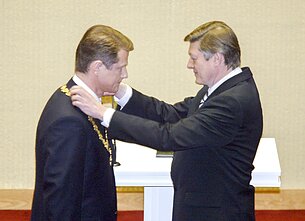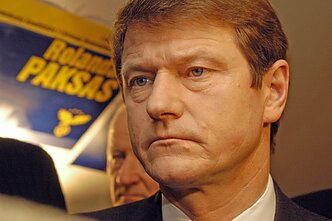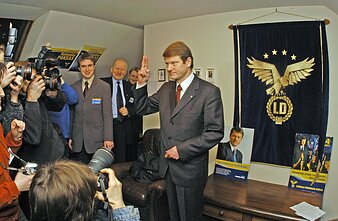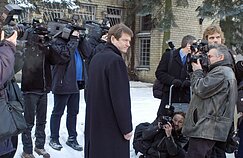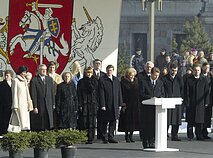










“Why should Paksas be elected? Because there is no one better,” the presidential candidate Rolandas Paksas said in late 2002. A few months later, he was elected the head of state and soon became the first and so far the only impeached Lithuanian president.
Exactly 20 years have passed since the Lithuanian parliament Seimas decided by secret ballot to remove Paksas from office 13 months after he took it up.
Today, recalling the process that shook Lithuania, the politicians who were in the thick of it say that everything happened quickly. However, the then Seimas Speaker Artūras Paulauskas believes the decision to impeach Paksas was the right one.
Unexpected document
In the winter of 2002, Lithuanians decided who should lead the country for the next five years. Among the 17 candidates were Valdas Adamkus, who was seeking re-election, and Rolandas Paksas, the former mayor of Vilnius and former prime minister. The two faced off in the second round of the presidential election.
“There are many intelligent, educated, talented people and good managers in Lithuania who could be presidents of the country and lead the Lithuanian nation for five years. But why should Paksas be elected? Because there is no one better. That is my simple answer,” Paksas told the public before the election.
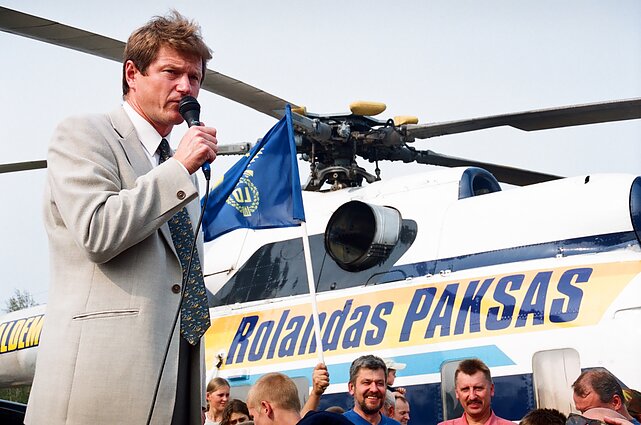
On January 5, 2003, he received the keys to the Presidential Palace on Daukanto Square in Vilnius. But he did not get to lead the country for five years as promised.
On October 30 of the same year, three top Lithuanian officials – Seimas Speaker Artūras Paulauskas, Prime Minister Algirdas Brazauskas, and Paksas himself – received an unexpected document from the State Security Department (VSD).
“We provided a document on possible threats to the state, [...] we revealed certain tendencies that we believed were really important for the security of the state,” the former VSD head Mečys Laurinkus later said in a documentary.
The document noted that the president was vulnerable because he had become dependent on certain criminal groups, which also endangered the national security of the state.
Seimas Speaker Paulauskas was quick to convene a meeting of the representatives of the parliament’s political groups.
“The situation could not have been left unassessed. It certainly seemed dangerous. That document forced me to make decisions. Some people say that maybe we should have kept the noise down, but there was no way I could have kept quiet and tried to make some kind of deal, either with Paksas or with someone else,” Paulauskas recalled the events of 20 years ago to LRT.lt.
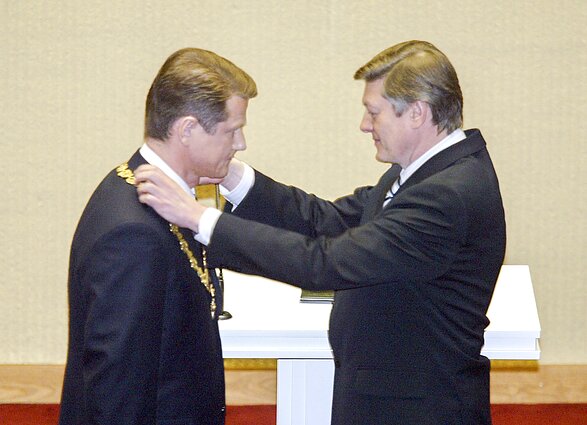
“My actions were clear at the time. It was clear that the document was not addressed to me, but that the members of the Seimas had to know about it, and that I could not make decisions alone in such an important case,” he added.
On the same evening, Paulauskas met with Paksas and informed him about the decision to convene a Seimas session to decide on the establishment of a special commission to assess the information provided by the VSD.
At the same time, Paksas appeared on television, trying to dispel the allegations.
“The publication of the documents without presenting them to the president could be considered a conspiracy. Once again, I dissociate myself from all the attempts made today to link me to the criminal world. I am sure that soon all the perpetrators of this story will be named,” Paksas told LRT TV at the time.
Thus began a political scandal that rocked Lithuania for five months.
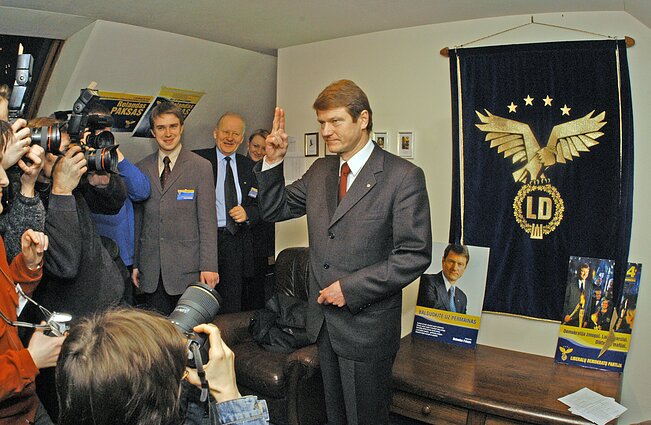
Refused to answer questions
Gintaras Steponavičius, the then member of the parliamentary Committee on Legal Affairs, who worked in the special commission, recalled that he found out about the VSD document while at the theatre.
“Even 20 years later, these events still have dramatic overtones. I remember that during a play in the theatre, I received information that I and other members of the Seimas leadership were invited to come to meet the Seimas speaker in the evening for important reasons,” he said.
“The situation was then briefly outlined that the head of the VSD was being summoned to present material concerning the activities of the president. In retrospect, the events that followed were quite dynamic,” Steponavičius added.
The special commission on possible threats to national security was headed by Aloyzas Sakalas, the then chair of the parliamentary Committee on Legal Affairs. Steponavičius, a member of the commission, said that representatives of the president’s team and other relevant people were invited to the meetings.
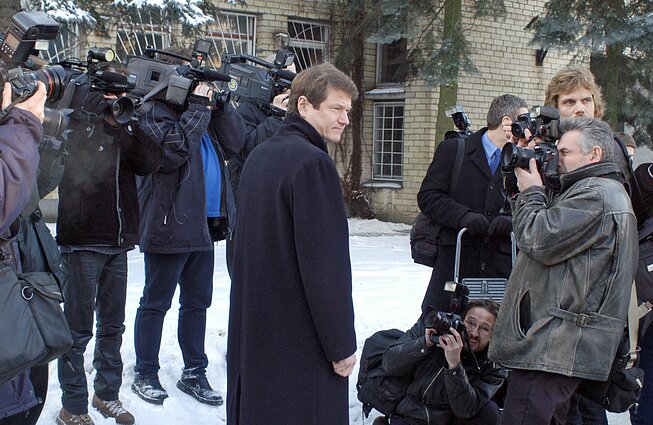
Paksas was also invited to attend one of the commission’s meetings but refused to do so and answer the MP’s questions.
“Little by little, all the information had come together in a mosaic that really showed the circumstances of all the events and the activities of the president and his inner circle, and that there were grounds for impeachment. All further steps were put in that direction,” Steponavičius said.
Two camps
While the Seimas were deciding whether the president was fit for office, Paksas himself was travelling around Lithuanian cities and towns, where he was met with ambivalence.
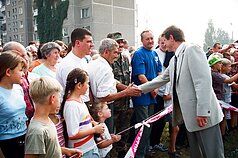
Some people defended Paksas and blamed the media for presenting assessments rather than facts. In some parts of Lithuania, the president was greeted with flowers and people wished him strength.
Others, however, took a radically different stance and argued that Paksas could no longer lead the country. This was also evident in the rallies held in front of the Presidential Palace, where people chanted “Paksas out”.
“Naturally, a drama was created, but all those legal steps were supported quite strongly at the political level and in society,” Steponavičius recalled.
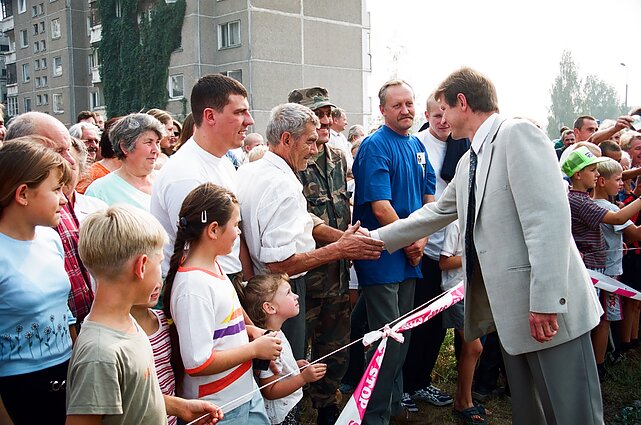
The archival footage captures the account of Sakalas, who headed the special commission at the time. He said that the MPs’ main goal was to protect the institution of the president.
“Initially, it was probably to protect the institution of the president. It was not Paksas himself who was being protected, but the institution, because undermining the presidential institution still has a huge impact on international political life,” he explained.
Asked whether the politicians had succeeded in protecting the presidential institution, Steponavičius praised Sakalas’ leadership in heading the commission and the willingness he showed to find out the truth.
“This was very important. At the time, we could probably expect all kinds of speculation saying that the still fragile foundations of our country’s most important institutions should not be destroyed. But after all this, in my understanding, our whole structure of power and division of functions as set out in the constitution recovered quite quickly,” he said.
Another shake-up
The Seimas examined a number of accusations against Paksas, including the illegal granting of Lithuanian citizenship to his biggest campaign donor, Russian businessman Yuri Borisov.
This did not prevent Paksas from appointing Borisov as his public adviser.
“The president invited Yuri Borisov to become his public adviser for a very simple reason – he was a great help to the president with his advice during the election campaign. The president believes that even now, in this situation, Yuri Borisov’s advice will be useful to him,” Paksas’ spokesperson Jūratė Overlingienė told reporters at the time.

This news was followed by outrage, which led Paksas to announce on March 25, 2004, that he had not had time to get to know Borisov well before appointing him as his public adviser.
“During the election campaign, I did not get to know this man, I did not see that behind the noble aspirations declared by this businessman to support me in helping all the people of Lithuania get out of poverty faster, there are also complex twists and turns of human nature and character,” Paksas said.
“In recent days, Yuri Borisov has unambiguously made me understand that, if I do not accept him as a public adviser, allegedly compromising material could be used against me,” he added.
Six days later, on March 31, 2004, the Constitutional Court issued its ruling stating that Paksas had committed three serious breaches of the constitution and violated his oath of office by illegally granting citizenship by way of exception to his most generous donor Borisov, by letting him know that his conversations were being listened to by the special services, and by exerting influence on the managers and shareholders of the company “Žemaitijos Keliai” in relation to the transfer of the company’s shares to persons close to the president.
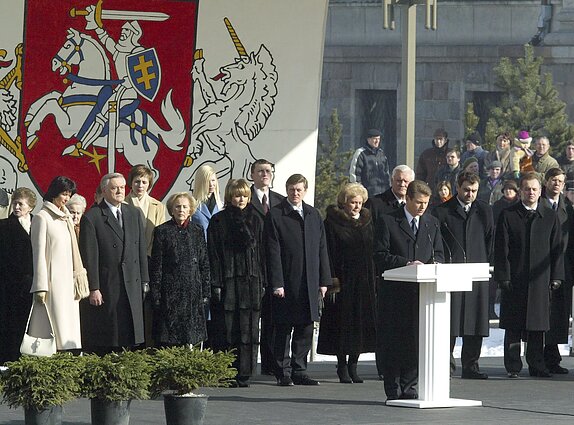
Less than a week later, the Seimas held an impeachment hearing for Paksas.
“This is unprecedented in European history. [...] Let us not be afraid to admit mistakes and correct them, let us not be afraid to change. Let us work for Lithuania. There is no higher goal than work on behalf of the people of Lithuania, on behalf of democracy and justice,” Paksas told the hearing.
However, shortly afterwards, after a secret ballot of MPs, the historic March 11 Hall of the Seimas resounded with the parliament’s decision: “Rolandas Paksas is removed from the office of the president of the Republic of Lithuania by the decision of the Seimas.”
Right decisions
Asked whether the right decisions were taken 20 years ago, the then Seimas Speaker Paulauskas said that he would take all the same steps now.
“I think today, just as I did then, that the decision was the right one, that there was a need for an investigation, a need for an assessment, and that I could not have left the situation without having investigated it, without having assessed it,” he told LRT.lt.
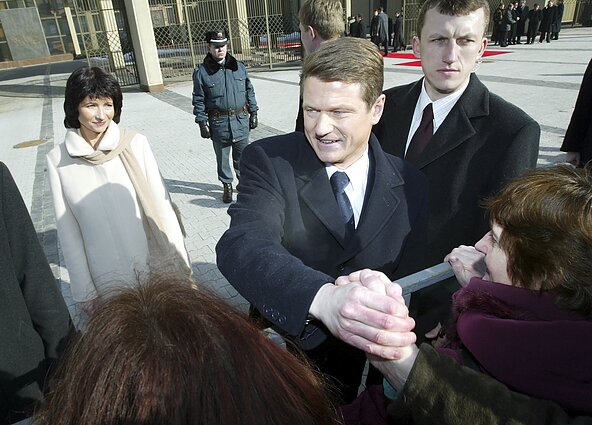
Speaking to the media 20 years ago, Paulauskas said that Paksas’ actions were dangerous. He has not changed his mind on this issue, he said.
“The VSD document set out all the facts that the president was vulnerable, that his environment was very, to say the least, untrustworthy, with a whiff of corruption, that he was even in contact with Russian organised crime, that he was interfering in privatisation processes. There was a lot of that. It certainly seemed dangerous, this situation could not remain,” Paulauskas explained.

Newsletter
Every Friday morning.