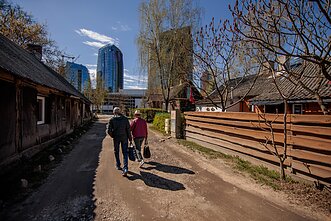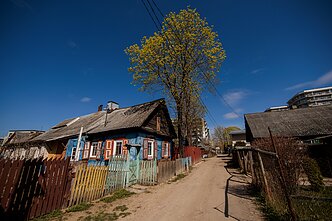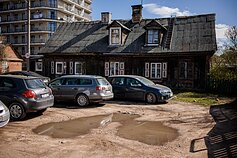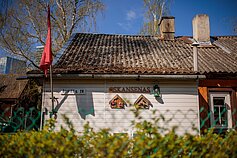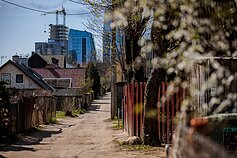















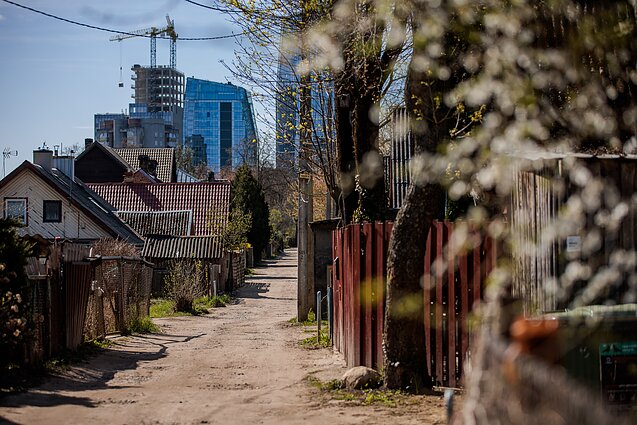
Vilnius’ Šnipiškės district, featuring old wooden houses surrounded by luxury apartment blocks and skyscrapers, has been dubbed Shanghai of the Lithuanian capital. Some consider it to be the city’s greatest disgrace, while others see it as a historically important and architecturally interesting area.
Not willing to sell
Walking through the streets of Shanghai of Vilnius, one can see that some of the houses here are quite derelict. However, the real estate in the area is one of the most desirable and valuable because of its location. The average land price here is over 100,000 euros per acre, according to the housing project management company Citus.
Nevertheless, the residents of the wooden houses of Šnipiškės are reluctant to sell their property.
“I’ve lived here with my parents and grandmother since childhood. I went to live in England and now I’m back here again,” says a resident of Giedraičių Street.

Asked if he and his family had considered selling their home, the man shakes his head.
“Good transport links, location, centre. We are satisfied,” he explains.
A woman interviewed by LRT.lt says she has lived in Giedraičių Street since 1968: “I have lived here for a long time. Now, I live with my grandchildren and great-grandchildren.”
According to her, the real estate in the area is valuable, but she is attached to the place and does not want to leave it.

Houses without value
Šarūnas Tarutis, head of Investment and Analysis at Citus, also highlights the attractiveness of Šnipiškės due to its location and infrastructure.
According to him, the old Šnipiškės is slowly changing, but this change may take decades. The biggest problem, he says, is not the residents’ reluctance to sell nor the real estate price.
“In the area in question, there is a prevalence of very high density, small plots. And even the old wooden houses built on these small plots are de facto like apartment blocks because several families live here,” Tarutis explains.
“So, there are many co-owners. The houses themselves have virtually no value – there is interest in plots of land for the project development,” he adds.

According to Tarutis, some residents of Šnipiškės would be willing to sell their plots but cannot do so without the agreement of the co-owners. For this reason, some owners are renovating their houses and renting them out.
“Dividing the price of the plot among all the co-owners leaves them with a relatively small share, with which they cannot afford to buy a home that meets their expectations and needs, so they choose to stay where they are,” the real estate analyst says.
Moreover, new housing projects usually need more space, requiring the purchase of several adjacent plots, which complicates the situation even more.

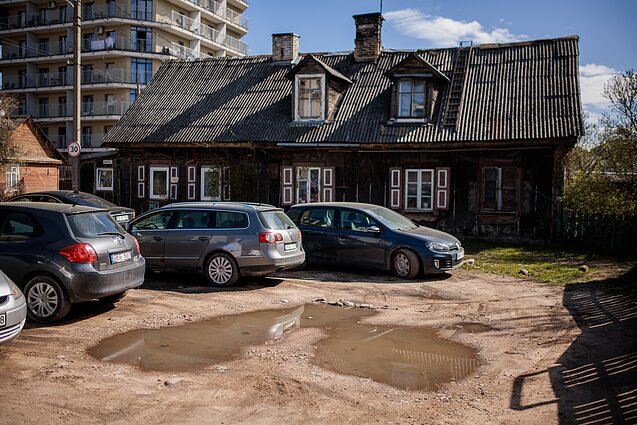
Most elderly residents of Shanghai of Vilnius are also determined to stay there for the rest of their lives, the real estate agents note. That is the reason we see a stark contrast: old, dilapidated houses with outdoor toilets next to modern glass skyscrapers.
Public auctions
Walking around Šnipiškės, one can see a few municipal signs announcing properties for sale by public auction. The starting price of a property on Giedraičių Street can be as low as 36 euros or as high as 131,000 euros.
According to Gabrielius Grubinskas, a representative of the Vilnius Municipality, there are currently 14 municipality-owned flats and one part of an unfurnished attic for sale in Šnipiškės.
“There is a constant interest in the municipality’s properties. For example, last year 58 properties were auctioned, including 10 in Šnipiškės,” he says.
According to Grubinskas, Šnipiškės is a very important part of Vilnius both because of its location and identity.
“It is a historical suburb of Vilnius, mentioned in historical sources as early as the 16th century. Šnipiškės has two protected cultural heritage sites at the municipal level, called Skansenas and Piromontas,” he notes.
“Skansenas is characterised by a relatively high concentration of wooden houses and homestead-type developments. Although the individual wooden houses are not valuable enough to be included in the Cultural Heritage Register as individual objects, the urban structure that they create, which determines the unique way of life in Šnipiškės, is of value,” Grubinskas explains.

However, the municipality representative admits that development in Šnipiškės has been rather chaotic, with new apartment buildings disrupting the visual integrity and urban context of the area.
“Such development is also worrying for the inhabitants of the wooden houses who want to preserve their identity. This is why this year a programme is being organised to involve the residents of Šnipiškės in the process of clarifying the uniqueness of the area and defining more clearly the rules and norms for preserving heritage,” he said. “The aim is to ensure that the development of the district is sustainable and in harmony with the historical urban distinctiveness of Šnipiškės.”

Newsletter
Every Friday morning.