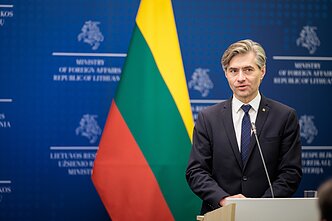


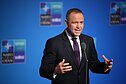








Elected in 2020, Lithuania’s government declared the ambitious goal of pursuing a values-based foreign policy. But was there more behind the rhetoric? In an interview with LRT, Foreign Minister Gabrielius Landsbergis talks about Taiwan, values in politics, and Lithuania’s identity.
This is the second part of the publication about values-based foreign policy and its echoes in Lithuania’s Taiwan pivot. Read part one here.
"I think our three-year period has proved that it is possible to define [a values policy] without getting into some kind of trenches and being able to explain decisions or their logic and to pass that test of values policy," Landsbergis said.
"Values politics is strongly pragmatic, because it also determines the survival of the state, the ability to defend itself – dependence on authoritarian regimes that promise some great economic successes, but in the long run come at a pragmatic cost," the minister said. "You potentially have to pay a security margin because we will be too dependent on a state that uses the economy as a weapon."
How much was Taiwan a values-based decision and how much a pragmatic, realpolitik decision? As far as it is said off the record, and you have said it before, it was done to get under the US security umbrella?
There are side effects [like] with the Taiwan more and many others. On Taiwan, the decision was, first of all, to reduce China's economic influence and to find new partners in the region, including by opening a Taiwanese representation in Vilnius. It started as an economic project.
[...] First of all, it is a decision based on economic logic, but it also has a strong base in values. In many cases, we see ourselves and our desire for freedom in these people, and they see and recognise it when they look at us.
Geopolitical overlaps are a side effect that I think is important for Lithuania.

This is hard to believe, given the geopolitical reaction that is triggered by any decision on Taiwan.
Yes and no, Lithuania is not the only country seeking to deepen economic ties with Taiwan. It is the same Germany that has fought relentlessly for the opening of the [Taiwanese chip company] TSMC factory.
Did Germany get ahead of Lithuania to win the bid?
Well, Lithuania still had some way to go.
Taiwan initially pledged €200 million of investment for Lithuania, then the fund expanded to include the rest of Central and Eastern Europe. Did Taiwan outplay Lithuania?
I don't see the game, I didn't like the discussion that Lithuania expects direct, pragmatic support from Taiwan, or that somebody has to compensate us for our decision. Lithuania is a sovereign state and makes its own decisions. [...] We are still saying that these are long-term projects, a long-term posture. The move of a small country into the Pacific will certainly not be resolved in one year.
Why did Lithuania need an Indo-Pacific strategy?
The world has turned there. Lithuania is a member of at least two very important alliances. Lithuania's future depends on the future of that region, both security and economic.
In this case, you are talking in US terms.
As far as those pragmatic elements are concerned, the fact is that a large part of politics is pragmatic anyway. The only question is, pragmatic with whom? Pragmatic with someone who works against your values or pragmatic with someone who works for those values?

The Pacific Strategy Paper was published just before the NATO summit in Vilnius. Was that just a good PR campaign?
I will leave the generalisations to you. Was it a good opportunity to present the strategy to NATO colleagues here? That’s a fact. At the same time, it was a good opportunity to present it to the media.
Lithuania has gone global. On certain issues, not always by choice – especially when it comes to the migrant crisis. How about that know-how, or are we short of hands?
It seems to me that we are certainly capable of carrying an issue like the Indo-Pacific [strategy]. And, again, I would not deny that we need to develop competencies, but that is why I wanted to approach the issue not in a [dispersed] way that we open embassies, send ambassadors, equip embassies and that's it, but that there were clear missions and tasks. That is the importance of that strategy.
Today, we have quite a wide network in the Pacific, but people also have a mission statement of what our purpose is there – economic, political, values. It is about making Lithuania's name known in geographically distant regions, and I am convinced that we can carry that.
In the broader context, [...] in foreign policy, we are limiting ourselves. First, we think we are small, and then we think we are not rich enough, we are not very good at identifying our challenges, we are critical, [...] and that shackles us.
It's one thing mentally, but it's another when there are only four people in a department – I'm hyperbolizing here of course …
I think letting go of restraints helps us to articulate our [aims] – sometimes four people can do that. There are smaller countries, or slightly larger countries, that we do not consider to be unfortunate cases in foreign policy.
For example?
I would point the finger first at the Nordic countries, with the possible exception of Sweden, which is bigger. Norway, Finland are similar to us, while Iceland – we can feel like a big country when compared with Iceland.
But this doesn’t mean that they do not have an effective foreign policy. With much fewer resources, they can do really significant things to defend their interests. The first task is to break the self-imposed barriers. When you present yourself with dignity, it is how you will be seen. It seems to me that we have gotten rid of that fear and we are succeeding in changing our inner attitude.

As far as freedom of action is concerned, you are the chairman of the lead party in the coalition, you have a majority in the Seimas, and you also work well together with Prime Minister Ingrida Šimonyte. Do you feel that in this position you have more freedom to take bold, perhaps controversial, decisions?
Necessary ones, I would say.
How much leeway do you have personally to be able to shape, for example, the Taiwan strategy?
The mandate of an MP is a bit broader when you are a party chairman and allows you to speak more freely.
I am not talking about language.
Language shapes policy. This is especially true in foreign policy. Sometimes it only takes one interview to shape the direction of foreign policy. [...] I have seen such cases. Of course, actions must accompany words.
Do actions accompany Lithuania's rhetoric?
I think that in the Indo-Pacific region, we are doing the maximum that we can do. It is very important that this direction takes root, and that it continues. In Ukraine as well.
If you ask me whether we could have done something better, of course, in retrospect, we could have.
Coming back to the freedom of action, do you feel that you can take the lead or just decide unilaterally?
Within my mandate. They may be broader than those of some of my colleagues who are not MPs or so on, but first and foremost the mandate is of the people.
In Estonia, there is now a scandal involving Prime Minister Kaja Kallas due to her husband's links to a business that continues to work in Russia. How do you see the scandal?
I am sad because I see that Russia is happy. It will probably surprise no one to hear a Conservative in Lithuania say that Kallas is, after all, one of the strongest voices in the West in countering Russian disinformation.
But, again, this is about the gap between voice and actions. Kallas is an important voice, but her husband continues to pursue business relations with Russia. Looking at Lithuania, journalistic investigations have shown that exports to Russia, including parts bound for the military, have been moving via Klaipėda. Is it not a matter of time before this could bring down Lithuania’s [pro-Ukrainian] voice?
There is a bit of hypocrisy here, and not on Lithuania's side. It is from the side of those who criticise. Lithuania is the EU's gateway to the East, we have the widest border with the East – not only with Belarus or Russia, but goods going to Kazakhstan, from Germany or the UK, if they go by road, if they are not sanctioned, they go through Lithuania.
Let me ask you differently – what is being done?
A lot is being done. Lithuania is so far the only country in the region to have unilateral restrictions on dual-use goods crossing Lithuania's external borders due to national security constraints. We have been trying to persuade our partners in the region to do the same, as we see a reconfiguration of flows to other countries. We are part of a rules-based order. Rules are also a value and they protect us.
[...] Our voice is important when we try to change or tighten those rules. I would like to remind you that often in Lithuania we do not feel the sentiment that the Baltic voice in Europe is very lonely on the side of tightening [sanctions]. More calls are coming from the other side.
A very simple example is that of Belarusian potash [fertiliser] – Lithuania is the only country that has vetoed the exemption for potash fertiliser, which would have brought money to the regime of Alexander Lukashenko.
You mentioned Belarus. In your opinion, are we turning away from the Belarusians?
I do not think so. Hats off to Sviatlana Tsikhanouskaya and her team. They have been doing tireless work.

On this issue, there is a [negative] voice from some of your party members about the Belarusians. And I think it is a very good example of where language shapes action. Although there are no real actions against the Belarusians, apart from the thousand visas and residence permits that have been refused or revoked, the Belarusian diaspora feels as if real action is being taken against them.
Even though I have an opinion and have said it many times, I see a difference between those coming from Belarus [and Russia] and I am not yet aware of any real evidence that would show that there is a threat from [Belarusians] who come here.
If that were said, if the authorities contacted the Foreign Ministry, the Interior Ministry, the government, I would not deny there was a threat, but I have not seen such information. I am against introducing additional restrictions on top of those already in place.
I also remind colleagues who have found refuge in Lithuania, who say that they are uncomfortable with this debate – Lithuania is a democratic country and uncomfortable debates are part of our political culture.
As we approach the presidential elections, there will be a lot of uncomfortable topics and we resolve those topics during the elections. We vote for politicians who say less unpleasant things to us, that is the way Lithuanian democracy works, and sometimes you have to accept that.
More and more things are coming under the label of national security. [...] If we accept that the war in Ukraine is our war, that we are in a military situation, how much of our personal freedoms are we prepared to sacrifice for national security?
I have not yet seen a major over securitisation, despite the fact that there are voices calling for it. So far, I think that Lithuanian democracy is strong and able to withstand these challenges.
Alongside this is the question of responsibility. I would not be a Conservative if I did not ask whether we feel responsible for the security of our country. Given the reports about the regional security situation that I read, that my colleagues in the government read, we do not yet have a strong sense of the burden that we have to carry in order to ensure our security.
There is a real war going on right next to us, and it is hundreds of kilometres from our territory, not thousands. We have two regimes that are difficult to predict, which have now turned their guns on the Ukrainians, and they are just as likely to turn those guns on anyone else.
You mentioned “as a Conservative” several times in your answer. Is it not the case, however, that the internal issues of Lithuanian politics, that [you position yourself as] the party that can provide security, also influence Lithuania’s foreign policy?
You can't deny the fact that there is an ideological orientation. If it is sincere, faith shapes policy. Otherwise, it is probably difficult to imagine democracy working, or it would be artificial – you say one thing for domestic policy, you say another for foreign policy. Of course, these are complementary [things].

I read the values-based programme of the government. Again, I’m hyperbolising a bit, but it seems that the only clear value is to withstand the Russian threat.
Maybe that is just the way it reads to you, I do not know why. We do not disguise what we are defending, as to what these threats can damage – they can take away the right to exist.
But this is Russia again. I’m talking about the values-based policy overall.
But it also carries over into foreign policy.
But every time we come back to Russia.
Not necessarily. Part of our identity is shaped by the threat of Russia – by the occupation, and in the period before Russia. If we take some of Lithuania's historical periods, they are inevitably linked to Russia. We were occupied, we liberated ourselves ...
... but if languages shape actions, are we then not shaped by the "other", ie Russia?
No, the threat is a kind of a reality-shaper. We cannot say that we are in a vacuum. I am not saying that Lithuania's identity is only through Russia. It is individually shaped coming from history and all sorts of things. But one thread is the threat, and that thread is recognisable in other countries that find themselves in geopolitical fractures, on the frontier.
The question is, who is defending that state? Is it being defended by sheer power, by the support of partners, by NATO’s Article 5, or is it being defended by an idea and by some spiritual element that is hard to describe, just in terms of values?
The value-based policy is only linked to the existential question, then, for example, we will not criticise Poland for its human rights violations because Poland's support helps us guarantee our main value, which is to defend against Russia? Is the values-based foreign policy simply the pursuit of values that will enable Lithuania [...] to survive the threat of Russia?
I think you would agree that it would not be wise to follow [something] that would reduce our [ability] to survive. But, on the other hand, I do not see that Lithuania is and has been silent on any other issues – on our strategic partner, our neighbour [Poland], that question was raised at the beginning of the mandate. I have also raised it in bilateral meetings.
I wouldn't say that Lithuania is bypassing the issue or otherwise. There are priorities, the closest and most painful crises that need a response. I think Lithuania is seen as quite consistent [...] in international politics.
However, the Lithuanian mission in Taiwan was named after Taipei. Was it somewhat of a step back?
Every country, every actor, has the right to decide for itself about the name [of its foreign missions].
So you decided on Taipei?
We decided.
Why?
Because that was our decision.
The interview was originally published in Lithuania.

Newsletter
Every Friday morning.