















Not all Lithuanians take heed of calls by the country’s institutions not to travel to Belarus. Many are tempted by offers of the Kelvita travel agency to rest in Belarusian sanatoriums.
“Treatment in Belarus at the NAROČ sanatorium, meals included!” This and at least five other similar offers can be found on the website of the Lithuanian travel agency Kelvita.
According to the agency, its Belarusian holiday packages are popular among Lithuanians.
“We now have places available from September 10 onwards. Buses and sanatoriums are full, there are no places. There are two places for a week from September 10, and if you want two weeks, places are available from September 17,” an employee of the travel agency who answered its phone told the LRT.lt journalist who posed as an interested traveller.
“The sanatorium Naroč costs 400 euros for a week and 600 euros for two weeks per person. If you want the Neman sanatorium near Grodno, it’s 460 euros for a week and 710 euros for two weeks. This is including travel expenses,” she explained.

She did not seem to take the institutions’ calls on Lithuanians not to travel to Belarus seriously.
“We go every weekend, that’s all... You know, if war breaks out, we won’t even know when it starts. Whether it’s something like that or whether it’s the closing of the borders – we cannot predict it. But for now, we’re going, everything is fine,” Kelvita’s representative said.
Cheaper than in Lithuania
Soon, Kelvita’s website announced that trips to Belarus are no longer being organised. But it seems that this decision is only temporary.
On August 16, the LRT.lt journalist again asked the agency’s representatives about the possibility of travelling to Belarus and was told to consult the exact departure dates in a few weeks.
Irina Šeinker, head of Kelvita, has confirmed a temporary break in planning trips to Belarus.
“We offered [trips to Belarus] some time ago, but we don’t do it for the time being. When we offered it, it was a popular trip because we offered mainly spa treatments. [...] We have put it on hold. We are watching, monitoring,” she said.
According to her, the trips to Belarus were especially popular among older people who speak Russian or Polish better than Lithuanian.
“Older people ask about these sanatoriums because the treatment there is cheaper than in Lithuania,” Šeinker said.

In her words, these tourists do not face any obstacles when crossing the Belarusian border, as they have confirmations of their stays in the sanatoriums.
When asked if she thinks that by selling such trips Kelvita is diverting the money of Lithuanians to Belarus and thus funding the Russian ally, Šeinker said she does not want to talk about this issue.
“For the younger ones, we offer treatment in Georgia and Bulgaria. Those who can afford it, go there. But those who cannot afford it and want to improve their health… It is much cheaper [in Belarus] anyway. You see, we need to look at whether it is good for our citizens, not what we are or are not funding,” she explained.
She pointed out that although the Lithuanian authorities urge people to refrain from travelling to Belarus, they do not forbid it. Šeinker also doubts that elderly travellers who go to Belarus could be recruited by Belarusian intelligence.
Serious risks
Politicians responsible for national security and defence see risks in offering Lithuanian citizens retreats in Belarus.
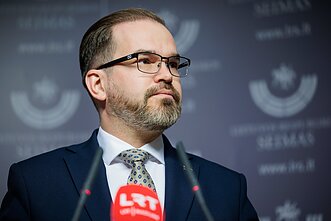
According to Dainius Gaižauskas, deputy chair of the Parliamentary Committee on National Security and Defence, Belarusian special services can exploit travellers from Lithuania for their own purposes.
“I think this is one of the means that can be used by the Belarusian KGB or Russian intelligence, which can attract certain Lithuanian citizens and recruit them through such sanatoriums,” he said.

He disagrees with Šeinker’s view that older people could not be recruited by Belarusian structures.
“Not only will they recruit them, but it is even easier to recruit them. [...] They come from the Soviet era, and they have a completely different approach to certain things,” Gaižauskas noted, adding that the Lithuanian citizens’ trips to Belarus may also be used for propaganda purposes.
Over the first six months of this year, 230,000 Lithuanians have travelled to Belarus, even as Vilnius-Minsk relations remain hostile, and the Lithuanian government has advised citizens against going to the country.
Further reading

Newsletter
Every Friday morning.