













As the war in Ukraine raged, Benjamin Tallis marvelled at the support emanating from the Baltic states and Eastern Europe. For the first time, the voice from the East was helping shape decisions in the West, not vice-versa. Grasping for a word to define what he was seeing, he coined a new term – neo-idealism.
“[Neo-idealism] is a morally grounded or morally-based approach to geopolitics that puts values first, including human rights, fundamental freedoms, and the right of free societies to collective self-determination,” says Tallis, senior researcher at the German Council on Foreign Relations who has previously worked for the EU in Ukraine and advised the German government.
“That means being free to choose [...] and not having to be under spheres of influence of great powers, for example,” Tallis adds.
By taking into account people’s views, and not viewing a country as a chess piece in great power competition, Ukraine should be able to join the European Union or NATO, without Russia having a veto over it, he says.
“Too often, we in democratic societies have doubted ourselves and our systems. Ukraine's fight [...] has reminded us why freedom, democracy and rights are worth dying for,” he wrote. “Putin's Russia reminds us very clearly of the alternative.”
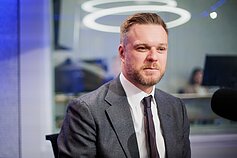
Gabrielius Landsbergis, Lithuania’s top diplomat who helped spearhead the government’s “values-based” foreign policy approach, was among those to pick up the neo-idealism concept. The foreign minister was also due to use the neo-idealism keyword in his NATO dinner speech as the concluding rallying cry, however, the address was cancelled.
The concept of neo-idealism, although borrowing influence from the existing theory that questions Cold War dogmas, is as novel as it is still full of gaps.
How does the pro-democracy rhetoric Lithuania deploys to criticise its authoritarian neighbours fit with its silence on anti-democratic reforms in its partner nation Poland?
Or how does it stand up to the values-based rhetoric when Vilnius officials admit off-record that the Taiwan pivot was primarily guided by national self-interest of aligning with the United States, not the proclaimed but later watered-down pledge to “defend those who fight for freedom in the world – from Belarus to Taiwan”?
Finally, is neo-idealism just a naive and futile hope of having morality guide international relations?
Tallis sat down with LRT.lt on the sidelines of the NATO summit in July to talk more about neo-idealism and whether it can be a viable policy tool rather than an empty rhetorical device mired in contradictions.
What is neo-idealism?
What I tried to do when I first coined the term in April last year [...] was to look at what I saw coming out of Central Eastern Europe as the response to the full-scale invasion [of Ukraine]. I tried to make sense of why this was so different and so differently articulated than it was in some other places.
And the more I looked at it, the more commonality there was about this values rhetoric plus very strong military support. So material combined with morality.
It was also a way that the region could actually punch above its weight. [...] But the more I looked, the more I found this rhetoric elsewhere as well as in some of the things that are said by [President of the European Commission] Ursula von der Leyen, for example.
Ie that amazing moment when she upturned two decades of EU policy on Ukraine in two sentences when she said: they're one of us, they belong with us. I've worked on EU-Ukraine [relations] for 20 years and I couldn't believe it. And then she pushed it through against the objections of France, Germany, the Netherlands, etc, with the support of leaders from this region.
So does neo-idealism stand in direct opposition to realism, as you said before, with its focus on “spheres of influence”?
[Realism is a set of theories in international relations that emphasise the role of states, national self-interest, and power in geopolitics. Critics name realism as the guiding principle behind calls to preserve Ukraine’s non-aligned status as a buffer between the so-called great powers.]
It's a very direct critique of realism. That's exactly what I intend to do – to show that those kinds of approaches are intellectual justifications for chauvinism and imperialism, and lead to the kind of thinking that says Ukraine doesn't matter, that only the great powers matter and that we have to listen to Russia and care about Russia's security concerns.
Dictatorships don't have legitimate security concerns. And if we pay too much attention to what they think, we forget about people who want to live in a democracy.
In a review of your book, you were grouped with writers like Anne Applebaum who are criticised for being stuck in the 1990s utopian, Fukuyama’s “end of history” paradigm. How is neo-idealism different?
[The End of History and the Last Man is a 1992 book by the American political scientist Francis Fukuyama. He argued that, with the end of the Cold War, we had reached “the end-point of mankind's ideological evolution and the universalisation of Western liberal democracy as the final form of human government”. His misplaced optimism is often attributed to the emergence of a unipolar world order following the collapse of the USSR.]
Neo-idealism is definitely about trying to restore and recover the hope of the 1990s. You can see that from the generation of leaders who are proposing it, people like Gabrielius Landsbergis, whose formative part of their lives were in the 1990s when it seemed, especially in this region, that things could only get better.
Now we know where that went wrong – it went wrong from 9/11 and the 2008 financial crisis onward in a significant way.
The security culture that came in after 9/11 empowered the neoconservatives. It unleashed an awful lot of problems on the world, Iraq being a key example of that.
The 2008 financial crisis showed the limits of neoliberalism that came alongside [neoconservatism] at the same time. And that's where I would certainly put Anne Applebaum in the neoliberal camp, along with a lot of the people who were around that circle in the 1990s.
The way the post-Soviet transition was handled in Central and Eastern Europe was thoroughly neoliberal and I think that was a mistake.
[Neoliberalism is generally associated with policies of economic deregulation, privatisation of state-owned industries, globalisation, austerity, and the reduction in public provision of services, thus massively increasing the role of the private sector.]
The promise of neoliberalism was that the aggregate benefit will be higher. And indeed it was. It's just where it went, that was the problem – it went to the already rich in Western societies and to people in China, loosely speaking.
The deal for that was that people were supposed to be retrained, people were supposed to get social capital investment and that just never happened. And it was at a time when social redistribution was declining.
So you see wealth inequality growing and you see pessimism growing. Four out of five Americans don't think their kids will live better than they [themselves] do. Well, unless we do something about it.
Neoliberalism [also envisioned] a very minimal role for the state as a facilitator of markets and we've seen the death of that with Covid. With the return of large-scale war to Europe, the state is very much an enabler now and a crucial player. Companies asking for guidance on how to bring geopolitical risks to their calculations is just one example.
Neo-idealism [...] is not tied in with neoliberal economics and that's another distinction from both neo-conservatism and liberal internationalism.
But the biggest difference with neo-conservatism is that neo-idealism seeks to defend and renew democracy where it exists, rather than trying to impose it by force. So if Iraq is a quintessential neoconservative case, then supporting Ukraine is in the neo-idealist case.
Is neo-idealism intrinsically linked with the post-Soviet transition?
No, definitely not. It has come from here and it's unusual for things, for big ideas and big new approaches to come from here and take on elsewhere in the world.
And that's also what I'm trying to help make happen, because I think Kaja Kallas, Gabrielius Landsbergis, Edgars Rinkēvičs, Artis Pabriks, Zuzana Čaputová, Eduard Heger, Michal Simečka, Jan Lipavsky, they have really good ideas about this and I think they have been ahead of the game in actually showing the future for a new kind of geopolitics for democratic countries.
There have also been neo-idealist moments in other countries, for example, some of the stuff that the United Kingdom has done on Ukraine has taken quite a neo-idealist form.
It's about defending democracies and it's about getting out there and pushing free societies [to go further].
[Democratic countries] are not consistent on it and you can see the problems with their economics, you can see the problems with their migration policy.
German Foreign Minister Annalena Baerbock would be someone I think of as a neo-idealist as well. It's not as fully developed in policy and practice but she has a lot of rhetoric pushing for values.

When sticking with this neo-idealist model, are you not just going to inevitably run into contradictions?
I mean, welcome to politics, right? I think there will always be choices to be made and some of them would be more in an idealist direction, others less so. You can't do everything at once, perhaps. And so one of the most important things to do is to build political will and support for this kind of move.
Do they have to be contradictions in perpetuity or do you keep addressing them progressively and working towards [fulfilling ideals]? That would be my question about how to solve this.
The question is what you can do where. And I think that was partly a lesson from the neoconservatives as well, that in certain situations going in militarily, intervening in certain places is not the right thing to do, especially if you don't have a plan for what to do afterwards and it's not a sincere plan about building democratic societies.
And I think [what happened] in both Iraq and Afghanistan hurt the United States, Western countries, and it hurt Iraqis and Afghans hugely.
One confusion that I’d like to address is that I'm trying to do by identifying an approach coming out of practice and then making it into a concept that has elements over different policy fields. But also that it's then unfair to judge that against what politicians are doing at the moment, because this concept hasn't been worked out fully.
It will ultimately be up to them. Do we think they will be able to implement this, be that here or in the US or wherever else? It might be that you're right, those contradictions continue to exist.

When Lithuania's current government came to power in 2020, they declared that they will pursue a values-based foreign policy. But officials are very open about the fact that Taiwan was not about values, it was about getting under the security umbrella of the United States. So, again, when you declare these values and your policy being guided by them, how does it then sit alongside very pragmatic political considerations?
I think it's a false distinction to say we're doing this [only] to get closer to the US. It's understanding that your values are your interests.
But then why dress it up in this rhetoric of values, when you're in fact doing it for very pragmatic reasons?
Because the two are connected. And I think what you are arguing is interconnected. I'm arguing that for neo-idealists, our values are our interests. And that's the distinction. This is also something Baerbock said to me in Berlin.
We were at an event and I asked her a question. And she said this distinction between values and interests is, quote, total crap. That's quite a bold comment from a foreign minister.
I think that's something that Landsbergis understands, so you can sell this both ways. You can sell it as a hard-nosed interest case, but you can also sell it as an appealing values case to other audiences. And it's actually the same thing.

Newsletter
Every Friday morning.