




This is a story about how Red Army veterans, mobilised by force, became anti-Soviet partisans. It’s also a story about survival, collaboration and resistance and the tough post-war years and the difficult choices people had to make.
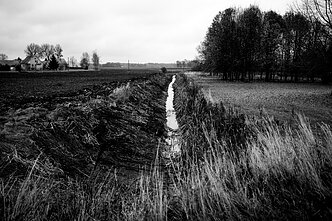
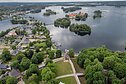
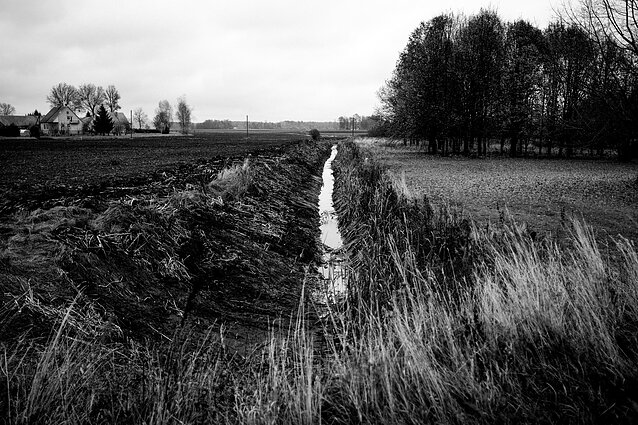
Water canals run through the plains surrounding the village. As you drive into Paluobiai, in southwestern Lithuania, you can see small farms, cows and sheep grazing in the fields. There is one other Stuba, a traditional house found in Lithuania’s Suvalkija region, in the village.
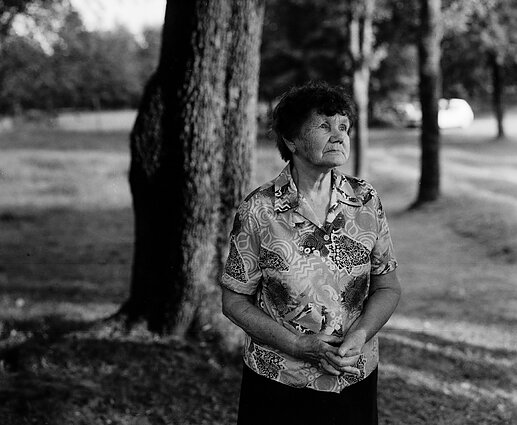
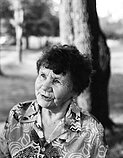
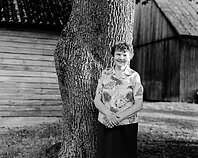
The home of Marcelė Kerušauskienė, the sister of the three brothers, is at the very end of the village. There are old trees in the yard, some of them planted by her brothers.
We sit down in her living room. On the wall, I see a photograph of her parents, Marcelė and Jonas Mockevičius, who lived a hard life and were small farmers.
The three brothers went into the woods to fight the Soviets at different times. The eldest brother Juozas was killed when he was betrayed. Later, Antanas was also wounded after someone’s betrayal and decided to end his life, rather than be captured alive. The youngest brother, Jonas, was arrested and spent ten years in Vorkuta exile. He died in Paluobiai in 2006.
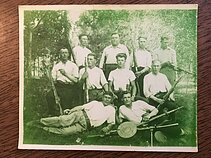
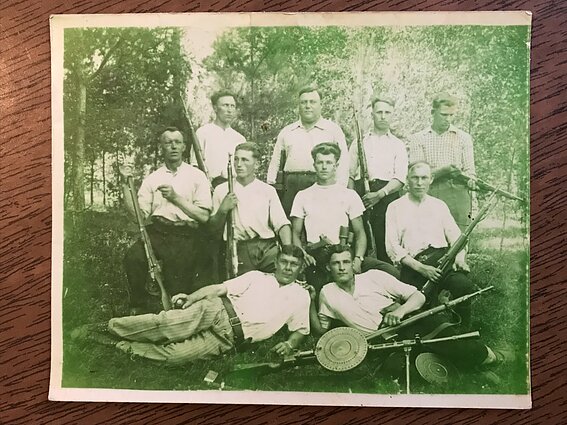
Marcelė begins her complex family history with a small, green-tinted photograph on the table. It shows her eldest brother Juozas, who worked in the police during the Nazi occupation, surrounded by other armed men. Marcelė describes him as a warm-hearted man, eager to learn and in very good health. Between the wars, he worked in the post office.
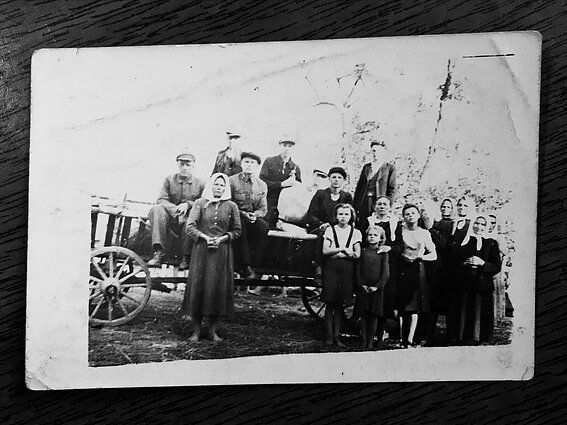
In another photograph, the entire Mockevičius family is standing next to a carriage in 1944, seeing off their three sons who were mobilised to the Red Army. Marcelė is standing in the first row and is the youngest child.
"The brothers were initially taken somewhere in Russia for training. They spent the winter there, and in the spring, exhausted, they had to walk back to Lithuania. If I remember correctly, they served in the 16th Lithuanian Division. Juozelis told me that the march was hard – many did not make it, dying of hunger or due to the wounds in their legs and infections. Juozelis was very strong. [...] They carried each other, which is why they reached Lithuania alive.
When they were brought here, they were locked up in a barbed-wire enclosure near Jonava. They started preparing for the front. The condition of the soldiers was bad – they were all soaked through, with injuries. My brother told me that a farmer had come to help the exhausted Lithuanians. There was a long queue to see him. Juozas was clever, he got involved in the cooking jobs, and that's how all three of them survived," Marcelė retells her brother's story.
In the spring of 1945, several people who refused to serve in the Red Army escaped from the camp. Among them was Juozas. As soon as they arrived in their villages, the soldiers looking for them immediately appeared. All the deserters surrendered, but Juozas ran into the forests and joined the anti-Soviet partisans, some of his acquaintances were already among them.
She recalls that at that time it was the very beginning of armed resistance, everyone was talking about the imminent help from the United States, which gave many people extra courage and the will to resist.
"They started letting me go to school. One day the teacher asked me to stay after school. I stayed and she started to ask: 'Marcelė, do you have any brothers or sisters'. I do, I said, 'but my brothers have gone to the army and we don't know anything more about them. We get letters from two of them, and one has disappeared.'"
The next day, the teacher put a note in a book and asked her to her brother.
"Juozas was just at home when I returned. I gave it to my mother, but my mother can't read, so she gave it to Juozas. During independence, Juozas was the postmaster, and my teacher turned out to be his secretary. So I carried letters to them – I became a liaison," Marcelė says about her involvement in the resistance. The teacher was later tracked down and sent to prison.
The other two brothers, Antanas and Jonas, stayed in the Red Army, even though they suffered because of their brother's escape. They were eventually sent to the front:
"Jonas had gone to Berlin and fought there. I don't know about Anatas – he was badly wounded somewhere at the front. He [had] an open wound in his chest. We met him in the spring of 1947."
Marcelė remembers that she was at home with her mother when a horse-drawn carriage drove into the yard. A large dog named Liūtas (Lion) was guarding the homestead. The dog was very attentive – if he sensed the Soviet collaborators, the so-called Stribai, he always barked, but if the partisans were coming, he was quiet.
"We see through the window people getting out. The dog is not barking, and when the man gets out, he approaches the dog, who gives him a friendly cuddle."
Then, they heard a knock on the door: "Mom, open up."
The badly wounded brother Antanas was also accompanied from the front by a doctor, as Marcelė remembers, apparently from Kharkiv. In the evening, after everyone had gone to bed, Juozas came out of the woods and knocked on the window.
Antanas was treated at the local hospital, but it didn't help. The mother found out that there was a doctor in Panemunė called Povilaitis.
She begged him to help, and the pharmacist asked her to come the next day. That evening they roasted a goose, prepared bacon and left. Food was a popular currency in those days. He got the medicine, and the pharmacist also added something from himself. He told them to eat as fresh food as possible, to walk more often in the woods, in the fresh air.
Despite his injuries, Antanas decided to join his brother in the forest.
"As soon as he got stronger, the collaborators come and take Antanas away for interrogation. Once he said 'it is better to die fighting than to go to the stribai.' And so he went to the forest," Marcelė recalls.
Soon after, Jonas, the third brother, joined them.
Aborted exile
Before Antanas and Jonas decided to join the local partisans, another important event took place – the deportations to Siberia in 1947.
"It was autumn, and we knew nothing about the deportations. My mother and I were lying inside, we heard a knock. We thought it was the partisans. We opened the door and saw the stribai. They started to search for us. [...] I got dressed, and I thought of running, but the stribai had surrounded the farmhouse. We went to the kitchen where my mother boiled some eggs, and made coffee."
Antanas said they would most likely be shot.
The stribai came inside, and read some act about our family being deported to Siberia.
"Antanas was lying in the barn, still feeling sick. [...] There was a little Russian called Boris. He was in charge of the deportations. I asked him to at least leave my dad, who was already sick. He told me that if I told him where my brother Juozas was, he would leave everyone alone.
I told him: 'We don't know where he is, but you leave us alone, and when I find out, I will let you know. Just don't go now.' He did not believe me.
Antanas is a quick-tempered man. He grabbed one of the policemen and a scuffle broke out. Everybody ran there, I thought it was a good chance to escape. So I did – I ran to school. My mother was chased into the kitchen by the stribai, but she jumped out the window and escaped, too, and came to the Mileriai family through a nearby canal.
Some of my acquaintances, the Giedraičiai, helped me. Then I was told that my family had already been deported and my mother had been shot. I was very scared, so I ran to the cemetery and hid in the bushes. I was afraid to go and look in our yard, I was afraid to see my mother dead.
Later it turned out that the collaborators had shot Liūtas, our dog. Everybody heard the shot, and when the collaborators were taking the family through the village, nobody saw my mother, so they thought she was the one who had been shot," says Marcelė.
Two sisters, two brothers and their father were taken to Pilviškiai village nearby, and from there they had to be transported further by train toward Siberia.
There were crowds of people, songs, screams, shouts and wailing.
"Two soldiers noticed my eldest sister Antanina crying. They asked her why she was crying so much.
And that's where we were saved by chance – my sister Elena, who had been herding cattle [and had] learned Russian quite well, started to shout angrily at that soldier: 'My brothers were in the army, now they are taking us away, how come?' The soldier got started and asked to see our brothers.
Another coincidence – it turned out that they both served in the same unit, he was the brothers' commander. He was told off for our brother Juozas [who escaped] and we were let go.
This was the first time the family escaped exile. Everyone rushed to get back home so that they could salvage some of the farm and property. The horse and two pigs had already been taken away by the soldiers. Potatoes and hay had already been sent for.”
Death of brothers
In the spring of 1948, news reached the family that Juozas had been killed on February 19. He had been betrayed.
The family didn't know much at the time – only that people saw Juozas’ body near the house of the stribai, the collaborators, lying in the courtyard among the bodies of the other partisans slaughtered in the two bunkers. Later, the men were buried somewhere.
Soon the family received another piece of news – they were going to be deported again.
“My mother was at home and was not going to hide. But at the last moment, she changed her mind and we decided to leave. By chance, we managed to escape. The stribai came to the house but did not find us. They took a horse and a cow and left. Jonas and Antanas had already gone into the woods by then."
Marcelė also talks about the death of her second brother Antanas: "There were two of them in the bunker – him and another partisan nicknamed Riešutas (Nut). It is a fact that someone betrayed us, but we don't know who. Some say that Dainelis was the one who set it up, others said that Andriuškevičius did. The testimony of a certain Juodsnukis is also mentioned in the NKVD [Soviet police] file. Their bunker was close to Juozas's bunker and the place of his death.
When they realised they had been betrayed, they both jumped out of hiding and ran. A bullet hit Antanas in the shin. As he ran past Antanas, Riešutas stopped and apologised, saying that there was nothing he could do to help him. As he ran away, he heard a shot - my brother did not want to be taken alive.
The body of Antanas was brought to town. The remains were examined by the same doctor who had treated his brother earlier. My mother and I went to see him later. When we entered the office, my mother introduced herself [by a false name] Mockevičienė. The doctor stood up, opened the door of the surgery, and looked around to see if there was anybody outside: 'Now let's talk,' he said.
He told the mother that he had indeed looked at her son's body. The doctor recalled seeing a local stribai looking at his brother's body and saying: 'Antanas, Antanas, you had such documents [of serving in the Red Army] why did you go into the forest?' He was in the war, he was wounded, he could have lived comfortably, but he chose to fight."
Marcelė found a former collaborator, who showed her where his father had buried Antanas.
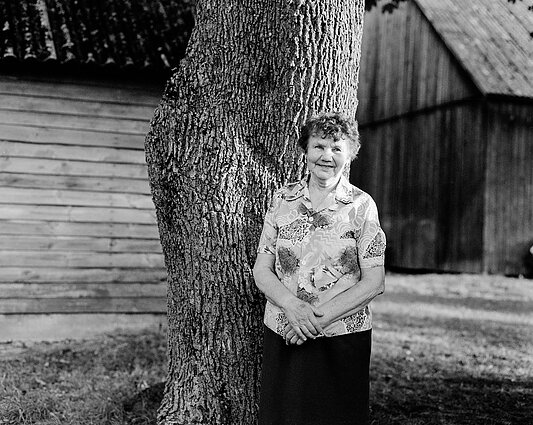
"He was young at the time and remembered his father's story well. His father had dug up a lot of partisans here. When he buried the body, he used to cut a nearby tree with an axe to mark the location. That was an important reference for us. I have dug up the bodies of other partisans with my own hands.
When my brother was killed in March, there was still snow. They threw his body into a trench left over from the war, covered it with branches and snow. His father also told him that Antanas' legs were sticking out, so they covered them with earth to prevent foxes from biting them. We found it exactly where he told us.”
In recounting the discovery of her brother Antanas' remains, Marcelė also recalls the story of finding the burial place of her other brother Juozas, which was the result of many coincidences.
It all started when Marcelė went to Šakiai, a town nearby, on business.
"I was late for the bus back to Paluobiai. I went to a taxi driver and asked if he could take me home. He refuses because there might not be enough petrol in the car. But he changes his mind, saying that if I drive on forest roads, there should be enough. He also says that he needs to go back to Lekėčiai.
We're on our way. I look at him carefully, and I see that the man is no longer a shepherd [not young], and he also mentioned Lekėčiai. ‘So you live in Lekėčiai, maybe you were born there?’ Yes, he replies, saying he had been born there, grew up there, and went to school there.
I keep asking him questions: ‘Did you happen to hear or see that partisans were being buried somewhere?’ ‘Yes’ he says, ‘I know. We were children, we went to see it, it was scary.’
I say, ‘I wonder where they buried them.’ He says he doesn’t know, ‘but there is a collaborator alive and living in the house where the bodies of the partisans were dumped.’"
Marcelė pulled up to a big yellow house in Lekėčiai. She got out, opened the door and went inside. There was a party going on.
"Who is the host here?” she asked. A man approached Marcelė. She asked him to step aside to talk.
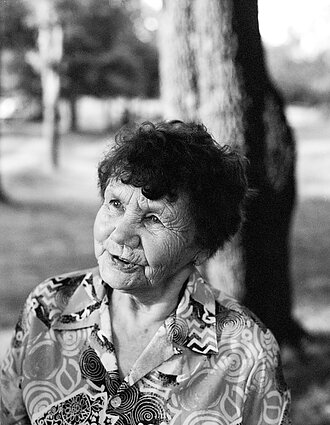
"We walked out and I said to him: 'I know you were a collaborator then. Help me – there were a lot of bodies dumped here. Where are they? We will be very grateful, we will repay you.’ He started to step back, saying that he didn't know anything, that he was young, just standing guard. I did not say anything back and asked him to try to remember, I told him that we did not condemn him. But he refused to help.
Two days later, we went again, and there was another party. But again, no reply. The stribai said nothing.
I also went to the pastor and visited the elderly people of Lekėčiai, but nobody spoke.
And then I went to see the forester. He recalled a case where, while digging gravel for a road, human bones started to show in one place. The forester was a very good man – he agreed to help, provided us with equipment, and allowed us to clear the forest so that we could carry out the excavation."
A mass grave was discovered, and the family bones were divided into two parts. Marcelė found the relatives of all the partisans who had been killed at that time:
“At that time I was working as a lab technician at the Lukšiai dairy, collecting milk from people in the area and taking it to the station. I found the wife of a partisan who had died together with my brother Juozas. She was in another bunker with her husband, but she survived.
She told me that when they were in the bunker, something banged on the hatch. They thought someone brought food. Her husband opened the hatch and immediately received a burst from a machine gun. He collapsed on the spot. She and her husband, the two Budriai brothers and one Jankauskas were in the bunker. When they realised that there was no way out, they all shot themselves to avoid being taken alive. Jankauskas shot himself, one of the Budrys shot himself, and the other was only wounded and could not bare to kill himself. As she told me herself, she saw the faces of her five children flash before her eyes and the gun fell out of her hand. So they took her alive.
Only later did I find out that this was not the end of the story. She was promised mountains of gold, she herself told me that they [collaborators and Russian officials] treated her nicely.
The woman worked in a kindergarten in Kaunas. I went there to see her. We had a lot of contact before the funeral, but later we found out. Various people told me, and then someone familiar with the secret archives confirmed it.”
Marcelė found out she was the woman who betrayed her brother, revealing the location of Juozas’ partisan bunker.

The final burial
When asked why she decided to search for the remains of her brothers, who died more than three decades ago, Marcelė says it was because of her mother.
“It was my mother's great desire to see her sons properly buried. I remember in her old age, she used to go to the forest, digging in the ground with a stick, saying 'maybe I'll find a small bone of Antanas’. She was so restless. I saw it, I felt it.”
She recalls that by then, "independence was beginning to dawn", and the feeling of freedom was approaching, so she decided to start looking.
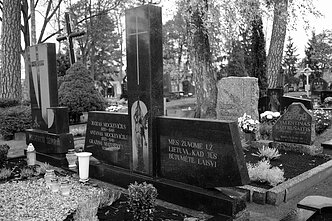
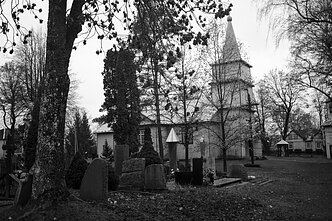
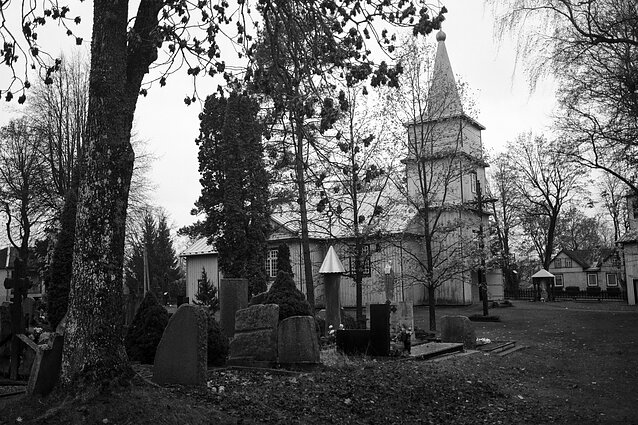
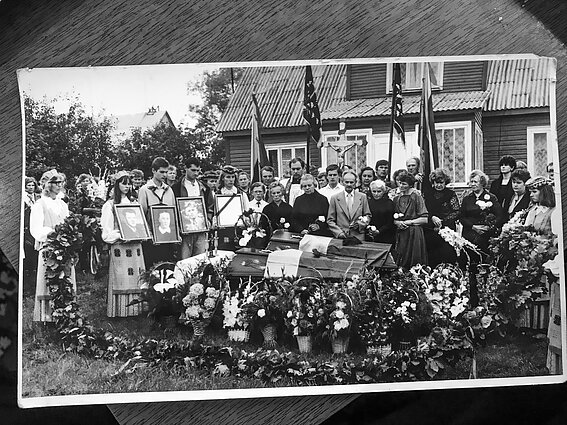
When the remains of Juozas and Antanas were finally found, Marcelė started to organise their burial in the Paluobiai cemetery.
The party secretary called a meeting of the collective farm, where the people were told that if anyone attended the funeral, they would be fired.
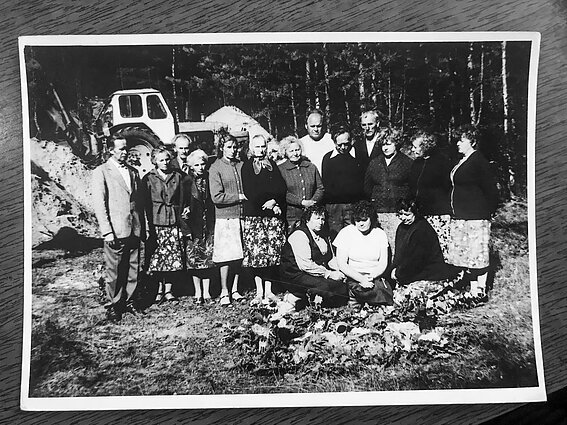
The local choir, with whom Marcelė spent a lot of time singing, refused to sing at the funeral: "They bowed their heads and remained silent. We invited singers from Griškabūdis," another town nearby.
"Before the day of the burial, I was like a non-person. There was a lot of gossiping, and local people were laughing: 'Miracles are happening, imagine, bandits [derrogative way to refer to the partisans] are being buried.' I know that in Siberia, before the coup in Moscow in 1991, the barracks [for deportees] were being repaired, and if the coup had ended differently, we would have been taken away.
In my area, I was the last of the nineteen people on the list. I was told this by a well-informed person. There were three high-ranking Communists in the district and there was another person in close contact with them who was passing information to me. He used to come to me at the dairy and carefully tell me what was happening.”
Bronislovas Lubys, a former Lithuanian prime minister and later a signatory of the country’s act of independence, helped spread the word about the funeral by publishing an advertisement in his newspaper.
It was August 1989. Marcelė recalls how tensions rose in the neighbourhood – some locals condemned the funeral, others silently supported it. Only a few people were willing to openly help prepare for the ceremony.
She recalls that as the funeral approached, three women, mostly likely informants, showed up – one was constantly sweeping the road, another was always riding on a bicycle, and a third was walking around and talking to people.
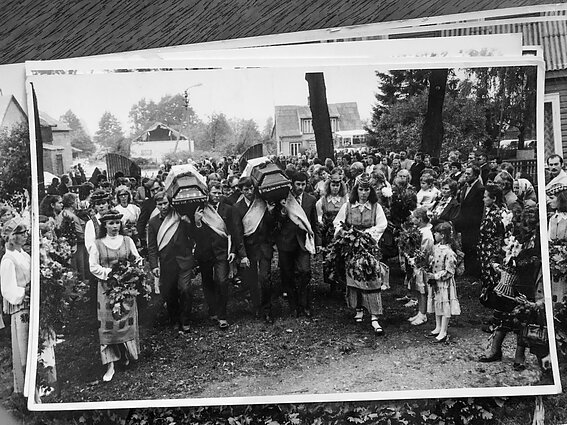
After reading an ad in the newspaper, people came from all over Lithuania to attend the burial of Marcelė's brothers.
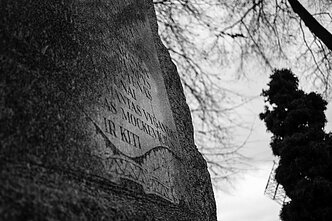
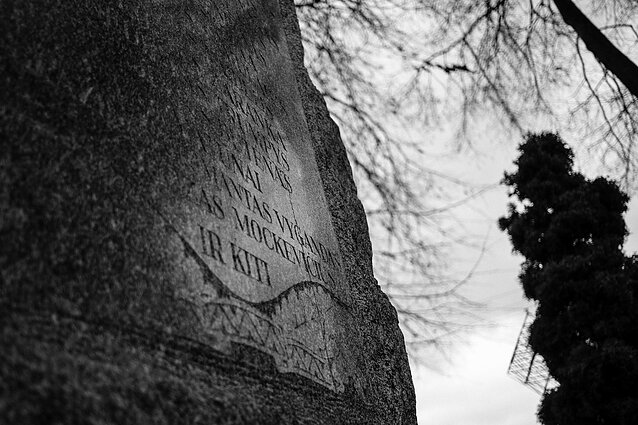
The funeral took place on Sunday, August 14, 1989. The brothers became the first anti-Soviet partisans in Lithuania to receive a proper burial.

Newsletter
Every Friday morning.