










NATO leaders meeting in Vilnius on Tuesday endorsed a communiqué promising Ukraine membership of the alliance. But does it show a breakthrough or merely a repeat of the fateful Bucharest declaration almost two decades ago?
This article originally appeared in Lithuanian here.
Back in 2008, then US President George W Bush persuaded allies to open NATO's doors to Ukraine and Georgia, despite strong opposition from Russia.
NATO welcomes Ukraine’s and Georgia’s Euro-Atlantic aspirations for membership in NATO. We agreed today that these countries will become members of NATO,” the summit’s declaration said at the time.
However, the gates of the alliance never opened for either Georgia or Ukraine, with Russia soon embarking on a war footing.
Fifteen years later, NATO leaders gathered in Vilnius reiterated that Ukraine belongs in NATO, but the communiqué only included the vague phrase "when allies agree and conditions are met”.
Margarita Šešelgytė, director of the Vilnius University Institute of International Relations and Political Science (TSPMI), called the communiqué "water".
"According to the way the communiqué is framed, there is room for a repeat [of the Bucharest scenario] and worse, because today the conditions have changed," said Šešelgytė.

Former Lithuanian Foreign Minister Linas Linkevičius, who attended the fateful Bucharest meeting, has always taken the position that it was precisely the indecisiveness shown by NATO at the time that led to Russia's aggression against Sakartveland and Ukraine.
However, some other diplomats, particularly from the West, take the opposite view – that the hints of pending membership put the Kremlin on a warpath. These ambiguities continue to shadow over any possible further NATO enlargement.
Linkevičius, now an ambassador-at-large, told LRT TV that the Vilnius declaration should have provided assurances that "we will help to the full extent, as much as is necessary, politically, with weapons and in every other way, and when the territory of Ukraine has been liberated [...] we will immediately discuss the issue of an invitation".
"But it is a pity that NATO has not again shown the courage, the leadership that it could have shown", the ambassador said.
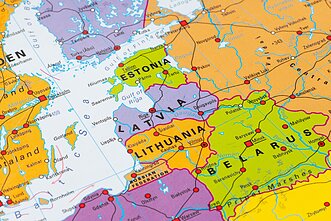
Lithuania remained the only nation in NATO to advocate for Ukraine’s early inclusion in the alliance. According to one diplomatic source, Lithuanian representatives were even preparing to block the summit’s conclusions together with at least a few other countries, but when they withdrew, Lithuania remained isolated and the communiqué was announced on the evening of the first day of the meeting.
Even Warsaw backed away from supporting Ukraine’s membership. Polish President Andrzej Duda later went on record saying that he does not see Kyiv in NATO “today”.

Two different NATO officials also said that the German and US positions were closely linked, and that it was Washington that blocked Ukraine's clear path to NATO.
This indicates a change from the situation in 2008. Although the Bush administration, together with the Eastern European countries, sought to include Ukraine as explicitly as possible in NATO's enlargement plans, this was mostly opposed by Germany and France.
Now, with a war already underway, which many diplomats and experts see as one of the many consequences of the abstract Bucharest communiqué, Washington is also toeing a soft line.
"The Bucharest summit left a lot of bad aftertaste and actually created the strategic ambiguity [...] the permanent NATO waiting room for Ukraine and Georgia," Chatham House expert Orysia Lutsevych told Reuters news agency.
She said that Ukrainian President Volodymyr Zelensky and his team are trying to minimise the uncertainty that could encourage Russia to continue the war – as NATO leaders say, as long as there is a war, there will be no Ukraine in the alliance, because that would mean a direct war with Moscow.

On Wednesday, the Kyiv Independent, a popular English-language news website that brings together Ukrainian and foreign journalists, published an editorial letter condemning "missed opportunities".
"The Vilnius summit comes 15 years after NATO committed arguably its biggest mistake in modern history. In 2008, German Chancellor Angela Merkel and French President Nicolas Sarkozy blocked the admission of Ukraine and Georgia into the alliance,” the letter reads, adding that "NATO should not make the same mistake twice".
The editorial reflects the largely prevalent sentiment in Ukraine that NATO has been, and still is, slow to react. But, as Zelensky also mentioned in his speech, the country is aware that some people are afraid of Ukraine's rapid membership of NATO, because "nobody wants a world war".
On the first day of the meeting in Vilnius, German Defence Minister Boris Pistorius refused to answer LRT’s question whether the communiqué would not end up being a rehash of Bucharest in different words, urging to wait for the final document. However, the text, which appeared just a few hours later, did not provide clarity on Ukraine's NATO membership.
"Berlin may be hiding behind Washington but this approach is short-sighted and self-defeating approach for both Germany and the United States," Benjamin Tallis, a senior researcher at the German Council on Foreign Relations, told LRT. He previously worked on European Union policy in Brussels and the German government.
"It sends a weak deterrence signal and seems to concede that Moscow has a veto on NATO enlargement," he added.

According to Linkevičius, it is now important to decide what would mean the end of the war, which would open the way for Ukraine to join NATO. And while the allies agreed to drop the Action Plan (MAP), thus making the adoption process a one-step rather than a two-step process, according to NATO Secretary General Stoltenberg, this did not provide clarity.
"Some vague terms have emerged, [...] nobody even knows what they are, because everybody explains it in their own way," Linkevičius said.
On Wednesday, the G7 leaders decided to provide coordinated military and economic support to Ukraine, although they did not specify what "modern military equipment in the land, air and sea domains" is planned for Kyiv. It is also not clear whether these will be the Israeli-type security guarantees that were discussed before the Vilnius meeting.
"The most important thing for Ukraine at the moment is to win the war, not some recorded words,” said Šešelgytė from TSPMI, adding that the biggest danger was of sending Putin the wrong message that “Ukraine was not important for NATO”.
However, if concrete actions follow the commitments expressed in Vilnius, then "there is no tragedy".
Vilnius also hosted the inauguration of the new Ukraine-NATO Council, which will allegedly mean that Kyiv and the alliance will take decisions "as equals", rather than dealing with each of the bloc's countries individually, Stoltenberg said.
"The allies who want to do more and who understand that Ukraine's fight is our fight too need to step up and make a more meaningful security offer [which] would help shorten the war," Tallis said.

Newsletter
Every Friday morning.