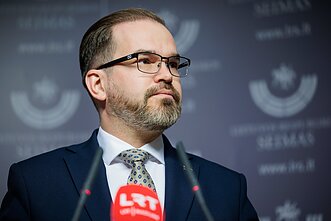

















To meet the audience where it is and to reach those groups of people who remain unseen – these are the goals of the public service broadcaster, said LRT director general Monika Garbačiauskaitė-Budrienė at the European Broadcasting Union’s (EBU) Media Summit event.
As online platforms such as YouTube are becoming market leaders, media organisations need to take this into account and look for ways to present their content on them, she believes.
Garbačiauskaitė-Budrienė stressed the need to make use of available data in order to analyse and understand what the audience of the public service broadcaster is, what it needs and tailor the content accordingly.
“You have to be where your audience is, and we realised that a few years ago. In the last five years, we have made a big push to strengthen our portal,” said Garbačiauskaitė-Budrienė.
Reaching youth
According to the director general of LRT, in recent years the Lithuanian public broadcaster has also focused on disseminating content on social media. This, she said, is important for reaching younger audiences, children and teenagers.

“Knowing that it’s difficult to reach this audience without a strong platform of our own, we have had to grow our social media following a lot: on Facebook, Instagram, and now on Tik Tok, where we are one of the largest channels in Lithuania. [...]
“The younger generation really appreciates that the public broadcaster is a reliable source of information, as we can see from surveys,” said the LRT chief.
This, however, follows a long period when LRT has been ignoring the younger generation, Garbačiauskaitė-Budrienė admits, producing little content for them. LRT plans to redress the situation in the coming five years.
“Young people are very important in LRT’s new strategy, and this is one of the key points. We have recently launched two new channels on YouTube, one for children and one for teenagers.
“Another thing we want to launch is news specifically for young audiences. We want them to develop the habit of watching the news, following the news and doing so on a trusted channel. We see that news programmes on the LRT YouTube channel are among the most popular,” said Garbačiauskaitė-Budrienė.
YouTube is and will remain for some time the main platform used by the youth audience, she believes.

A highly dynamic environment
As to platforms like Tik Tok, Garbačiauskaitė-Budrienė doubts whether they can be used for serious news, and one has to work with the specific format these platforms have. Moreover, the social media environment is highly dynamic and ever- changing, frustrating any attempts at long-term planning.
“You can get a grasp of the whole process only then to see Facebook restrict link sharing, or YouTube force you to give away your content for others to remake or use, or Tik Tok force you to use their pre-made formats. Then suddenly you realise that you have to change your entire strategy.”
The social media environment is changing very fast, but public service media can learn to adapt, she believes. “The most important thing is to remember that for a public service broadcaster, the mission comes first. We can become popular quite quickly by cheap means, but we don’t want to do that,” Garbačiauskaitė-Budrienė cautioned.
Social media could be productively used to share different kind of content, such as sharing behind-the-scenes footage, she said.
However, LRT also posts serious news to reach young people, such as coverage of the war in Ukraine. There is a problem, Garbačiauskaitė-Budrienė noted, that social media algorithms push such content down.

Working with experts and parents
What does LRT have in store for the young? According to Garbačiauskaitė-Budrienė, public service media will provide everything this audience needs, and what they probably do not yet realise they need.
“We are targeting children and teenagers. We have worked with experts, psychologists, teachers, and young people themselves. We have identified four groups, starting with the youngest children, and have recently added a fifth group, 18-25-years-olds, after the strategy was approved.
“Children are still very young, so we work with parents, we organise focus groups to find out what their needs are, and we carefully select content for them, such as suitable animated films,” LRT’s director general said.
However, Garbačiauskaitė-Budrienė stressed that the digitisation of content and full transition to online platforms is not the only goal for public service media. According to her, LRT seeks to meet the needs of those parts of its audience that are less notices, whatever they may be.
“If it’s going to be TV, it’s going to be TV. [The goal is] to be where the audience is and to reach the part of the audience that we don’t notice,” said LRT CEO M. Garbačiauskaitė-Budrienė.

Newsletter
Every Friday morning.