


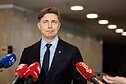







On Sunday, Vilnius mayoral candidate Artūras Zuokas of the Freedom and Justice party conceded defeat to conservative Valdas Benkunskas.
“Dear Vilnius residents, thank you for your trust, but I did not win this election and I congratulate Benkunskas,” Zuokas told reporters at his headquarters.
According to the Central Electoral Commission, Zuokas received 47 percent of the vote in the second round of the mayoral election, while Benkunskas received 52 percent.

Remigijus Šimašius, who has served as Vilnius mayor since 2015, has decided not to run for another term.
Benkunskas, 38, is a lawyer by trade. He currently sits in the Vilnius Council and is a deputy mayor of the Lithuanian capital in charge of energy and sport.
“We will make Vilnius exceptional not only in Lithuania but also in Europe in the next four years,” Benkunskas told reporters at his headquarters on Sunday evening.
He said forming a coalition in the Vilnius Council, as well as his team, would be his first job as Vilnius mayor.
“We’ll have time to talk to our partners and colleagues. I think it’s going to be easy, because we’ve had some conversations, and the Homeland Union has a large group [in the Council],” he said.
Benkunskas last week discussed coalition issues with the liberal Freedom Party.
He reiterated on Sunday that he saw the Lithuanian Social Democratic Party (LSDP) as his potential partners as well.
“As I said after the first round, I’d definitely see the Social Democrats as partners, since the party is strong in its ideological direction,” he said on Sunday night.
The Homeland Union (TS-LKD) won 19 seats in the capital’s Council after the first round, and the Freedom Party and the Freedom and Justice party received nine seats each.
Seven seats went to the Electoral Action of Poles in Lithuania, four to the LSDP, and three to the National Alliance.
Mayor without circuses
Benkunskas’ campaign promised that he will be a “mayor without circuses”.
According to him, the biggest problem in Vilnius that he will address is the poor location of public services, such as kindergartens and polyclinics.
“This leads to problems such as traffic congestion, long commuting times,” Benkunkas says.

He also focuses on the lack of pedestrian paths and bike lanes and promises to repair most of the 230 streets that are in poor condition.
“We have the money to do it, we just need leadership and control,” says the conservative politician.
He plans to build new educational facilities – both schools and kindergartens – in residential areas of the city. Benkunskas also promises incentives to attract more medics to Vilnius.
No intrigue in Klaipėda
In Klaipėda, Lithuania’s third biggest city, it became clear who the new mayor would be even before counting all votes.
Arvydas Vaitkus, who ran with the political committee Loyalto Klaipėda, was elected mayor of the port city after receiving 62 percent of the vote. In the second round, he faced Audrius Petrošius of TS-LKD.

The city’s incumbent mayor Vytautas Grubliauskas received only 7.54 percent of the vote in the first round of mayoral elections and will leave the post after having served three times.
Vaitkus, 59, is a businessman and politician. He has headed the Klaipėda State Seaport Authority, served as director of logistics of the Achema Group and as secretary of the Ministry of Transport and Communications.

Newsletter
Every Friday morning.