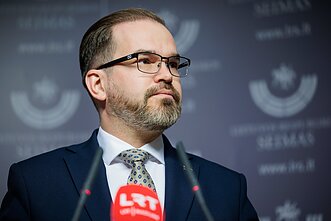


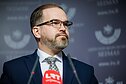







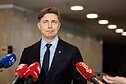

After meeting with Facebook representatives, Lithuania’s government chancellor says that she plans to raise the platform’s content moderation issue with the European Commission.
Government Chancellor Giedrė Balčytytė met with representatives of Meta, the owner of Facebook, on Monday to discuss what Lithuania says is censoring of pro-Ukraine posts.
Read more: Lithuania presses Facebook to stop blocking pro-Ukraine accounts
“We want to raise the issue of content moderation at the European level,” Balčytytė told reporters after the meeting.
At the meeting, Facebook representatives pointed out that when moderating its content, the social network applies the same rules regardless of whether offensive posts are aimed at Russia, Ukraine, or other countries, she said.
“Facebook does not differentiate between war and peace and applies exactly the same content moderation practices, regardless of the fact that there’s an ongoing war, there’s an aggressor country, and there’s a country that is defending itself,” the chancellor said.
“Basically, be it some action against the Kremlin or against the White House, it would be treated in exactly the same way [...]. The context of the war does not change the circumstances at all,” Balčytytė said.

The meeting was held in response to Lithuania’s concern that Facebook is blocking some pro-Ukraine comments.
The chancellor said during the meeting that Russia’s position could not be treated the same way as it would been treated in peacetime.
In her words, the main point made by the Meta representatives was that the company “defends certain groups in society against insults”.
Pro-Ukraine accounts are most often blocked for the use of the terms like “Moscals”, “katsaps” and “orcs”, all used as derogatory references to Russians, according to a study carried out last year by debunk.org.
“Moscal” is a word used by Ukrainians to insult Russians, especially those who come from Moscow.
A “katsap” is a word used mainly by Ukrainians to refer to Russians. It originated from the word “goat” (tsap), referring to the goatees once almost universally popular in Russia.
An “orc” is a derogatory nickname the Ukrainian troops gave Russian soldiers during the Russian invasion of Ukraine in 2022.
Debunk.org also said that only pro-Ukraine accounts are blocked, while the other side faces no restrictions for making similar statements.

Newsletter
Every Friday morning.