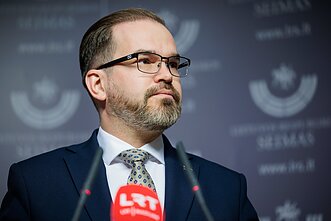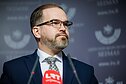















The Lithuanian delegation will not take part in the Organization for Security and Co-operation in Europe Parliamentary Assembly session, if Russian lawmakers are allowed to attend it, Vilija Aleknaitė-Abramikienė, who leads the Lithuanian the delegation, says.
“We are waiting for the Austrian government’s decision. [...] If they do not take it into consideration, our delegation will probably not be able to go there and sit in the same room with the people who should be standing before a special military tribunal because those people are directly responsible for initiating the war,” she told reporters at the Lithuanian parliament on Friday. “We don’t see such possibilities and then Lithuania will not be able to go.”
This is an opinion share by all three Lithuanian delegates, she said.
The PA session will take place on February 23-24, which coincides with the first anniversary of Russia’s invasion of Ukraine.
The Austrian Foreign Ministry earlier told AFP that the country is “obliged under international law to grant entry to the delegates of all OSCE participating states”.
“This is not an Austrian invitation, but an official meeting of the OSCE Parliamentary Assembly... EU sanctions provide for an exception to the entry bans precisely for such cases,” a spokeswoman for the ministry said.
Austria is right to say that the Russian delegation was invited to the session by the PA secretariat, not the country, Aleknaitė-Abramikienė says, but the country “has the right and even the obligation in this case” not to issue visas to Russian delegates, pointing out that the delegation members are on the EU sanctions list.

Poland and the United Kingdom took this position in the past, she underlined, adding that Canada plans to do the same.
Lithuania and Poland initiated an appeal to Austria, and the letter has been signed by 81 lawmakers from 20 countries, Aleknaitė-Abramikienė said.
The spokeswoman for the Austrian Foreign Ministry confirmed to AFP that the country had received the letter.
It states that the Russian delegation’s participation in the session “would not only not send a positive message to the international community but could even be perceived as a provocation”.
The parliamentary representatives say they are convinced that the Russian delegates would use the PA session as a “forum to sow disinformation, fake news, and hate speech”.
Aleknaitė-Abramikienė said she did not know how many countries would also decide to boycott the PA session.
“Probably not very many but, you know, when you represent a moral position, you don’t look around and just think why you are doing this,” the MP said.

Newsletter
Every Friday morning.