






Veronika (Vėra) Šleivytė was an exceptional artist and an early figure of Lithuania’s queer history.
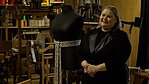
Art historian and curator Agnė Narušytė says Vėra was the first Lithuanian to photograph lesbian love, and she turned her life into a constant performance in front of the camera.
Šleivytė (1906-1998) was born into a family of 14 children, and in her autobiography, she emphasised the hardships of her childhood and youth. Her parents were landless peasants, so both Vėra and her siblings had to work at farms in order to support the family. From a young age, Vėra was artistic and had the ambition to become an art teacher.
“She saw the beauty of nature when she was herding cows, saw her eldest sister Ona sewing at home, and saw her mother singing beautifully. The beauty of nature and the art of her family members led to these aesthetic experiences, which gave birth to the desire to become an art teacher at a very early age,” says Narušytė.

Vėra’s father did not want her to continue her education, he needed his children to help out and work, but her mother and sister helped her. Without enough money to buy art supplies, Vėra made a paintbrush out of a twig.
“She must have been very persistent about going to school,” says Narušytė.
After graduating, Vėra enrolled at the Kaunas School of Art and worked as a draughtswoman at the Ministry of Agriculture. Šleivytė later said that hard life of working and studying had a toll on her health. This is a motif she explored when taking photos of hospitals.
Even under these conditions, Vėra fulfilled her dream by finishing school and working as an art teacher.
“Despite coming from a backwater of the country and a poor background, Šleivytė made it big. This is an inspiring story, now and at all times,” says Narušytė.
‘For women and with women’
According to the art historian, Vėra’s work shows her interest in women’s emancipation. She was one of the founders of the first Women Artists’ Society and became its president.
“The fact that she loved women must have helped her be for women and with women,” says Narušytė.

While Lithuania of the early twentieth century was quite a patriarchal society, women were actively involved in the national revival, she says.
“Women took care that their suffrage was included in various declarations. [...] When men got away with not inviting women to the Council of Lithuania, which later adopted the Act of Independence, women gathered at a protest rally in Kaunas on February 17, 1918,” according to Narušyte. “They did not give up and in 1918, the Constitution of Lithuania included women’s right to vote.”
Šleivytė, for her part, was involved in the struggle of women artists for opportunities to exhibit their works. She was among a few women in the first amateur photography exhibition in 1933.
An island in a sea of traditional society
In her works, Šleivytė looked at the codes of patriarchy and women’s self-identity in the society of the time.
“When we look at Šleivytė’s photographs of herself, we don’t see a traditional, typical woman, nor a virgin, but we see a woman who lives her own life, has her own interests.”
In some of the photos, Vėra is reading newspapers, in others she is tending to her nails or doing her hair, says Narušytė.
“She cares about how she looks, but at the same time she draws, travels, gets ill... She photographs those situations too. This is the sea of Šleivytė’s photography, there is a huge variety of objects and situations that attract her lens and her eye. She is everywhere, she is the creator of her own life, she is a participant in modern life.”

Šleivytė is also someone seen to be an early figure in Lithuania’s queer history. Her photographs include portraits of herself and her female lovers. Narušytė says that she knows of no other cases where homosexual love between women has been documented in this way in Lithuania.
“The photographs show cuddling, comments, sadness that the girlfriend left and only a photo remains. All this is shown in the image, in the commentary, in the words. You can see that there is one such friend at a time, and then life separates them, for example, Čiurlionytė dies, Pupuliukas leaves, and Felicia also leaves,” says Narušytė.
Mapplethorpian imagery
Although there are letters in which Vėra declared her love openly, her photographs spoke about it only in code, adds the art historian. For example, Vėra often drew flowers and took photographs of herself with flowers.
Although it may seem banal, Vėra’s flower photography is very expressive, and the blossoms are open and vivid, says Narušytė. She compares her images to those of another gay photography icon, Robert Mapplethorpe.

“Later on, I thought that maybe photographing flowers is a bit like a secret code. Homosexual love was forbidden until very recently. [...] And the blossom of a plant is its sexual organ,” Narušytė reflects.
According to her, Vėra used to bring her girlfriends to her parents’ house – it appears that the family accepted them, and that Vėra was free to be with her girlfriends. Šleivytė was probably the first one in Lithuania to capture lesbian love on film, Narušytė says.
“Her photographs really add a lot to our history. [...] And history has this function, it is an argument.”

Newsletter
Every Friday morning.