









Exactly 20 years ago, Lithuania received its arguably most consequential state visit when US President George W Bush came to Vilnius. The occasion was ripe with challenges – from geopolitical considerations to security concerns.
From St Petersburg to Vilnius
The US president’s visit to Lithuania in November 2002 marked an important milestone in Lithuania’s NATO membership: the day before the visit, Lithuania received an invitation to start accession talks.
But before Vilnius, Bush visited St Petersburg and met President Vladimir Putin. Antanas Valionis, Lithuania’s then foreign minister, recalls that Putin still spoke of the Baltic states – and their Western integration – in a friendly manner, and that there were no threats of the kind we hear now.
“Putin said: Yes, we understand that your accession to the European Union can be beneficial for us and for the Kaliningrad region. But why do you need NATO? We can have common security guarantees, we are not aggressors. He said what stuck with me: Now that you are determined to join [NATO], there is nothing we can do for you. That was a young Putin,” Valionis says, recalling a meeting between Lithuanian President Valdas Adamkus and Putin in 2001.
Vygaudas Ušackas, Lithuania’s former ambassador to Washington, says that times have changed dramatically since 2002 – neither a visit to Russia by a US president nor such a restrained Russian attitude towards NATO are conceivable today.
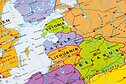
“The Americans told us from the very beginning that the biggest obstacle was the Russian factor. In Latvia and Estonia, there was the Russian minority, and in Lithuania there was the Kaliningrad aspect. We tried to defuse the tensions, and in 2000 we worked very hard to make the people of Kaliningrad see NATO not as a threat but as a good neighbour.

“Admiral Vladimir Yegorov, the then commander of the Baltic Fleet in Kaliningrad, publicly stated that he did not think that Lithuania’s NATO membership would be a threat to Kaliningrad,” recalls Ušackas.
According to Valionis, however, there were already signs of Moscow’s resentment. Lithuania was offered double security guarantees and a transit regime where Russia could transport weapons to Kaliningrad and Russian passengers would be able to travel without a passport. According to the former diplomat, these were the first signs that Russia would not remain benevolent for long.
“There were many small attempts to stop us, to undermine us, we felt threatened all the time. Only now the West is saying that we were right,” says Valionis.
Bomb scare
“Many doubted that freedom would come to this country.”
This is how Bush addressed the crowd gathered at Vilnius Town Hall.

“We knew that this continent would not remain divided. We knew that arbitrary lines drawn by dictators would be erased, and those lines are now gone. No more Munichs. No more Yaltas. The long night of fear, uncertainty, and loneliness is over. You're joining the strong and growing family of NATO,” he said.
These words were followed by the historic phrase: “Anyone who would choose Lithuania as an enemy has also made an enemy of the United States of America.” It was followed by chants “thank you” from the crowd.
According to Ušackas, President Bush was a little confused and did not understand whether these were shouts of support or hostility but was reassured it was the former.
Vytautas Grigaravičius, the then police commissioner general, says that he remembers from the visit the extraordinary task for the police and security services. It was an unprecedented visit in terms of its importance: even the suitability of Vilnius Airport for the Air Force One aircraft had to be considered.

“The most memorable thing for me was the advance preparation. I was surprised that the US has a lot of special services dealing with security. A lot of them flew here in advance, stayed in hotels, and started gathering information,” Grigaravičius recalls.
And when Bush was already visiting City Hall, the police received a report that there was a bomb in an apartment on Didžioji Street. The identity of the caller and the fact that it was a prank call would be clarified later, but Grigaravičius feared that the event would have to be cancelled and that the visit would be ruined. However, the US officials trusted their Lithuanian colleagues and calmly told them to just do their job. Unlike in Romania a few days later, Bush gave his speech in Vilnius with a lot more security.
“As far as I know, there he gave the speech from a protective bullet-proof glass cage. It showed the attitude towards us and the trust in our services,” he recalls.

Change of public mood
There was no shortage of security measures taken by the Lithuanians. The venue was guarded by the special operations unit Aras and local residents were warned not to go near windows or open them.
“The mood was very positive, with only one strange newspaper, which is still running, explaining that Vilnius was becoming a ghetto during the visit. [...] But you only had to be at the City Hall when President Bush was giving his speech to sense the enthusiasm. Everybody understood that this was an existential change for Lithuania. And we have repeated it many times since: in all its history, Lithuania has never had better security guarantees than it had then and has today,” says Valionis.

Ušackas recalls that during President Bush’s visit, the share of the Lithuanian population that had a positive view of the US was around 60 percent, a result of a several-year-long information campaign.
“Politicians were pushing for NATO membership, but the public, as far as I remember from the polls, was sceptic to see Lithuania becoming a member of NATO, either because of the Russian opposition or because of other factors. There was not much support,” says the former Lithuanian ambassador to Washington.
According to Valionis, the White House also saw Lithuania in a slightly different light than it does today – as a post-Soviet state still in transition. At the same time, according to Ušackas, a number of factors worked in Lithuania’s favour that led Bush to visiting Vilnius rather than Tallinn or Riga: campaigning from Lithuanian-Americans, Poland, and the Jewish Committee.
He says Lithuania’s NATO membership was supported by current President Joe Biden, and the Bush family were personally familiar with the Adamkus family.
“When President Adamkus appointed me ambassador to the US in 2001, he joked: You get a one-way ticket and don’t come back until Lithuania is in NATO,” Ušackas recalls.

But twenty years ago, Vilnius, Riga and Tallinn were even competing to be the first to join the alliance.
“After the Madrid Summit in 1997, we saw that we would not be able to break open the US gates alone. There was a kind of reassurance: Central European countries like Poland, the Czech Republic, Hungary were admitted to NATO. We needed to create a critical mass of countries, geopolitically and emotionally, to point out: look, as George W. Bush’s father also said, the project of a united Europe was not yet complete, 10 countries are not yet NATO members,” says Ušackas.
Valionis recalls how the so-called ‘Vilnius Ten’ – the ten countries seeking NATO membership – met in Vilnius City Hall in 2000. According to him, US diplomats were also hanging around there, which is why Bush went to Vilnius first and Romania was chosen as the southern flank of the candidates.
“Russia was drawing red lines very firmly across the former border of the Soviet Union. The Hungarians [in NATO] – fine, the Bulgarians, the Romanians – let them do what they want, but [the Baltic States] were already a zone of Russia’s legitimate interests, please stay out of it,” Valionis says.
“Then there were various ideas, like Zbigniew Brzezinski’s at least one Baltic country first. It will be totally unacceptable for Russia to have all the Baltic states [in NATO], but if one of them is accepted, it will be palatable for Russia, and the Soviet Union’s border will be broken and further expansion will be unstoppable,” he recalls.


Newsletter
Every Friday morning.