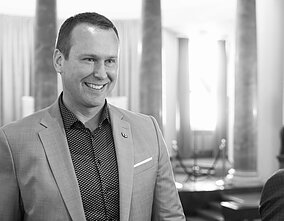












In an interview with LRT, Director General of the European Broadcasting Union (EBU) Noel Curran says there will always be people who distrust the media: "I think that's a part of the variety of the world, and democracy allows those people to have those opinions."
Curran sat down to speak about the unprecedented challenges faced by the media today, as well as how crises can offer an opportunity to reconnect with audiences and gain trust.
In the last few years, we have faced a pandemic, now, we are closely following Russia's war in Ukraine, encountering the problem of fake news and distrust of the media. What would you say is the importance of public broadcasters in the context of these challenges?
I think we are facing unprecedented challenges in media, I have been involved in media for 30 years, and there has never been a time like this with the massive growth in huge multinational, mainly American-owned, tech companies, social media platforms with huge consolidation in the industry, bigger players merging with other bigger players. We just face a huge competitive threat [...].

I think public service media acts as kind of a bulwark against some of those trends because we are trusted, we invest so much in European production, we value our news output, and prioritise our news and current affairs output so much.
I think this is our unique opportunity to show what is exceptional about public service media. I think the Covid crisis and the invasion of Ukraine have given us an opportunity to reconnect with so much of the audience and to show them again why they trust us, why they pay and fund us, as well as the range of services that we provide.
So even though these have been terrible events for the world, they have actually, I believe, enhanced the reputation of public service media.

In the context of all of these challenges, what would you say should be a public broadcaster's mission?
Serving the public. We are not here to make money or to reach some sales targets. We are here to serve the public. And that has to be our priority. We have to serve the public in the entire range of what we do because we're not just one-dimensional.
We're not just about news. We have to offer a range of services. And we have to offer quality in those services. I think what we've seen is that public service media is the most trusted media. And that's an extraordinary achievement. It's been hard-won and hard-earned.
But we can't take that for granted. We need to constantly work on those trust levels and deliver what our audience wants.
Even though the audience usually trusts public service media more, we still see that there's a group of people in our society who does not trust media and public broadcasters. What can be done in order to prevent this and to increase the trust in media?
Let's not be naive, there will always be a group of people who distrust media and public institutions. I think that's a part of the variety of the world, and democracy allows those people have those opinions.
I think from our point of view, it is maintaining the quality of what we do, maintaining our trust levels, investing in our journalism, investing in training, and being independent of the government that is key. Because if you lose that independence, the public views you completely differently.

I would also like to talk about LRT. In your opinion, how does LRT currently compare to other public broadcasters in terms of regulation and legal framework? Where do we stand?
I think LRT stands very well – it has shown its independence. I think LRT has obviously shown its connection and trust levels with the audience.
It has also looked beyond its own borders. Your director general is a very prominent member of the Executive Board of the EBU, and the Executive Board has been very strong on issues around independence and the invasion of Ukraine. I think that has given LRT an international voice as well.
I think we had some concerns about the proposed legislation in 2018-2019. We contacted the government about the proposed legislation. And we were happy with the result of that legislation – the Supervisory Council being selected the way it is, is good governance practice; the Supervisory Council appointing the Director General is good governance practice.
I think we shouldn't take anything for granted, and everything can be improved in any country. But I think LRT stands well in terms of what it's delivering.

A while ago, LRT was subject to attempts by politicians to put pressure on the public broadcaster. The EBU was also concerned by proposed changes to LRT's governance including the appointment of members of the governing bodies. Do other public broadcasters face similar problems?
There is growing pressure on the independence of public service media. But we shouldn't get despondent about that. Public service media by and large remains independent across Europe. That is one of the reasons why we have [high] trust levels. But governments in some countries will always try and put pressure.
I think a lot more of my time in recent years has been spent on reacting to this, highlighting it, reaching out to the governments concerned, discussing it with them and the regulators.
It definitely is a growing issue across Europe. But we are trying to deal with it. I think within the European Union, the new Media Freedom Act is also going to tackle some of these issues around independence and the responsibilities of government.
But it's absolutely key and vital for us that public service media remains independent because governments change, political parties change, and the public, if they see their national broadcaster lacking in independence or being aligned with the government, they will lose trust in it and that will damage democracy as a whole.

EBU research has also shown that a well-funded, independent public broadcaster is integral to a healthy democracy. Why is it important for public broadcasters to remain independent and immune from political pressure?
I think it's absolutely important that the public get access to trusted, independent sources of news. I started out as a journalist in the early 90s. And the range of outlets that are more opinion based has rapidly increased during that time.
The digital world is largely a world based on opinion. It is not an impartial world of media. And I think that the public realizes that and that's why social media is not trusted.
The public looks at it, but they don't trust it. And I believe that democracy needs a trusted source of news and information. For me, the independence of public service media is what preserves that trust. And if you lose independence, you will lose the trust of your public.

I would like to talk more about democracy. A while ago, the EBU executive board suspended three Russian representatives. Earlier, it also suspended a Belarusian member. Some say these decisions have some negative aspects because now, we don't get as much information, video and audio footage from those countries. What do you think?
I think that the EBU made the right decision in terms of Belarusian and Russian members. I say that regrettably because it's not a decision that EBU wanted to make.
We have many nations, and that is part of the strength of EBU. But I think, in this case, the circumstances were so extreme that to stand by our values, we had to take dramatic action.
I think there's a negative [because] we are an organisation that is based on sharing – sharing footage, news reports, and resources. There's always a downside when you take an action like this, and we should be realistic about that.

What can we and other public broadcasters do to protect the role of democracy?
I think the main thing is to preserve your independence. Once you lose that, you lose trust and connection with the audience. Continue to invest in your journalism, train, and prioritise that journalism.
I think maintaining the governance around our journalism to maintain that independence is critical. It's a hard battle at the moment, as we deal with incredible competitive threats.
But we have shown through the war in Ukraine and the Covid crisis that we still have that connection with our audience.
On Tuesday, Curran will visit Lithuania and take part in the international conference "Public Service Media for Democracy", organised by the Council of Europe and the European Broadcasting Union in cooperation with LRT.
The European Broadcasting Union (EBU) is an alliance of 115 public broadcasters in Europe and beyond, as well as 34 associate members in Asia, Africa, the United States, and South America. The organisation represents and defends the interests of public service broadcasters internationally and locally.

Newsletter
Every Friday morning.