




Mikhail Gorbachev, the last leader of the Soviet Union who presided over its relatively peaceful dissolution, passed away on Tuesday aged 91. In contrast to positive tributes from Western leaders, Lithuania’s public opinion stands largely outside the ‘Gorbamania’.
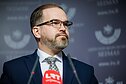
The country’s Foreign Minister Gabrielius Landsbergis summarised his take on Gorbachev’s legacy in a tweet on Wednesday.
“Lithuanians will not glorify Gorbachev. We will never forget the simple fact that his army murdered civilians to prolong his regime’s occupation of our country. His soldiers fired on our unarmed protestors and crushed them under his tanks. That is how we will remember him,” he posted.
His grandfather Vytautas Landsbergis, who was Lithuania’s leader during the country’s push to gain independence from Gorbachev’s Soviet Union, called him “a prisoner”.
“A prisoner passed away. That’s what can be said about Mikhail Gorbachev. He was never allowed to think on his own or to express his thoughts,” Landsbergis posted on Facebook on Wednesday.

Defence Minister Arvydas Anušauskas, formerly a historian researching Lithuania’s post-war underground resistance to the Soviet rule, went even further, calling Gorbachev “a criminal”.
Gorbachev’s policies of Perestroika (reform) and Glasnost (openness) paved the way for Lithuania’s independence movement in the late 1980s. In fact, the name of the movement –Lietuvos Persitvarkymo Sąjūdis (the Lithuanian Reform Movement), or simply Sąjūdis – made a direct reference to Gorbachev’s signature policy.
However, when the push came to shove and the Lithuanian Supreme Council – dominated by Sąjūdis deputies elected in polls that were free and fair thanks to Gorbachev’s reforms – declared the country independent from the USSR in March 1990, the Soviet leader’s reaction disappointed the Lithuanians.
What was no less frustrating was that Western leaders were reluctant to give support to independence movements within the USSR, seemingly taking Gorbachev’s side rather than the Lithuanians’.

“[Gorbachev] contributed to the reduction of international tensions, to disarmament, he did not oppose the fall of the Berlin Wall, the reunification of Germany, the dissolution of the Warsaw Pact, the liberation of socialist countries. Even before that, he withdrew troops from Afghanistan,” says Česlovas Juršėnas, one of the deputies who signed Lithuania’s Independence Act.
All that made Western leaders careful not to harm Gorbachev’s domestic standing.
“He had a very formidable group of reactionaries that he had to either lean on or push away, to contain in some way. And, at the same time, to carry out his reforms. And that was important for the West,” Juršėnas adds.
Gorbachev would not recognise Lithuania’s independence and pressure the Supreme Council to withdraw the declaration of March 11.
“We declared a moratorium on the consequences of the Act of March 11, made some concessions and prepared for negotiations, but those negotiations were very difficult. And then January 13 came,” Juršėnas says.

The crackdown of January 13, 1991, was what decisively ruined Gorbachev’s reputation in Lithuania. Soviet troops tried unsuccessfully to take control of key institutions in Vilnius, killing 14 people and injuring hundreds.
It is unclear who issued the order for Soviet tanks to leave their bases, but Lithuanians hold Gorbachev responsible.
“Gorbachev was the leader of the Soviet Union. Whether his power was real or not, he was the supreme commander of the armed forces. He should have, firstly, prevented it from happening, secondly, when it happened, he should have stopped it, and thirdly, and very importantly, once the blood had been spilled, he should have apologised,” says Juršėnas.

Several dozen people behind the January 13 crackdown were tried and sentenced several years ago by a Lithuanian court. Most of them would not be extradited by Russia and Belarus and were therefore tried in absentia, with little hope that the sentences would ever be enforced. Prosecutors tried to summon Gorbachev as a witness in the case, but to no avail.
Family members of some of the victims of the January 13 massacre also brought a civil lawsuit against the Soviet leader, but it is likewise bound to remain a largely symbolic gesture.
“He certainly did a lot of things for the world and he got the Nobel Peace Prize for that, but here he has a completely different reputation because of what happened, what we went through. [...] This is his stain, his guilt,” Juršėnas concludes.

Newsletter
Every Friday morning.